OCR · A-Level · Chemistry
Course version: H432 · Version from Sept 2017
(i) by reduction (e.g. with H₂/Ni) to form amines
Full specification wording
Carbon–carbon bond formation: (i) by reduction (e.g. with H₂/Ni) to form amines
This statement covers the reduction of a nitrile to an amine.
- Point 7 of 9
Study notes
From the teaching notes for this specification point.
The idea
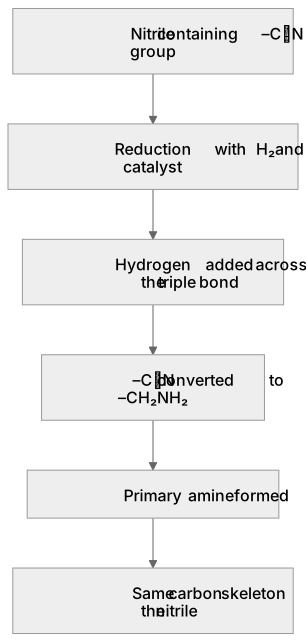
This statement covers the reduction of a nitrile to an amine. The nitrile, formed by addition of HCN to a carbonyl compound, contains a –C≡N group. Reducing it with hydrogen and a nickel catalyst converts the triple bond and adds hydrogen so that the carbon becomes bonded to an –NH₂ group, giving a primary amine. You should be able to write the equation or displayed formula, name the amine product and state the reagent and catalyst. Recognise that the carbon skeleton is unchanged apart from the functional group, so the amine has the same number of carbons as the nitrile.
What earns the marks
- States that reduction of a nitrile with H₂ and a nickel catalyst produces a primary amine.
- Shows that the –C≡N group is converted to a –CH₂NH₂ group, adding hydrogen across the triple bond.
- Names the amine product correctly, keeping the same carbon skeleton as the starting nitrile.
- Identifies H₂ as the reducing agent and nickel as the catalyst in the stated conditions.
Common mistakes and how to put them right
Writes that the product is a secondary or tertiary amine.
Put it right by stating that a nitrile is reduced to a primary amine.
Omits the catalyst or uses an incorrect one.
Put it right by naming nickel with hydrogen.
Changes the number of carbon atoms in the product.
Put it right by keeping the same carbon skeleton as the nitrile.
Confuses reduction with hydrolysis.
Put it right by stating that hydrolysis gives a carboxylic acid whereas reduction gives an amine.
Exam tips
- Write the reagent and catalyst together, for example H₂ with a Ni catalyst, to gain the condition mark.
- Draw the displayed formula of the amine to check the –NH₂ group is on the correct carbon.
- Count carbons in the nitrile and the amine to confirm the skeleton is unchanged.
- Distinguish clearly between hydrolysis and reduction when the question asks for the amine.
Try the lesson
The start of the Carbon–carbon bond formation: (i) by reduction (e.g. with H₂/Ni) to form amines lesson, made from teaching notes for this specification point.
Listen
This statement covers the reduction of a nitrile to an amine. The nitrile, formed by addition of HCN to a carbonyl compound, contains a –C≡N group. Reducing it with hydrogen and a nickel catalyst converts the triple bond and adds hydrogen so that the carbon becomes bonded to an –NH₂ group, giving a primary amine. You should be able to write the equation or displayed formula, name the amine product and state the reagent and catalyst. Recognise that the carbon skeleton is unchanged apart from the functional group, so the amine has the same number of carbons as the nitrile. A strong answer earns marks for these points. States that reduction of a nitrile with H₂ and a nickel catalyst produces a primary amine. Shows that the –C≡N group is converted to a –CH₂NH₂ group, adding hydrogen across the triple bond. Names the amine product correctly, keeping the same carbon skeleton as the starting nitrile. Identifies H₂ as the reducing agent and nickel as the catalyst in the stated conditions. A common slip: Writes that the product is a secondary or tertiary amine. Instead, stating that a nitrile is reduced to a primary amine. Exam tip: Write the reagent and catalyst together, for example H₂ with a Ni catalyst, to gain the condition mark.
See it
Put it in order
Put these steps in the order they happen.
- 1. Hydrogen added across the triple bond
- 2. Reduction with H₂ and Ni catalyst
- 3. Nitrile containing –C≡N group
- 4. Same carbon skeleton as the nitrile
- 5. Primary amine formed
- 6. –C≡N converted to –CH₂NH₂
Label the diagram
Some boxes have lost their names. Pick the right name for each number.
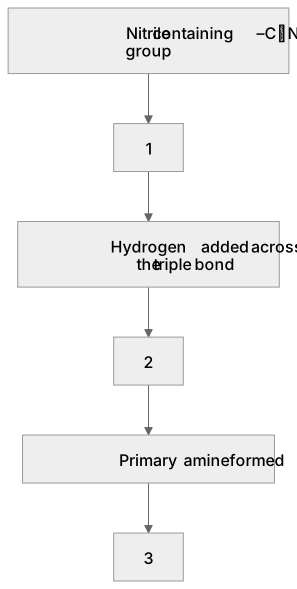
1Box 1
2Box 2
3Box 3
There is more to this lesson
The full lesson goes on to check your understanding and help you earn the marks. Create a free account to carry on, with your progress saved.
A week of Premium from your first lesson · Then the free plan continues · No card, no charge
Test your understanding of Carbon–carbon bond formation: (i) by reduction (e.g. with H₂/Ni) to form amines
Active recall beats re-reading. Take an instant quiz now to test what you’ve learned and lock it into long-term memory.
A week of Premium from your first lesson · Then the free plan continues · No card, no charge