OCR · A-Level · Chemistry
Course version: H432 · Version from Sept 2017
(a) explanation of the water solubility of carboxylic acids in terms of…
Full specification wording
Carboxylic acids and esters: (a) explanation of the water solubility of carboxylic acids in terms of hydrogen bonding
Carboxylic acids dissolve in water because their molecules can form hydrogen bonds with water molecules.
- Point 2 of 13
- 4 key terms
Study notes
From the teaching notes for this specification point.
The idea
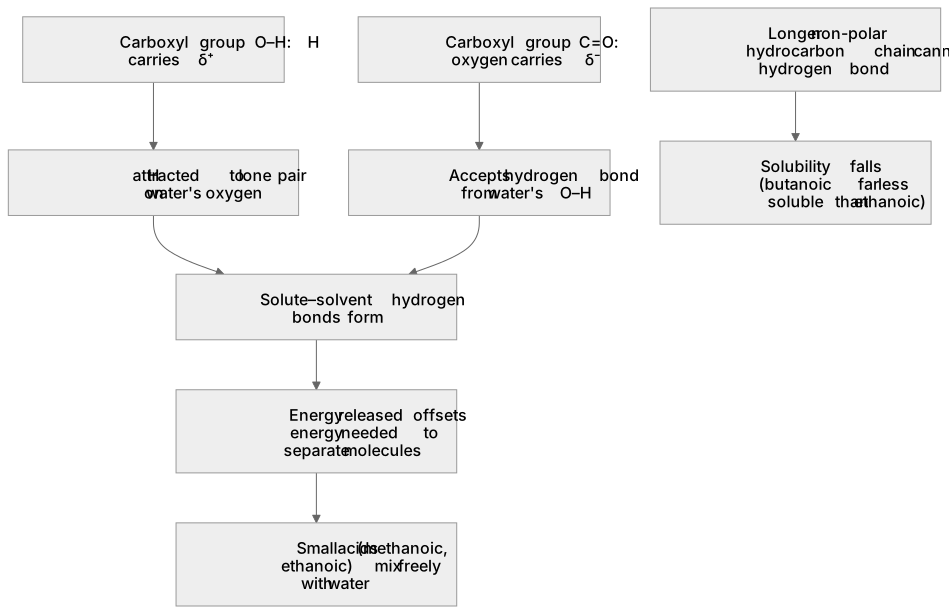
Carboxylic acids dissolve in water because their molecules can form hydrogen bonds with water molecules. The carboxyl group contains a polar O–H bond, so the hydrogen atom carries a partial positive charge (δ⁺) and can be attracted to a lone pair on the oxygen of a water molecule. The C=O oxygen carries a partial negative charge (δ⁻) and can accept a hydrogen bond from a water molecule's O–H. These solute–solvent hydrogen bonds release energy that offsets the energy needed to separate the acid molecules and the water molecules, so small carboxylic acids such as methanoic and ethanoic acid mix freely with water. As the hydrocarbon chain lengthens, the non-polar part cannot hydrogen bond, so solubility falls; butanoic acid is far less soluble than ethanoic acid.
What earns the marks
- Identifies the polar O–H bond of the carboxyl group as the hydrogen-bond donor to a lone pair on water's oxygen.
- Identifies the C=O oxygen of the carboxyl group as a hydrogen-bond acceptor from a water O–H.
- States that hydrogen bonding between acid and water molecules releases energy that offsets the energy needed to separate the molecules.
- Explains that a longer non-polar hydrocarbon chain reduces solubility because that part cannot form hydrogen bonds with water.
Common mistakes and how to put them right
Claims that carboxylic acids hydrogen bond only with each other and not with water.
Put it right by showing solute–solvent hydrogen bonds to water.
Treats the whole molecule as polar.
Put it right by locating polarity in the carboxyl group and noting the non-polar chain.
Says the hydrocarbon chain forms hydrogen bonds with water.
Put it right by stating that only the carboxyl group does so.
Confuses hydrogen bonding with covalent bonding to water.
Put it right by describing an intermolecular attraction, not a new covalent bond.
Exam tips
- Name the donor atom and the acceptor atom explicitly rather than saying 'it hydrogen bonds'.
- Link solubility to the balance between energy released on forming solute–solvent hydrogen bonds and energy needed to separate molecules.
- Use the trend down the homologous series to show the effect of chain length on solubility.
Try the lesson
The start of the Carboxylic acids and esters: (a) explanation of the water solubility of carboxylic acids in terms of hydrogen bonding lesson, made from teaching notes for this specification point.
Listen
Carboxylic acids dissolve in water because their molecules can form hydrogen bonds with water molecules. The carboxyl group contains a polar O–H bond, so the hydrogen atom carries a partial positive charge (δ⁺) and can be attracted to a lone pair on the oxygen of a water molecule. The C=O oxygen carries a partial negative charge (δ⁻) and can accept a hydrogen bond from a water molecule's O–H. These solute–solvent hydrogen bonds release energy that offsets the energy needed to separate the acid molecules and the water molecules, so small carboxylic acids such as methanoic and ethanoic acid mix freely with water. As the hydrocarbon chain lengthens, the non-polar part cannot hydrogen bond, so solubility falls; butanoic acid is far less soluble than ethanoic acid. A strong answer earns marks for these points. Identifies the polar O–H bond of the carboxyl group as the hydrogen-bond donor to a lone pair on water's oxygen. Identifies the C=O oxygen of the carboxyl group as a hydrogen-bond acceptor from a water O–H. States that hydrogen bonding between acid and water molecules releases energy that offsets the energy needed to separate the molecules. Explains that a longer non-polar hydrocarbon chain reduces solubility because that part cannot form hydrogen bonds with water. A common slip: Claims that carboxylic acids hydrogen bond only with each other and not with water. Instead, showing solute–solvent hydrogen bonds to water. Exam tip: Name the donor atom and the acceptor atom explicitly rather than saying 'it hydrogen bonds'.
See it
Key words
Say what each word means before you turn the card.
Hydrogen bonding
Try answering aloud or in your head before turning the card.
Polarity of the carboxyl group
Try answering aloud or in your head before turning the card.
Solute–solvent interactions
Try answering aloud or in your head before turning the card.
Effect of hydrocarbon chain length on solubility
Try answering aloud or in your head before turning the card.
See every definition
- Hydrogen bonding
- An intermolecular attraction in which the hydrogen atom of a polar O–H bond is attracted to a lone pair on the oxygen of a water molecule.
- Polarity of the carboxyl group
- The carboxyl group contains a polar O–H bond, so its hydrogen carries a partial positive charge, and its C=O oxygen carries a partial negative charge.
- Solute–solvent interactions
- Hydrogen bonds form between the acid and water molecules, releasing energy that offsets the energy needed to separate the acid molecules and the water molecules.
- Effect of hydrocarbon chain length on solubility
- As the hydrocarbon chain lengthens, the non-polar part cannot hydrogen bond, so solubility falls.
Label the diagram
Some boxes have lost their names. Pick the right name for each number.
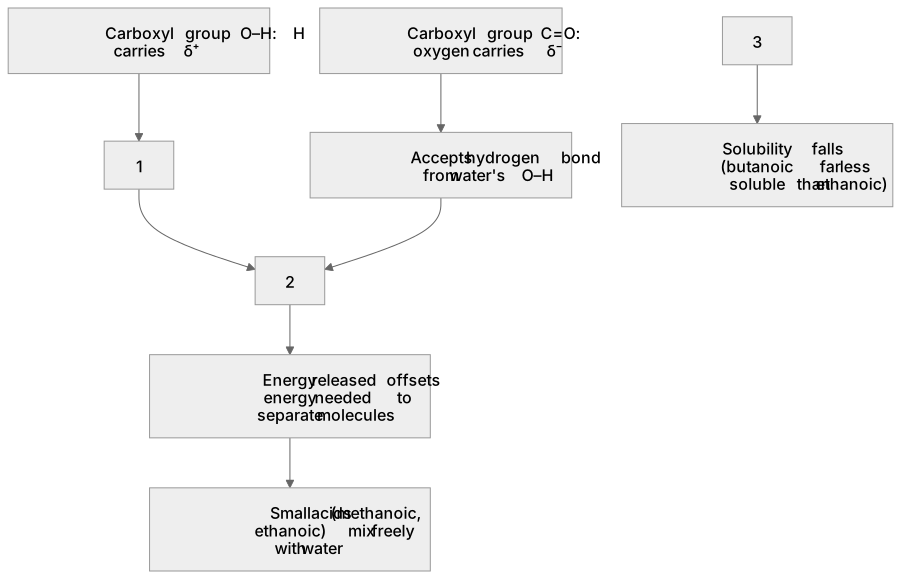
1Box 1
2Box 2
3Box 3
There is more to this lesson
The full lesson goes on to check your understanding and help you earn the marks. Create a free account to carry on, with your progress saved.
A week of Premium from your first lesson · Then the free plan continues · No card, no charge
Test your understanding of Carboxylic acids and esters: (a) explanation of the water solubility of carboxylic acids in terms of hydrogen bonding
Active recall beats re-reading. Take an instant quiz now to test what you’ve learned and lock it into long-term memory.
A week of Premium from your first lesson · Then the free plan continues · No card, no charge