OCR · A-Level · Chemistry
Course version: H432 · Version from Sept 2017
(i) in hot aqueous acid to form carboxylic acids and alcohols
Full specification wording
Carboxylic acids and esters: (i) in hot aqueous acid to form carboxylic acids and alcohols
Under hot aqueous acid conditions an ester reacts with water to give a carboxylic acid and an alcohol.
- Point 9 of 13
- 4 key terms
Study notes
From the teaching notes for this specification point.
The idea
Under hot aqueous acid conditions an ester reacts with water to give a carboxylic acid and an alcohol. The acid acts as a catalyst: it protonates the carbonyl oxygen, making the carbonyl carbon more electrophilic so water can attack, and a proton is lost to regenerate the catalyst. The reaction is an equilibrium, so it is reversible and does not go to completion unless a product is removed. For example, ethyl ethanoate with hot dilute hydrochloric acid gives ethanoic acid and ethanol. Learn to write the balanced equation, to identify the two products by functional group, and to explain why the acid is described as a catalyst rather than a reactant consumed in the reaction.
What earns the marks
- States that hot aqueous acid hydrolysis of an ester yields a carboxylic acid and an alcohol.
- Writes a correct balanced equation for a named ester, for example ethyl ethanoate plus water giving ethanoic acid and ethanol.
- Explains that the acid is a catalyst because it is regenerated at the end of the reaction.
- Describes the mechanism step in which the acid protonates the carbonyl oxygen, increasing the electrophilic character of the carbonyl carbon.
- Recognises that the reaction is an equilibrium and is therefore reversible.
Common mistakes and how to put them right
Writes a carboxylate salt as the product of acid hydrolysis.
Put it right by writing the free carboxylic acid.
Treats the acid as consumed.
Put it right by stating that the acid is regenerated and acts as a catalyst.
Forgets that water is a reactant.
Put it right by including water on the left-hand side of the equation.
Claims the reaction goes to completion.
Put it right by describing it as an equilibrium.
Exam tips
- Balance the equation by counting oxygen and hydrogen atoms on each side.
- Name the alcohol and the acid separately so both products are clearly identified.
- State the word 'catalyst' and justify it by noting the acid is regenerated.
Try the lesson
The start of the Carboxylic acids and esters: (i) in hot aqueous acid to form carboxylic acids and alcohols lesson, made from teaching notes for this specification point.
Listen
Under hot aqueous acid conditions an ester reacts with water to give a carboxylic acid and an alcohol. The acid acts as a catalyst: it protonates the carbonyl oxygen, making the carbonyl carbon more electrophilic so water can attack, and a proton is lost to regenerate the catalyst. The reaction is an equilibrium, so it is reversible and does not go to completion unless a product is removed. For example, ethyl ethanoate with hot dilute hydrochloric acid gives ethanoic acid and ethanol. Learn to write the balanced equation, to identify the two products by functional group, and to explain why the acid is described as a catalyst rather than a reactant consumed in the reaction. A strong answer earns marks for these points. States that hot aqueous acid hydrolysis of an ester yields a carboxylic acid and an alcohol. Writes a correct balanced equation for a named ester, for example ethyl ethanoate plus water giving ethanoic acid and ethanol. Explains that the acid is a catalyst because it is regenerated at the end of the reaction. Describes the mechanism step in which the acid protonates the carbonyl oxygen, increasing the electrophilic character of the carbonyl carbon. A common slip: Writes a carboxylate salt as the product of acid hydrolysis. Instead, writing the free carboxylic acid. Exam tip: Balance the equation by counting oxygen and hydrogen atoms on each side.
See it
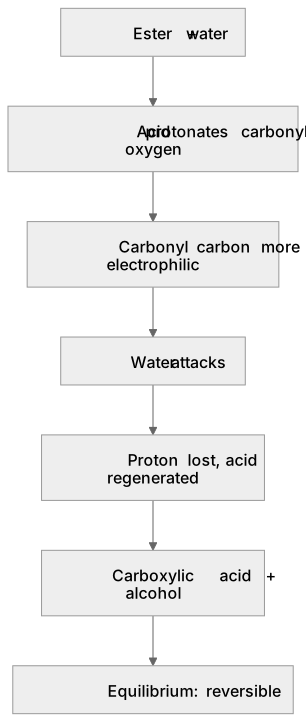
Put it in order
Put these steps in the order they happen.
- 1. Equilibrium: reversible
- 2. Carboxylic acid + alcohol
- 3. Carbonyl carbon more electrophilic
- 4. Proton lost, acid regenerated
- 5. Ester + water
- 6. Acid protonates carbonyl oxygen
- 7. Water attacks
Key words
Say what each word means before you turn the card.
Acid-catalysed hydrolysis
Try answering aloud or in your head before turning the card.
Carbonyl electrophilicity
Try answering aloud or in your head before turning the card.
Equilibrium and reversibility
Try answering aloud or in your head before turning the card.
Functional group interconversion
Try answering aloud or in your head before turning the card.
See every definition
- Acid-catalysed hydrolysis
- Reaction in hot aqueous acid in which an ester reacts with water to give a carboxylic acid and an alcohol, with the acid regenerated at the end.
- Carbonyl electrophilicity
- The acid protonates the carbonyl oxygen, making the carbonyl carbon more electrophilic so water can attack.
- Equilibrium and reversibility
- The reaction is an equilibrium, so it is reversible and does not go to completion unless a product is removed.
- Functional group interconversion
- An ester is converted into a carboxylic acid and an alcohol, the two products identified by functional group.
Label the diagram
Some boxes have lost their names. Pick the right name for each number.
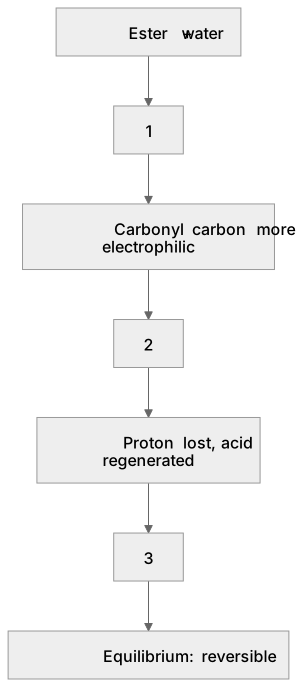
1Box 1
2Box 2
3Box 3
There is more to this lesson
The full lesson goes on to check your understanding and help you earn the marks. Create a free account to carry on, with your progress saved.
A week of Premium from your first lesson · Then the free plan continues · No card, no charge
Test your understanding of Carboxylic acids and esters: (i) in hot aqueous acid to form carboxylic acids and alcohols
Active recall beats re-reading. Take an instant quiz now to test what you’ve learned and lock it into long-term memory.
A week of Premium from your first lesson · Then the free plan continues · No card, no charge