OCR · A-Level · Chemistry
Course version: H432 · Version from Sept 2017
(d) the techniques and procedures used to investigate changes to the…
Full specification wording
Chemical equilibrium: (d) the techniques and procedures used to investigate changes to the position of equilibrium for changes in concentration and temperature.
Investigating equilibrium shifts requires a reversible system with a visible or measurable change, such as the colour of an indicator or of a transition-metal complex ion.
- Point 5 of 8
- 4 key terms
Study notes
From the teaching notes for this specification point.
The idea
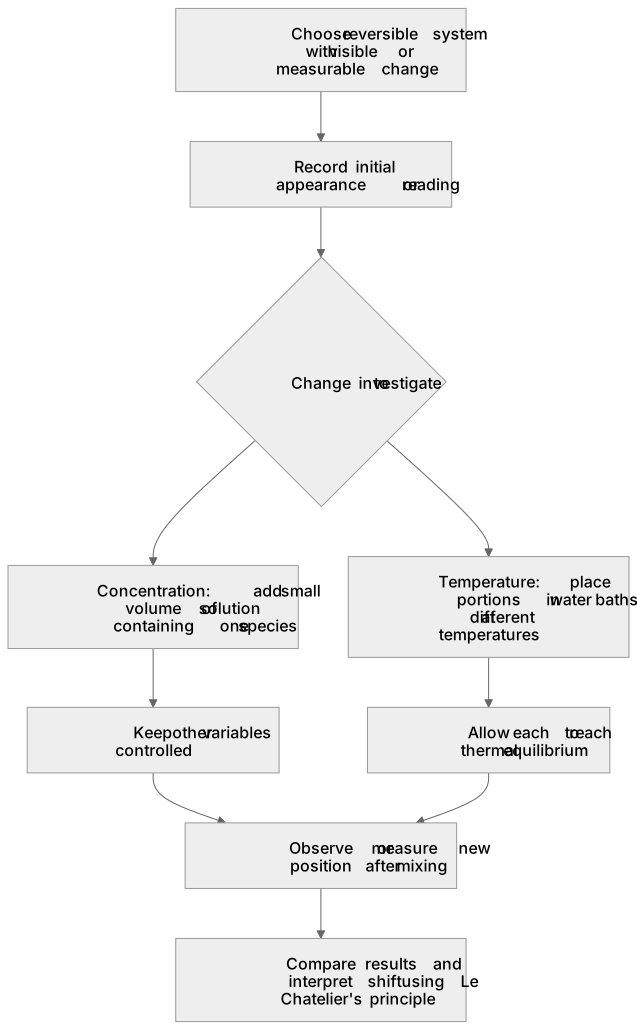
Investigating equilibrium shifts requires a reversible system with a visible or measurable change, such as the colour of an indicator or of a transition-metal complex ion. To test a change in concentration, prepare the equilibrium mixture, record the initial appearance or reading, then add a small volume of a solution containing one of the species and observe or measure the new position after mixing. To test a change in temperature, place portions of the same mixture in water baths at different temperatures, allow each to reach thermal equilibrium, and compare the colour or reading. Control variables such as total volume, concentrations of other species and observation time so that only the chosen factor changes. Interpret each result using Le Chatelier's principle, identifying the direction of the shift.
What earns the marks
- Selects a reversible system that shows a visible or measurable change in position of equilibrium.
- Records an initial observation or measurement before changing concentration or temperature.
- Adds a solution containing one species to change concentration while keeping other variables controlled.
- Uses water baths at different temperatures to investigate the effect of temperature change.
- Compares results and interprets each shift using Le Chatelier's principle.
Common mistakes and how to put them right
Changes more than one variable at once.
Put it right by altering only concentration or only temperature in each test.
Omits a control or initial reading.
Put it right by recording the starting appearance or measurement before the change.
Fails to allow the mixture to reach the new temperature.
Put it right by waiting until thermal equilibrium is established.
Describes observations without interpreting them.
Put it right by linking each change to the direction of equilibrium shift.
Exam tips
- Name the reversible system and the observable change you will monitor.
- State the variable you change and list the variables you keep constant.
- Describe the procedure in ordered steps, including mixing and equilibration.
- Interpret each result with Le Chatelier's principle rather than only describing colour changes.
Try the lesson
The start of the Chemical equilibrium: (d) the techniques and procedures used to investigate changes to the position of equilibrium for changes in concentration and temperature. lesson, made from teaching notes for this specification point.
Listen
Investigating equilibrium shifts requires a reversible system with a visible or measurable change, such as the colour of an indicator or of a transition-metal complex ion. To test a change in concentration, prepare the equilibrium mixture, record the initial appearance or reading, then add a small volume of a solution containing one of the species and observe or measure the new position after mixing. To test a change in temperature, place portions of the same mixture in water baths at different temperatures, allow each to reach thermal equilibrium, and compare the colour or reading. Control variables such as total volume, concentrations of other species and observation time so that only the chosen factor changes. Interpret each result using Le Chatelier's principle, identifying the direction of the shift. A strong answer earns marks for these points. Selects a reversible system that shows a visible or measurable change in position of equilibrium. Records an initial observation or measurement before changing concentration or temperature. Adds a solution containing one species to change concentration while keeping other variables controlled. Uses water baths at different temperatures to investigate the effect of temperature change. A common slip: Changes more than one variable at once. Instead, altering only concentration or only temperature in each test. Exam tip: Name the reversible system and the observable change you will monitor.
See it
Key words
Say what each word means before you turn the card.
Reversible systems with observable changes
Try answering aloud or in your head before turning the card.
Controlling variables in equilibrium experiments
Try answering aloud or in your head before turning the card.
Effect of concentration change on equilibrium position
Try answering aloud or in your head before turning the card.
Effect of temperature change on equilibrium position
Try answering aloud or in your head before turning the card.
See every definition
- Reversible systems with observable changes
- A reversible system chosen for investigation shows a visible or measurable change, such as the colour of an indicator or of a transition-metal complex ion.
- Controlling variables in equilibrium experiments
- Total volume, concentrations of other species and observation time are kept constant so that only the chosen factor changes.
- Effect of concentration change on equilibrium position
- After an initial observation or measurement, a small volume of a solution containing one of the species is added and the new position is observed or measured after mixing.
- Effect of temperature change on equilibrium position
- Portions of the same mixture are placed in water baths at different temperatures, each is allowed to reach thermal equilibrium, and the colour or reading is compared.
Label the diagram
Some boxes have lost their names. Pick the right name for each number.
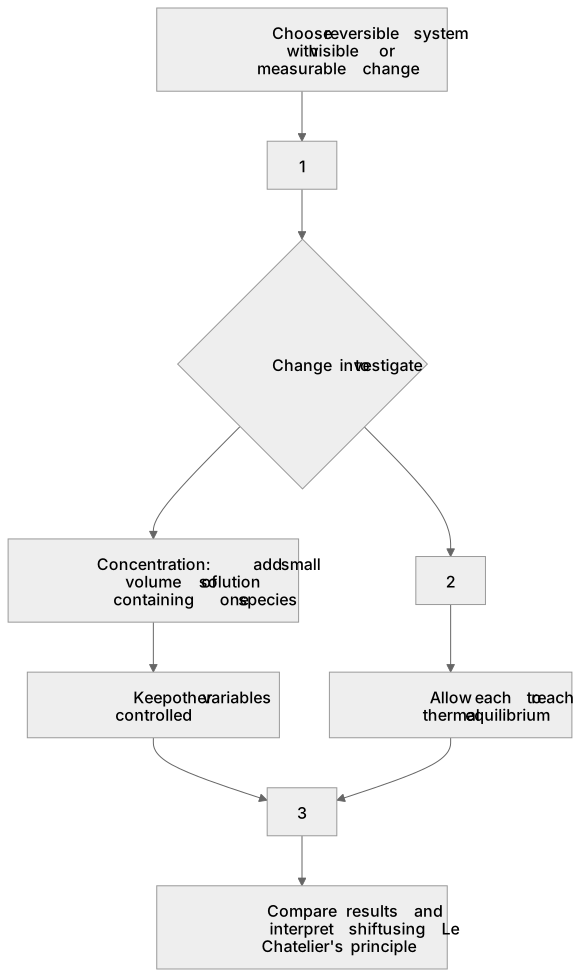
1Box 1
2Box 2
3Box 3
There is more to this lesson
The full lesson goes on to check your understanding and help you earn the marks. Create a free account to carry on, with your progress saved.
A week of Premium from your first lesson · Then the free plan continues · No card, no charge
Test your understanding of Chemical equilibrium: (d) the techniques and procedures used to investigate changes to the position of equilibrium for changes in concentration and temperature.
Active recall beats re-reading. Take an instant quiz now to test what you’ve learned and lock it into long-term memory.
A week of Premium from your first lesson · Then the free plan continues · No card, no charge