OCR · A-Level · Chemistry
Course version: H432 · Version from Sept 2017
(f) expressions for the equilibrium constant, Kc , for homogeneous…
Full specification wording
Chemical equilibrium: (f) expressions for the equilibrium constant, Kc , for homogeneous reactions and calculations of the equilibrium constant, Kc , from provided equilibrium concentrations
For a homogeneous equilibrium all species share one phase, so their concentrations can appear together in a single Kc expression.
- Point 7 of 8
- 4 key terms
Study notes
From the teaching notes for this specification point.
The idea
For a homogeneous equilibrium all species share one phase, so their concentrations can appear together in a single Kc expression. Take the balanced equation, for example N₂(g) + 3H₂(g) ⇌ 2NH₃(g). Write products over reactants, each concentration raised to its stoichiometric coefficient: Kc = [NH₃]² / ([N₂][H₂]³). Pure solids and pure liquids are omitted because their concentration is effectively constant. To calculate Kc, substitute the equilibrium concentrations given, keeping units consistent (mol dm⁻³), then evaluate. Units of Kc follow from the powers: here (mol dm⁻³)² / (mol dm⁻³ × (mol dm⁻³)³) = mol⁻² dm⁶. Check the arithmetic and the power on each species before selecting an answer.
What earns the marks
- Writes the product concentration raised to its stoichiometric coefficient over the reactant concentrations each raised to their coefficients.
- Omits pure solids and pure liquids from the Kc expression because their concentration is constant.
- Substitutes the supplied equilibrium concentrations into the expression and evaluates Kc correctly.
- Derives the units of Kc from the powers in the expression, for example mol⁻² dm⁶ for the ammonia synthesis.
- Distinguishes a homogeneous equilibrium, where all species share one phase, from a heterogeneous one.
Common mistakes and how to put them right
Inverts the expression by placing reactants over products.
Put it right: Write products over reactants.
Raises concentrations to the wrong power by ignoring stoichiometric coefficients.
Put it right: Apply each coefficient as the exponent.
Includes a solid or liquid in the expression.
Put it right: Omit pure solids and liquids.
Uses initial rather than equilibrium concentrations.
Put it right: Substitute the equilibrium values supplied.
Exam tips
- Write the balanced equation first, then build the expression term by term from the coefficients.
- Check each exponent against the coefficient in the equation before substituting numbers.
- Work out the units separately from the numerical value so an error in one does not hide an error in the other.
Try the lesson
The start of the Chemical equilibrium: (f) expressions for the equilibrium constant, Kc , for homogeneous reactions and calculations of the equilibrium constant, Kc , from provided equilibrium concentrations lesson, made from teaching notes for this specification point.
Listen
For a homogeneous equilibrium all species share one phase, so their concentrations can appear together in a single Kc expression. Take the balanced equation, for example N₂(g) + 3H₂(g) ⇌ 2NH₃(g). Write products over reactants, each concentration raised to its stoichiometric coefficient: Kc = [NH₃]² / ([N₂][H₂]³). Pure solids and pure liquids are omitted because their concentration is effectively constant. To calculate Kc, substitute the equilibrium concentrations given, keeping units consistent (mol dm⁻³), then evaluate. Units of Kc follow from the powers: here (mol dm⁻³)² / (mol dm⁻³ × (mol dm⁻³)³) = mol⁻² dm⁶. Check the arithmetic and the power on each species before selecting an answer. A strong answer earns marks for these points. Writes the product concentration raised to its stoichiometric coefficient over the reactant concentrations each raised to their coefficients. Omits pure solids and pure liquids from the Kc expression because their concentration is constant. Substitutes the supplied equilibrium concentrations into the expression and evaluates Kc correctly. Derives the units of Kc from the powers in the expression, for example mol⁻² dm⁶ for the ammonia synthesis. Exam tip: Write the balanced equation first, then build the expression term by term from the coefficients.
See it
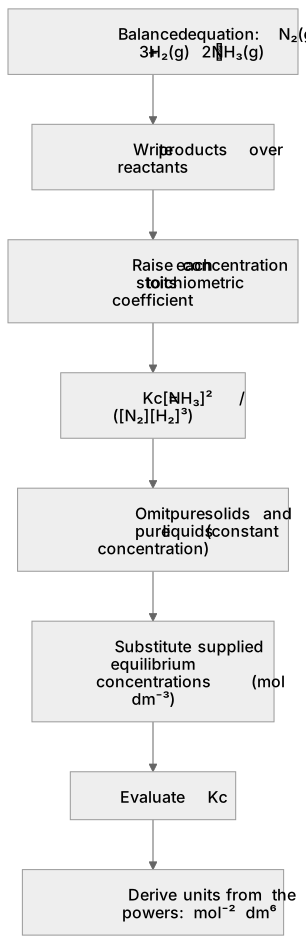
Put it in order
Put these steps in the order they happen.
- 1. Omit pure solids and pure liquids (constant concentration)
- 2. Derive units from the powers: mol⁻² dm⁶
- 3. Substitute supplied equilibrium concentrations (mol dm⁻³)
- 4. Balanced equation: N₂(g) + 3H₂(g) ⇌ 2NH₃(g)
- 5. Write products over reactants
- 6. Evaluate Kc
- 7. Raise each concentration to its stoichiometric coefficient
- 8. Kc = [NH₃]² / ([N₂][H₂]³)
Key words
Say what each word means before you turn the card.
Homogeneous equilibrium
Try answering aloud or in your head before turning the card.
Kc expression from a balanced equation
Try answering aloud or in your head before turning the card.
Stoichiometric coefficients as exponents
Try answering aloud or in your head before turning the card.
Calculating Kc from equilibrium concentrations
Try answering aloud or in your head before turning the card.
See every definition
- Homogeneous equilibrium
- An equilibrium in which all species share one phase, so their concentrations can appear together in a single Kc expression.
- Kc expression from a balanced equation
- Written with product concentration over reactant concentration, each concentration raised to its stoichiometric coefficient, omitting pure solids and pure liquids because their concentration is effectively constant.
- Stoichiometric coefficients as exponents
- Each concentration in the Kc expression is raised to its stoichiometric coefficient from the balanced equation.
- Calculating Kc from equilibrium concentrations
- Substitute the supplied equilibrium concentrations into the expression, keeping units consistent in mol dm⁻³, then evaluate and derive the units of Kc from the powers.
Label the diagram
Some boxes have lost their names. Pick the right name for each number.
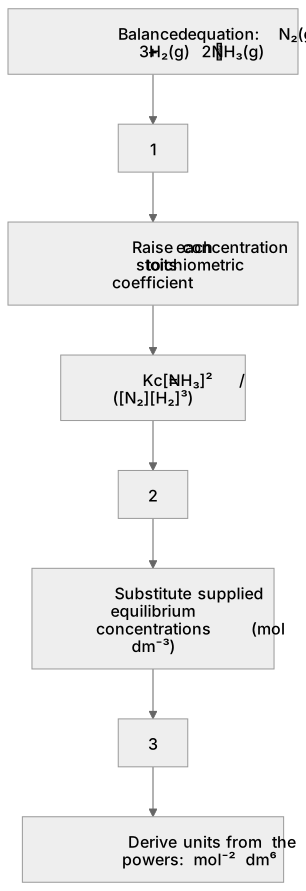
1Box 1
2Box 2
3Box 3
There is more to this lesson
The full lesson goes on to check your understanding and help you earn the marks. Create a free account to carry on, with your progress saved.
A week of Premium from your first lesson · Then the free plan continues · No card, no charge
Test your understanding of Chemical equilibrium: (f) expressions for the equilibrium constant, Kc , for homogeneous reactions and calculations of the equilibrium constant, Kc , from provided equilibrium concentrations
Active recall beats re-reading. Take an instant quiz now to test what you’ve learned and lock it into long-term memory.
A week of Premium from your first lesson · Then the free plan continues · No card, no charge