OCR · A-Level · Chemistry
Course version: H432 · Version from Sept 2017
(b) construction of balanced chemical equations (including ionic…
Full specification wording
Compounds, formulae and equations: (b) construction of balanced chemical equations (including ionic equations), including state symbols, for reactions studied and for unfamiliar reactions given appropriate information.
This criterion asks you to build equations, not merely to read them.
- Point 4 of 4
- 4 key terms
Study notes
From the teaching notes for this specification point.
The idea
This criterion asks you to build equations, not merely to read them. For a familiar reaction you write the correct formulae for every reactant and product, then adjust coefficients so that each element and each charge balances. For an unfamiliar reaction you use the information given, such as the names or formulae of the species involved, to deduce the products and then balance. Ionic equations show only the species that change: you split soluble ionic compounds into their ions, keep insoluble solids, gases and water together, then cancel spectator ions. State symbols (s), (l), (g) and (aq) must match the physical state under the stated conditions. Check both atom balance and, in ionic equations, charge balance.
What earns the marks
- Writes correct formulae for all reactants and products before adjusting any coefficients.
- Balances each element in turn and confirms the final atom count on both sides.
- Splits soluble ionic compounds into their constituent ions when constructing an ionic equation.
- Cancels spectator ions so that only the species that change appear in the ionic equation.
- Adds state symbols that match the physical state of each species under the stated conditions.
- Checks that total charge balances on both sides of an ionic equation.
Common mistakes and how to put them right
Changes a subscript inside a formula to balance atoms.
Put it right: Adjust only the coefficients in front of formulae.
Leaves spectator ions in an ionic equation.
Put it right: Cancel ions that appear unchanged on both sides.
Omits or misassigns state symbols.
Put it right: Match each symbol to the actual physical state described.
Balances atoms but ignores charge in an ionic equation.
Put it right: Confirm the charge total on each side.
Exam tips
- Write the full balanced equation first, then derive the ionic equation by splitting and cancelling.
- Underline each element in turn and count atoms on both sides before moving on.
- For unfamiliar reactions, list the species named in the question and predict products from the information given.
- Recheck state symbols against any conditions stated in the question stem.
Try the lesson
The start of the Compounds, formulae and equations: (b) construction of balanced chemical equations (including ionic equations), including state symbols, for reactions studied and for unfamiliar reactions given appropriate information. lesson, made from teaching notes for this specification point.
Listen
This criterion asks you to build equations, not merely to read them. For a familiar reaction you write the correct formulae for every reactant and product, then adjust coefficients so that each element and each charge balances. For an unfamiliar reaction you use the information given, such as the names or formulae of the species involved, to deduce the products and then balance. Ionic equations show only the species that change: you split soluble ionic compounds into their ions, keep insoluble solids, gases and water together, then cancel spectator ions. State symbols (s), (l), (g) and (aq) must match the physical state under the stated conditions. Check both atom balance and, in ionic equations, charge balance. A strong answer earns marks for these points. Writes correct formulae for all reactants and products before adjusting any coefficients. Balances each element in turn and confirms the final atom count on both sides. Splits soluble ionic compounds into their constituent ions when constructing an ionic equation. Cancels spectator ions so that only the species that change appear in the ionic equation. Exam tip: Write the full balanced equation first, then derive the ionic equation by splitting and cancelling.
See it
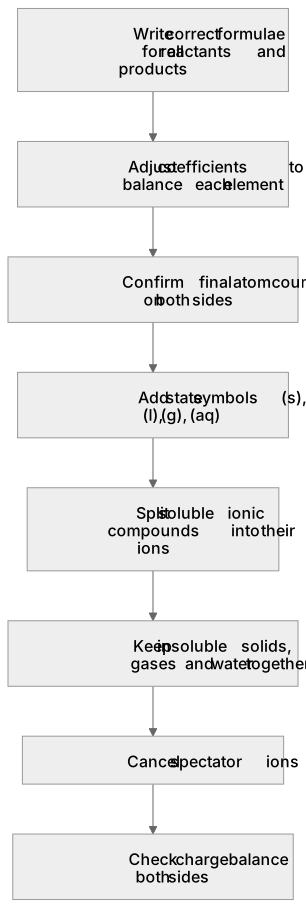
Put it in order
Put these steps in the order they happen.
- 1. Split soluble ionic compounds into their ions
- 2. Check charge balance on both sides
- 3. Keep insoluble solids, gases and water together
- 4. Write correct formulae for all reactants and products
- 5. Adjust coefficients to balance each element
- 6. Cancel spectator ions
- 7. Confirm final atom count on both sides
- 8. Add state symbols (s), (l), (g), (aq)
Key words
Say what each word means before you turn the card.
Balanced chemical equations
Try answering aloud or in your head before turning the card.
Ionic equations
Try answering aloud or in your head before turning the card.
State symbols
Try answering aloud or in your head before turning the card.
Spectator ions
Try answering aloud or in your head before turning the card.
See every definition
- Balanced chemical equations
- Equations in which the correct formulae are written for every reactant and product and the coefficients are adjusted so that each element balances.
- Ionic equations
- Equations that show only the species that change, by splitting soluble ionic compounds into their ions and keeping insoluble solids, gases and water together.
- State symbols
- The symbols (s), (l), (g) and (aq), which must match the physical state of each species under the stated conditions.
- Spectator ions
- Ions that appear unchanged on both sides of an ionic equation and are cancelled so that only the species that change appear.
Label the diagram
Some boxes have lost their names. Pick the right name for each number.
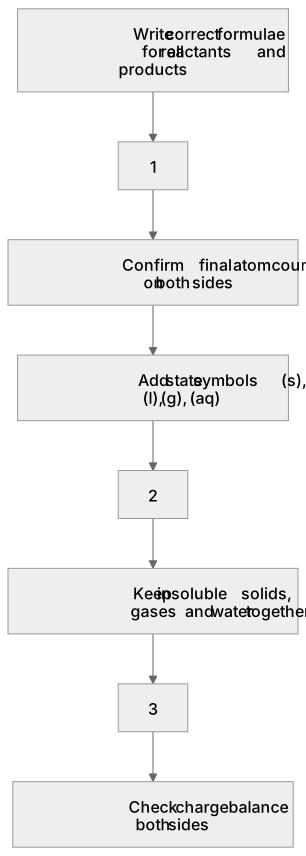
1Box 1
2Box 2
3Box 3
There is more to this lesson
The full lesson goes on to check your understanding and help you earn the marks. Create a free account to carry on, with your progress saved.
A week of Premium from your first lesson · Then the free plan continues · No card, no charge
Test your understanding of Compounds, formulae and equations: (b) construction of balanced chemical equations (including ionic equations), including state symbols, for reactions studied and for unfamiliar reactions given appropriate information.
Active recall beats re-reading. Take an instant quiz now to test what you’ve learned and lock it into long-term memory.
A week of Premium from your first lesson · Then the free plan continues · No card, no charge