OCR · A-Level · Chemistry
Course version: H432 · Version from Sept 2017
(i) prediction of ionic charge from the position of an element in the…
Full specification wording
Compounds, formulae and equations: (i) prediction of ionic charge from the position of an element in the periodic table
Ions form when atoms gain or lose electrons to reach a stable noble-gas configuration.
- Point 2 of 4
- 4 key terms
Study notes
From the teaching notes for this specification point.
The idea
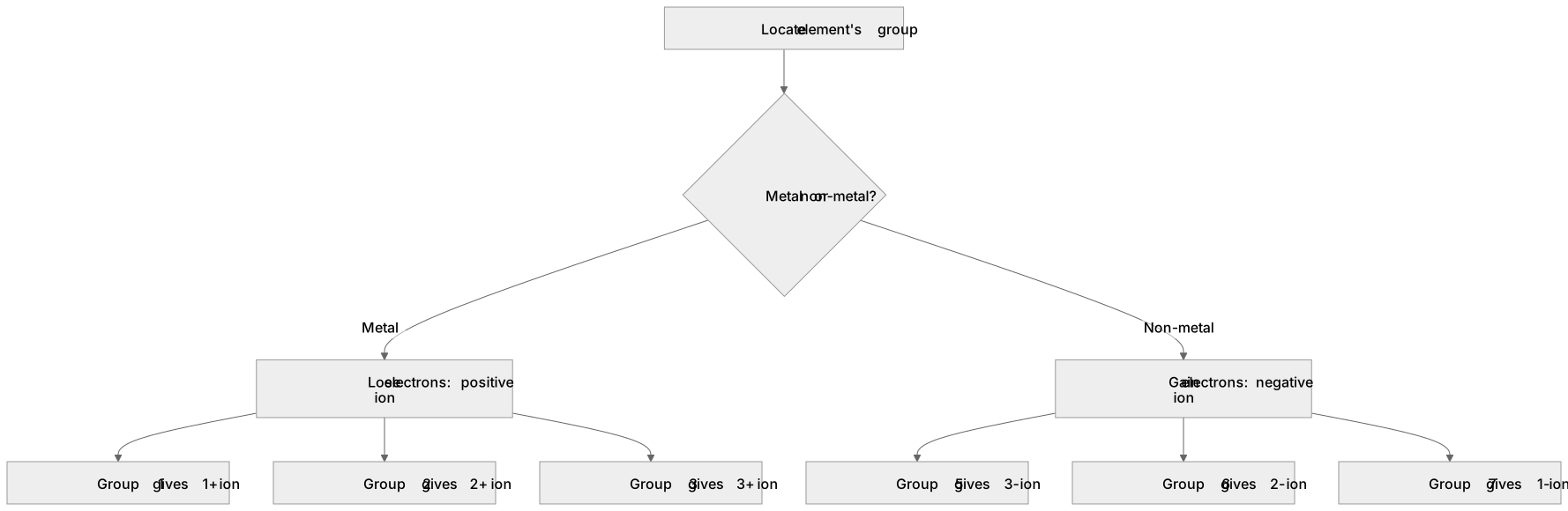
Ions form when atoms gain or lose electrons to reach a stable noble-gas configuration. For main-group elements the charge of the common ion follows directly from the group number. Group 1 metals lose one electron and form 1⁺ ions, such as Na⁺. Group 2 metals lose two electrons and form 2⁺ ions, such as Mg²⁺. Group 3 metals such as Al lose three electrons and form Al³⁺. Non-metals gain electrons: Group 5 elements form 3⁻ ions such as N³⁻, Group 6 elements form 2⁻ ions such as O²⁻, and Group 7 elements form 1⁻ ions such as Cl⁻. Group 4 elements are not usually described this way. To predict a charge, locate the element's group, decide whether it is metal or non-metal, and count electrons gained or lost to reach the nearest noble-gas shell. Transition metals are variable and are not predicted this way.
What earns the marks
- Identifies the group number of the element from its position in the periodic table.
- States that metals lose electrons to form positive ions and non-metals gain electrons to form negative ions.
- Applies the pattern that Group 1 gives 1⁺, Group 2 gives 2⁺ and Group 3 gives 3⁺ ions.
- Applies the pattern that Group 5 gives 3⁻, Group 6 gives 2⁻ and Group 7 gives 1⁻ ions.
- Writes the charge with the number before the sign, for example Mg²⁺ and O²⁻.
- Recognises that transition metals do not follow a single predictable charge.
Common mistakes and how to put them right
Writes the charge with the sign before the number.
Put it right: Place the number first, as in Ca²⁺.
Assumes every metal forms a 1⁺ ion.
Put it right: Match the charge to the group, so calcium in Group 2 forms Ca²⁺.
Predicts a fixed charge for a transition metal such as iron.
Put it right: Treat transition-metal charges as variable.
Gives a Group 7 element a positive charge.
Put it right: Halogens gain one electron to form 1⁻ ions such as Br⁻.
Exam tips
- Read the question to see whether it asks for the group, the ion charge or the ion symbol, and answer exactly that.
- Check the sign and the size of the charge against the group number before selecting an option.
- Eliminate options that give transition metals a single fixed charge, since these are usually wrong.
Try the lesson
The start of the Compounds, formulae and equations: (i) prediction of ionic charge from the position of an element in the periodic table lesson, made from teaching notes for this specification point.
Listen
Ions form when atoms gain or lose electrons to reach a stable noble-gas configuration. For main-group elements the charge of the common ion follows directly from the group number. Group 1 metals lose one electron and form 1⁺ ions, such as Na⁺. Group 2 metals lose two electrons and form 2⁺ ions, such as Mg²⁺. Group 3 metals such as Al lose three electrons and form Al³⁺. Non-metals gain electrons: Group 5 elements form 3⁻ ions such as N³⁻, Group 6 elements form 2⁻ ions such as O²⁻, and Group 7 elements form 1⁻ ions such as Cl⁻. Group 4 elements are not usually described this way. To predict a charge, locate the element's group, decide whether it is metal or non-metal, and count electrons gained or lost to reach the nearest noble-gas shell. Transition metals are variable and are not predicted this way. A strong answer earns marks for these points. Identifies the group number of the element from its position in the periodic table. States that metals lose electrons to form positive ions and non-metals gain electrons to form negative ions. Applies the pattern that Group 1 gives 1⁺, Group 2 gives 2⁺ and Group 3 gives 3⁺ ions. Applies the pattern that Group 5 gives 3⁻, Group 6 gives 2⁻ and Group 7 gives 1⁻ ions. Exam tip: Read the question to see whether it asks for the group, the ion charge or the ion symbol, and answer exactly that.
See it
Key words
Say what each word means before you turn the card.
Relationship between group number and ionic charge
Try answering aloud or in your head before turning the card.
Electron loss and gain to reach a noble-gas configuration
Try answering aloud or in your head before turning the card.
Distinguishing metals from non-metals
Try answering aloud or in your head before turning the card.
Variable oxidation states of transition metals
Try answering aloud or in your head before turning the card.
See every definition
- Relationship between group number and ionic charge
- For main-group elements the charge of the common ion follows directly from the group number.
- Electron loss and gain to reach a noble-gas configuration
- Ions form when atoms gain or lose electrons to reach a stable noble-gas configuration.
- Distinguishing metals from non-metals
- Metals lose electrons to form positive ions and non-metals gain electrons to form negative ions.
- Variable oxidation states of transition metals
- Transition metals are variable and are not predicted this way.
There is more to this lesson
The full lesson goes on to check your understanding and help you earn the marks. Create a free account to carry on, with your progress saved.
A week of Premium from your first lesson · Then the free plan continues · No card, no charge
Test your understanding of Compounds, formulae and equations: (i) prediction of ionic charge from the position of an element in the periodic table
Active recall beats re-reading. Take an instant quiz now to test what you’ve learned and lock it into long-term memory.
A week of Premium from your first lesson · Then the free plan continues · No card, no charge