OCR · A-Level · Chemistry
Course version: H432 · Version from Sept 2017
(iii) the number of orbitals making up s-, p- and d-sub-shells, and the…
Full specification wording
Electron structure: (iii) the number of orbitals making up s-, p- and d-sub-shells, and the number of electrons that can fill s-, p- and d-sub-shells
Each sub-shell is built from a fixed number of orbitals, and each orbital holds a maximum of two electrons.
- Point 6 of 12
- 4 key terms
Study notes
From the teaching notes for this specification point.
The idea
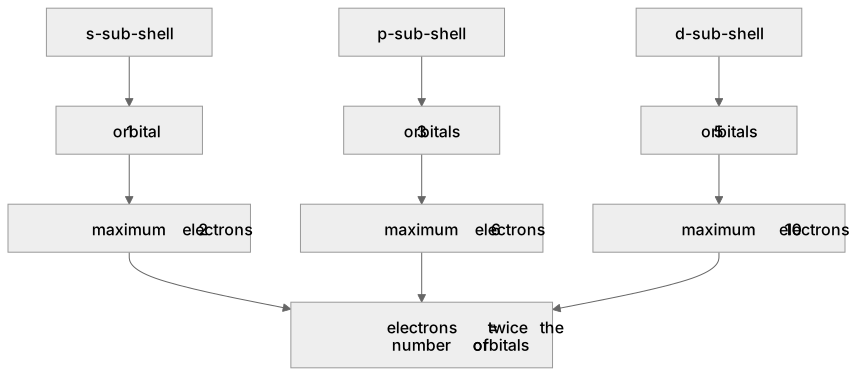
Each sub-shell is built from a fixed number of orbitals, and each orbital holds a maximum of two electrons. An s-sub-shell contains one orbital, so it holds a maximum of two electrons. A p-sub-shell contains three orbitals, so it holds a maximum of six electrons. A d-sub-shell contains five orbitals, so it holds a maximum of ten electrons. The pattern is that the number of electrons a sub-shell can hold equals twice the number of its orbitals. Use this relationship to check answers: count the orbitals, then double the number to find the maximum electron capacity. Keep the three sub-shells distinct, since a common slip is to give the orbital count as the electron count.
What earns the marks
- States that an s-sub-shell contains one orbital and holds a maximum of two electrons.
- States that a p-sub-shell contains three orbitals and holds a maximum of six electrons.
- States that a d-sub-shell contains five orbitals and holds a maximum of ten electrons.
- Applies the relationship that the maximum number of electrons equals twice the number of orbitals in the sub-shell.
Common mistakes and how to put them right
Gives the number of orbitals as the number of electrons a sub-shell holds.
Put it right by doubling the orbital count to obtain the electron capacity.
States that a d-sub-shell contains three orbitals.
Put it right by stating that a d-sub-shell contains five orbitals.
States that a p-sub-shell holds a maximum of three electrons.
Put it right by stating that a p-sub-shell holds a maximum of six electrons.
Exam tips
- Memorise the orbital counts 1, 3 and 5 for s, p and d, then double them for electron capacity.
- Check whether the question asks for orbitals or electrons before selecting an answer.
- Use the doubling relationship to verify any figure you are unsure of.
Try the lesson
The start of the Electron structure: (iii) the number of orbitals making up s-, p- and d-sub-shells, and the number of electrons that can fill s-, p- and d-sub-shells lesson, made from teaching notes for this specification point.
Listen
Each sub-shell is built from a fixed number of orbitals, and each orbital holds a maximum of two electrons. An s-sub-shell contains one orbital, so it holds a maximum of two electrons. A p-sub-shell contains three orbitals, so it holds a maximum of six electrons. A d-sub-shell contains five orbitals, so it holds a maximum of ten electrons. The pattern is that the number of electrons a sub-shell can hold equals twice the number of its orbitals. Use this relationship to check answers: count the orbitals, then double the number to find the maximum electron capacity. Keep the three sub-shells distinct, since a common slip is to give the orbital count as the electron count. A strong answer earns marks for these points. States that an s-sub-shell contains one orbital and holds a maximum of two electrons. States that a p-sub-shell contains three orbitals and holds a maximum of six electrons. States that a d-sub-shell contains five orbitals and holds a maximum of ten electrons. Applies the relationship that the maximum number of electrons equals twice the number of orbitals in the sub-shell. A common slip: Gives the number of orbitals as the number of electrons a sub-shell holds. Instead, doubling the orbital count to obtain the electron capacity. Exam tip: Memorise the orbital counts 1, 3 and 5 for s, p and d, then double them for electron capacity.
See it
Key words
Say what each word means before you turn the card.
Fixed number of orbitals per sub-shell
Try answering aloud or in your head before turning the card.
Maximum of two electrons per orbital
Try answering aloud or in your head before turning the card.
Electron capacity of s-, p- and d-sub-shells
Try answering aloud or in your head before turning the card.
Relationship between orbital count and electron capacity
Try answering aloud or in your head before turning the card.
See every definition
- Fixed number of orbitals per sub-shell
- Each sub-shell is built from a fixed number of orbitals, with an s-sub-shell containing one, a p-sub-shell containing three and a d-sub-shell containing five.
- Maximum of two electrons per orbital
- Each orbital holds a maximum of two electrons.
- Electron capacity of s-, p- and d-sub-shells
- An s-sub-shell holds a maximum of two electrons, a p-sub-shell a maximum of six electrons and a d-sub-shell a maximum of ten electrons.
- Relationship between orbital count and electron capacity
- The number of electrons a sub-shell can hold equals twice the number of its orbitals.
Label the diagram
Some boxes have lost their names. Pick the right name for each number.
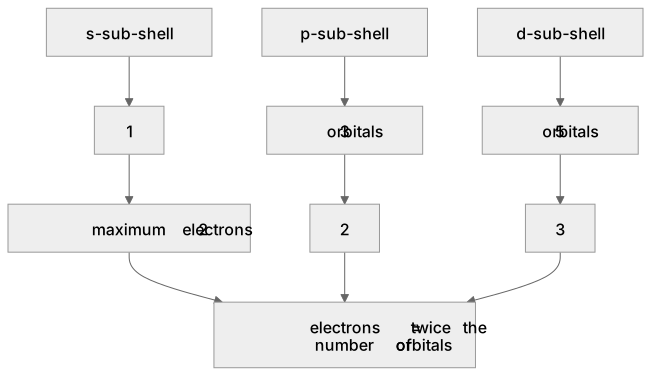
1Box 1
2Box 2
3Box 3
There is more to this lesson
The full lesson goes on to check your understanding and help you earn the marks. Create a free account to carry on, with your progress saved.
A week of Premium from your first lesson · Then the free plan continues · No card, no charge
Test your understanding of Electron structure: (iii) the number of orbitals making up s-, p- and d-sub-shells, and the number of electrons that can fill s-, p- and d-sub-shells
Active recall beats re-reading. Take an instant quiz now to test what you’ve learned and lock it into long-term memory.
A week of Premium from your first lesson · Then the free plan continues · No card, no charge