OCR · A-Level · Chemistry
Course version: H432 · Version from Sept 2017
(a) explanation that some chemical reactions are accompanied by enthalpy…
Full specification wording
Enthalpy changes: (a) explanation that some chemical reactions are accompanied by enthalpy changes that are exothermic (∆H, negative) or endothermic (∆H, positive)
Enthalpy change (∆H) measures the heat energy exchanged with the surroundings at constant pressure.
- Point 2 of 20
- 4 key terms
Study notes
From the teaching notes for this specification point.
The idea
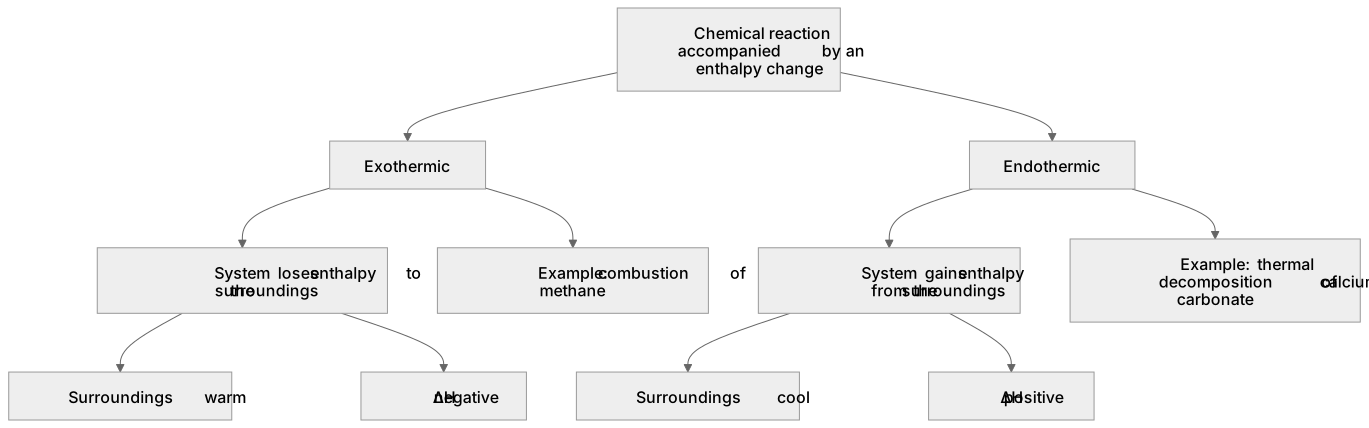
Enthalpy change (∆H) measures the heat energy exchanged with the surroundings at constant pressure. In an exothermic reaction the system loses enthalpy to the surroundings, so the surroundings warm and ∆H carries a negative sign; combustion of methane is a familiar example. In an endothermic reaction the system gains enthalpy from the surroundings, so the surroundings cool and ∆H carries a positive sign; thermal decomposition of calcium carbonate is a familiar example. The sign is a convention fixed relative to the system, not a statement about magnitude, so a large exothermic change is more negative, not more positive. Learners should classify a described reaction, assign the correct sign and explain the direction of energy transfer in words.
What earns the marks
- States that an exothermic reaction transfers enthalpy from the system to the surroundings and records ∆H with a negative sign.
- States that an endothermic reaction transfers enthalpy from the surroundings to the system and records ∆H with a positive sign.
- Classifies a named reaction such as methane combustion as exothermic and assigns a negative ∆H.
- Classifies a named reaction such as calcium carbonate decomposition as endothermic and assigns a positive ∆H.
- Explains that the sign of ∆H follows the convention of energy leaving or entering the system rather than the size of the change.
Common mistakes and how to put them right
Reverses the sign convention by giving exothermic reactions a positive ∆H.
Put it right by linking negative ∆H to enthalpy leaving the system.
Treats a numerically large exothermic value as more positive.
Put it right by noting that a larger release makes ∆H more negative.
Describes endothermic reactions as releasing heat because bonds are broken.
Put it right by stating that the system absorbs enthalpy overall from the surroundings.
Exam tips
- Read the question for the word exothermic or endothermic before choosing a sign, then check the sign matches the direction of energy transfer.
- Write the sign explicitly with the value, for example ∆H = −890 kJ mol⁻¹, rather than giving a bare number.
- Justify a classification with one sentence naming where the enthalpy goes, since explanation marks reward the reasoning not just the label.
Try the lesson
The start of the Enthalpy changes: (a) explanation that some chemical reactions are accompanied by enthalpy changes that are exothermic (∆H, negative) or endothermic (∆H, positive) lesson, made from teaching notes for this specification point.
Listen
Enthalpy change (∆H) measures the heat energy exchanged with the surroundings at constant pressure. In an exothermic reaction the system loses enthalpy to the surroundings, so the surroundings warm and ∆H carries a negative sign; combustion of methane is a familiar example. In an endothermic reaction the system gains enthalpy from the surroundings, so the surroundings cool and ∆H carries a positive sign; thermal decomposition of calcium carbonate is a familiar example. The sign is a convention fixed relative to the system, not a statement about magnitude, so a large exothermic change is more negative, not more positive. Learners should classify a described reaction, assign the correct sign and explain the direction of energy transfer in words. A strong answer earns marks for these points. States that an exothermic reaction transfers enthalpy from the system to the surroundings and records ∆H with a negative sign. States that an endothermic reaction transfers enthalpy from the surroundings to the system and records ∆H with a positive sign. Classifies a named reaction such as methane combustion as exothermic and assigns a negative ∆H. Classifies a named reaction such as calcium carbonate decomposition as endothermic and assigns a positive ∆H. A common slip: Reverses the sign convention by giving exothermic reactions a positive ∆H. Instead, linking negative ∆H to enthalpy leaving the system. Exam tip: Read the question for the word exothermic or endothermic before choosing a sign, then check the sign matches the direction of energy transfer.
See it
Key words
Say what each word means before you turn the card.
Exothermic
Try answering aloud or in your head before turning the card.
Endothermic
Try answering aloud or in your head before turning the card.
Enthalpy change (∆H)
Try answering aloud or in your head before turning the card.
Sign convention
Try answering aloud or in your head before turning the card.
See every definition
- Exothermic
- A reaction in which the system loses enthalpy to the surroundings, so the surroundings warm and ∆H carries a negative sign.
- Endothermic
- A reaction in which the system gains enthalpy from the surroundings, so the surroundings cool and ∆H carries a positive sign.
- Enthalpy change (∆H)
- A measure of the heat energy exchanged with the surroundings at constant pressure, recorded with a sign fixed relative to the system.
- Sign convention
- A convention fixed relative to the system, so the sign of ∆H follows the direction of energy leaving or entering the system rather than the size of the change.
Label the diagram
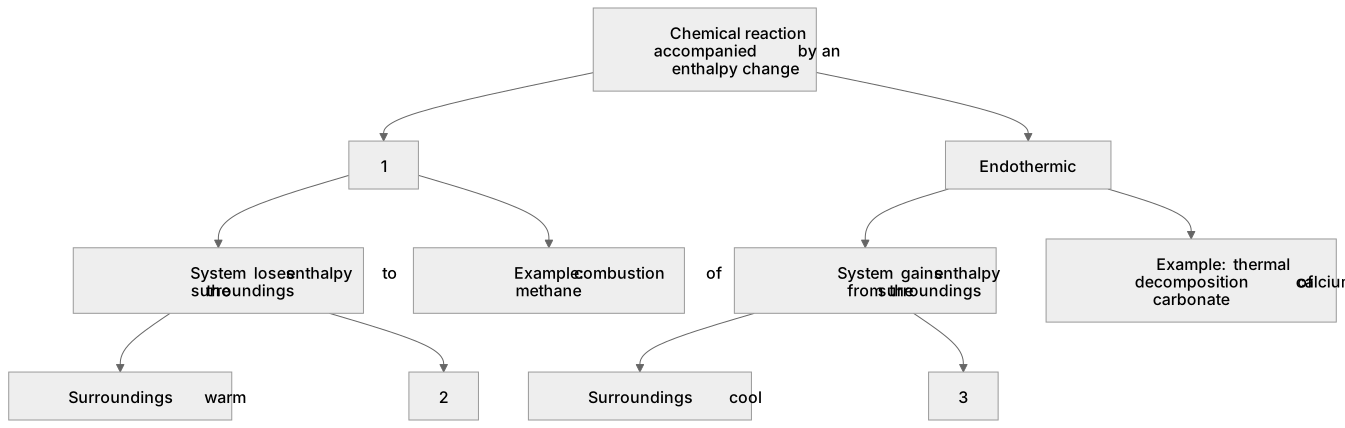
Some boxes have lost their names. Pick the right name for each number.
1Box 1
2Box 2
3Box 3
There is more to this lesson
The full lesson goes on to check your understanding and help you earn the marks. Create a free account to carry on, with your progress saved.
A week of Premium from your first lesson · Then the free plan continues · No card, no charge
Test your understanding of Enthalpy changes: (a) explanation that some chemical reactions are accompanied by enthalpy changes that are exothermic (∆H, negative) or endothermic (∆H, positive)
Active recall beats re-reading. Take an instant quiz now to test what you’ve learned and lock it into long-term memory.
A week of Premium from your first lesson · Then the free plan continues · No card, no charge