OCR · A-Level · Chemistry
Course version: H432 · Version from Sept 2017
(e) determination of enthalpy changes directly from appropriate…
Full specification wording
Enthalpy changes: (e) determination of enthalpy changes directly from appropriate experimental results, including use of the relationship: q = mc∆T
Enthalpy changes can be found experimentally by measuring a temperature change and using q = mc∆T, where q is the heat energy transferred in joules, m is the mass of the substance heated or cooled…
- Point 10 of 20
- 4 key terms
Study notes
From the teaching notes for this specification point.
The idea
Enthalpy changes can be found experimentally by measuring a temperature change and using q = mc∆T, where q is the heat energy transferred in joules, m is the mass of the substance heated or cooled in grams, c is the specific heat capacity in J g⁻¹ K⁻¹ and ∆T is the temperature change in kelvin or degrees Celsius. For a solution, m is taken as the mass of the solution, often approximated as its volume in cm³ because the density is close to 1 g cm⁻³. The energy q is then divided by the number of moles reacting to give the enthalpy change per mole, with a sign that reflects whether the reaction is exothermic or endothermic.
What earns the marks
- Uses the relationship q = mc∆T, identifying q as energy in joules, m as mass in grams, c as specific heat capacity and ∆T as temperature change.
- Calculates the temperature change from the initial and final readings and substitutes it into q = mc∆T.
- Divides the calculated energy q by the number of moles of reactant to obtain the enthalpy change per mole.
- Assigns the correct sign so that an exothermic reaction gives a negative enthalpy change and an endothermic reaction gives a positive one.
Common mistakes and how to put them right
Uses the mass of the solute instead of the mass of the solution.
Put it right: Use the total mass of solution heated.
Forgets to convert the energy in joules to kilojoules before quoting an enthalpy change in kJ mol⁻¹.
Put it right: Divide by 1000.
Leaves the answer as a total energy rather than per mole.
Put it right: Divide q by the moles of limiting reactant.
Exam tips
- Assume the density of a dilute aqueous solution is about 1 g cm⁻³ so that the mass in grams equals the volume in cm³.
- Keep track of units: c is often given as 4.18 J g⁻¹ K⁻¹, so q comes out in joules before conversion to kJ.
- State the sign convention explicitly: energy released to the surroundings means the enthalpy change is negative.
Try the lesson
The start of the Enthalpy changes: (e) determination of enthalpy changes directly from appropriate experimental results, including use of the relationship: q = mc∆T lesson, made from teaching notes for this specification point.
Listen
Enthalpy changes can be found experimentally by measuring a temperature change and using q = mc∆T, where q is the heat energy transferred in joules, m is the mass of the substance heated or cooled in grams, c is the specific heat capacity in J g⁻¹ K⁻¹ and ∆T is the temperature change in kelvin or degrees Celsius. For a solution, m is taken as the mass of the solution, often approximated as its volume in cm³ because the density is close to 1 g cm⁻³. The energy q is then divided by the number of moles reacting to give the enthalpy change per mole, with a sign that reflects whether the reaction is exothermic or endothermic. A strong answer earns marks for these points. Uses the relationship q = mc∆T, identifying q as energy in joules, m as mass in grams, c as specific heat capacity and ∆T as temperature change. Calculates the temperature change from the initial and final readings and substitutes it into q = mc∆T. Divides the calculated energy q by the number of moles of reactant to obtain the enthalpy change per mole. Assigns the correct sign so that an exothermic reaction gives a negative enthalpy change and an endothermic reaction gives a positive one. Exam tip: Assume the density of a dilute aqueous solution is about 1 g cm⁻³ so that the mass in grams equals the volume in cm³.
See it
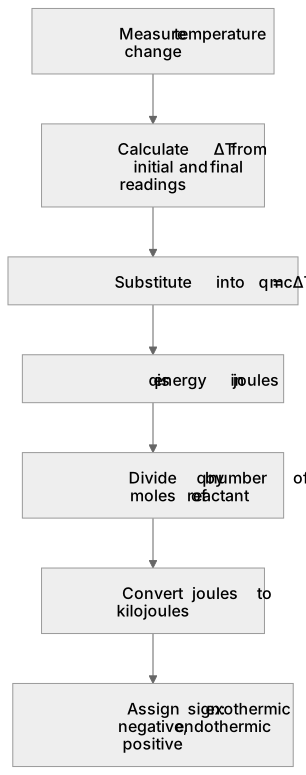
Put it in order
Put these steps in the order they happen.
- 1. Assign sign: exothermic negative, endothermic positive
- 2. Convert joules to kilojoules
- 3. Substitute into q = mc∆T
- 4. Divide q by number of moles of reactant
- 5. Measure temperature change
- 6. Calculate ∆T from initial and final readings
- 7. q is energy in joules
Key words
Say what each word means before you turn the card.
q = mc∆T
Try answering aloud or in your head before turning the card.
Measuring temperature change experimentally
Try answering aloud or in your head before turning the card.
Converting energy to enthalpy change per mole
Try answering aloud or in your head before turning the card.
Sign convention for exothermic and endothermic reactions
Try answering aloud or in your head before turning the card.
See every definition
- q = mc∆T
- The relationship used to find heat energy transferred, where q is energy in joules, m is mass in grams, c is specific heat capacity and ∆T is temperature change.
- Measuring temperature change experimentally
- Calculating the temperature change from the initial and final readings and substituting it into q = mc∆T.
- Converting energy to enthalpy change per mole
- Dividing the calculated energy q by the number of moles of reactant to obtain the enthalpy change per mole.
- Sign convention for exothermic and endothermic reactions
- An exothermic reaction gives a negative enthalpy change and an endothermic reaction gives a positive one.
Label the diagram
Some boxes have lost their names. Pick the right name for each number.
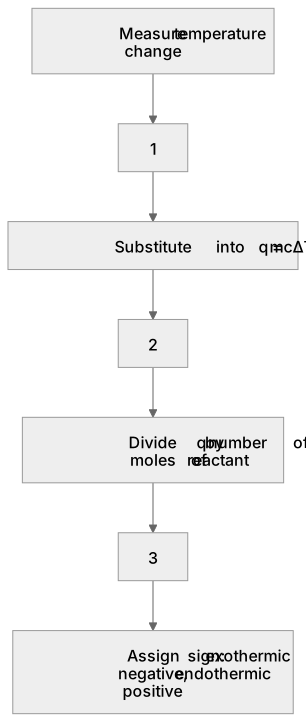
1Box 1
2Box 2
3Box 3
There is more to this lesson
The full lesson goes on to check your understanding and help you earn the marks. Create a free account to carry on, with your progress saved.
A week of Premium from your first lesson · Then the free plan continues · No card, no charge
Test your understanding of Enthalpy changes: (e) determination of enthalpy changes directly from appropriate experimental results, including use of the relationship: q = mc∆T
Active recall beats re-reading. Take an instant quiz now to test what you’ve learned and lock it into long-term memory.
A week of Premium from your first lesson · Then the free plan continues · No card, no charge