OCR · A-Level · Chemistry
Course version: H432 · Version from Sept 2017
(g) Hess’ law for construction of enthalpy cycles and calculations to…
Full specification wording
Enthalpy changes: (g) Hess’ law for construction of enthalpy cycles and calculations to determine indirectly:
Construction means drawing a cycle in which the direct route from reactants to products is set equal to an alternative route through intermediate substances, with arrows showing each step.
- Point 16 of 20
- 4 key terms
Study notes
From the teaching notes for this specification point.
The idea
Construction means drawing a cycle in which the direct route from reactants to products is set equal to an alternative route through intermediate substances, with arrows showing each step. The calculation then sums the known enthalpy changes along the alternative route, reversing signs where an arrow is reversed, to obtain the unknown value. Typical cases use standard enthalpies of formation from elements or standard enthalpies of combustion to the same oxides. Keep states consistent, label each arrow, and solve the arithmetic to give the indirect enthalpy change with its correct sign and units.
What earns the marks
- Constructs an enthalpy cycle with a direct route and an alternative route between the same initial and final states.
- Labels each arrow with the appropriate enthalpy change and its direction.
- Reverses the sign of a value when the cycle requires the step to run in the opposite direction.
- Sums the known enthalpy changes along the alternative route to determine the unknown change indirectly.
- Gives the final enthalpy change with the correct sign and units, keeping states consistent.
Common mistakes and how to put them right
Draws a cycle whose two routes do not start and end at the same states.
Put it right: Make both routes connect identical initial and final states.
Forgets to reverse the sign when an arrow is reversed.
Put it right: Adjust the sign to match the direction used in the calculation.
Leaves out units or uses the wrong sign on the final answer.
Put it right: State the value with correct sign and units such as kJ mol⁻¹.
Exam tips
- Draw and label the full cycle before substituting numbers so each step direction is fixed.
- Work systematically around one route, writing each term with its sign, then equate to the direct change.
- Recheck that every substance appears in the same physical state on both routes.
Try the lesson
The start of the Enthalpy changes: (g) Hess’ law for construction of enthalpy cycles and calculations to determine indirectly: lesson, made from teaching notes for this specification point.
Listen
Construction means drawing a cycle in which the direct route from reactants to products is set equal to an alternative route through intermediate substances, with arrows showing each step. The calculation then sums the known enthalpy changes along the alternative route, reversing signs where an arrow is reversed, to obtain the unknown value. Typical cases use standard enthalpies of formation from elements or standard enthalpies of combustion to the same oxides. Keep states consistent, label each arrow, and solve the arithmetic to give the indirect enthalpy change with its correct sign and units. A strong answer earns marks for these points. Constructs an enthalpy cycle with a direct route and an alternative route between the same initial and final states. Labels each arrow with the appropriate enthalpy change and its direction. Reverses the sign of a value when the cycle requires the step to run in the opposite direction. Sums the known enthalpy changes along the alternative route to determine the unknown change indirectly. Exam tip: Draw and label the full cycle before substituting numbers so each step direction is fixed.
See it
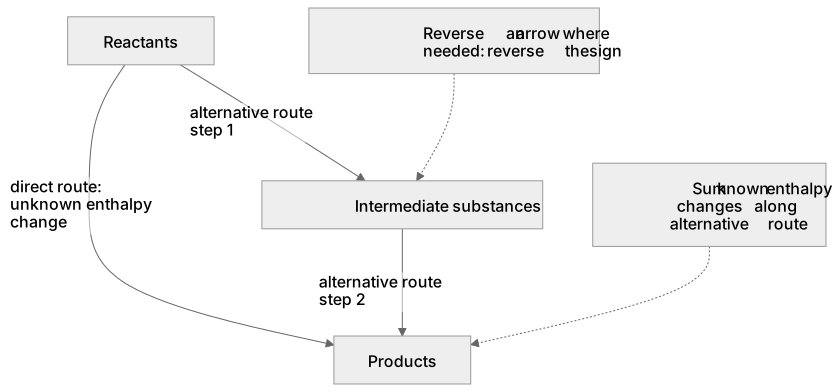
Key words
Say what each word means before you turn the card.
Construction of enthalpy cycles
Try answering aloud or in your head before turning the card.
Indirect determination of enthalpy change
Try answering aloud or in your head before turning the card.
Standard enthalpies of formation and combustion
Try answering aloud or in your head before turning the card.
Sign conventions
Try answering aloud or in your head before turning the card.
See every definition
- Construction of enthalpy cycles
- Drawing a cycle in which the direct route from reactants to products is set equal to an alternative route through intermediate substances, with arrows showing each step.
- Indirect determination of enthalpy change
- Summing the known enthalpy changes along the alternative route, reversing signs where an arrow is reversed, to obtain the unknown value.
- Standard enthalpies of formation and combustion
- Typical cases of the calculation use standard enthalpies of formation from elements or standard enthalpies of combustion to the same oxides.
- Sign conventions
- The sign of a value is reversed when the cycle requires the step to run in the opposite direction.
Label the diagram
Some boxes have lost their names. Pick the right name for each number.
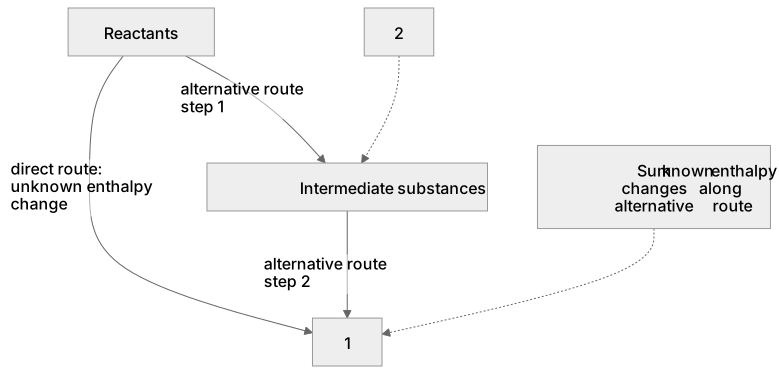
1Box 1
2Box 2
There is more to this lesson
The full lesson goes on to check your understanding and help you earn the marks. Create a free account to carry on, with your progress saved.
A week of Premium from your first lesson · Then the free plan continues · No card, no charge
Test your understanding of Enthalpy changes: (g) Hess’ law for construction of enthalpy cycles and calculations to determine indirectly:
Active recall beats re-reading. Take an instant quiz now to test what you’ve learned and lock it into long-term memory.
A week of Premium from your first lesson · Then the free plan continues · No card, no charge