OCR · A-Level · Chemistry
Course version: H432 · Version from Sept 2017
Group 2: (i) Ca(OH)₂ in agriculture to neutralise acid soils
Farmers spread calcium hydroxide, Ca(OH)₂, also called slaked lime, on acidic soil to raise its pH.
- Point 10 of 11
- 4 key terms
Study notes
From the teaching notes for this specification point.
The idea
Farmers spread calcium hydroxide, Ca(OH)₂, also called slaked lime, on acidic soil to raise its pH. The hydroxide ions accept protons from the acid in the soil, neutralising it and making conditions better for crops. A simplified equation is Ca(OH)₂ + 2H⁺ → Ca²⁺ + 2H₂O, showing that each hydroxide ion takes a proton to form water. Calcium hydroxide is a base, so it reacts with the acid rather than adding to it. In multiple-choice questions, link the use to neutralisation, identify Ca(OH)₂ as the base, and check that the equation balances in atoms and charge.
What earns the marks
- States that calcium hydroxide is added to acidic soil to neutralise the acid and raise pH.
- Identifies Ca(OH)₂ as a base that accepts protons from the soil acid.
- Writes a balanced ionic equation such as Ca(OH)₂ + 2H⁺ → Ca²⁺ + 2H₂O.
- Explains that hydroxide ions react with hydrogen ions to form water.
- Links the agricultural use to improved conditions for crop growth.
Common mistakes and how to put them right
Describes Ca(OH)₂ as an acid.
Put it right: State that it is a base that neutralises soil acid.
Writes an equation that omits water as a product.
Put it right: Show H⁺ and OH⁻ combining to give H₂O.
Uses an unbalanced charge in the ionic equation.
Put it right: Check that charge balances on both sides.
Confuses slaked lime with quicklime.
Put it right: Name Ca(OH)₂ as calcium hydroxide.
Exam tips
- Read the stem for the word 'neutralise' and match it to a base.
- Check the ionic equation balances in both atoms and charge.
- Keep the agricultural context brief and focus on the chemistry.
Try the lesson
The start of the Group 2: (i) Ca(OH)₂ in agriculture to neutralise acid soils lesson, made from teaching notes for this specification point.
Listen
Farmers spread calcium hydroxide, Ca(OH)₂, also called slaked lime, on acidic soil to raise its pH. The hydroxide ions accept protons from the acid in the soil, neutralising it and making conditions better for crops. A simplified equation is Ca(OH)₂ + 2H⁺ → Ca²⁺ + 2H₂O, showing that each hydroxide ion takes a proton to form water. Calcium hydroxide is a base, so it reacts with the acid rather than adding to it. In multiple-choice questions, link the use to neutralisation, identify Ca(OH)₂ as the base, and check that the equation balances in atoms and charge. A strong answer earns marks for these points. States that calcium hydroxide is added to acidic soil to neutralise the acid and raise pH. Identifies Ca(OH)₂ as a base that accepts protons from the soil acid. Writes a balanced ionic equation such as Ca(OH)₂ + 2H⁺ → Ca²⁺ + 2H₂O. Explains that hydroxide ions react with hydrogen ions to form water. Exam tip: Read the stem for the word 'neutralise' and match it to a base.
See it
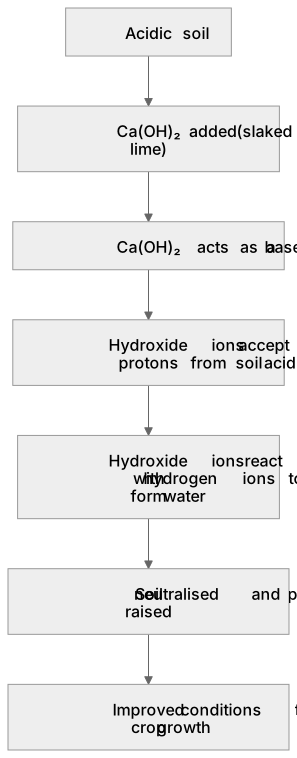
Put it in order
Put these steps in the order they happen.
- 1. Improved conditions for crop growth
- 2. Soil neutralised and pH raised
- 3. Ca(OH)₂ acts as a base
- 4. Hydroxide ions react with hydrogen ions to form water
- 5. Acidic soil
- 6. Ca(OH)₂ added (slaked lime)
- 7. Hydroxide ions accept protons from soil acid
Key words
Say what each word means before you turn the card.
Calcium hydroxide as a base
Try answering aloud or in your head before turning the card.
Neutralising acid soils
Try answering aloud or in your head before turning the card.
Ionic equations and proton transfer
Try answering aloud or in your head before turning the card.
Agricultural applications of Group 2 compounds
Try answering aloud or in your head before turning the card.
See every definition
- Calcium hydroxide as a base
- Calcium hydroxide is a base, so it reacts with the acid rather than adding to it.
- Neutralising acid soils
- Calcium hydroxide is added to acidic soil to neutralise the acid and raise pH.
- Ionic equations and proton transfer
- Hydroxide ions accept protons from the acid, reacting with hydrogen ions to form water, as in Ca(OH)₂ + 2H⁺ → Ca²⁺ + 2H₂O.
- Agricultural applications of Group 2 compounds
- Farmers spread calcium hydroxide on acidic soil to neutralise it and make conditions better for crops.
Label the diagram
Some boxes have lost their names. Pick the right name for each number.
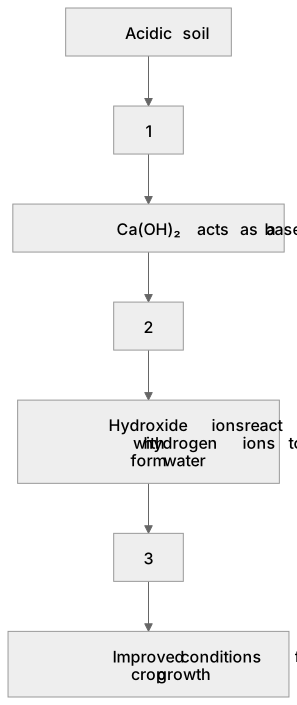
1Box 1
2Box 2
3Box 3
There is more to this lesson
The full lesson goes on to check your understanding and help you earn the marks. Create a free account to carry on, with your progress saved.
A week of Premium from your first lesson · Then the free plan continues · No card, no charge
Test your understanding of Group 2: (i) Ca(OH)₂ in agriculture to neutralise acid soils
Active recall beats re-reading. Take an instant quiz now to test what you’ve learned and lock it into long-term memory.
A week of Premium from your first lesson · Then the free plan continues · No card, no charge