OCR · A-Level · Chemistry
Course version: H432 · Version from Sept 2017
Group 2: (i) oxygen
This item sits in the Group 2 section, where you study how the alkaline earth metals magnesium, calcium, strontium and barium react and how their compounds behave.
- Point 4 of 11
- 3 key terms
Study notes
From the teaching notes for this specification point.
The idea
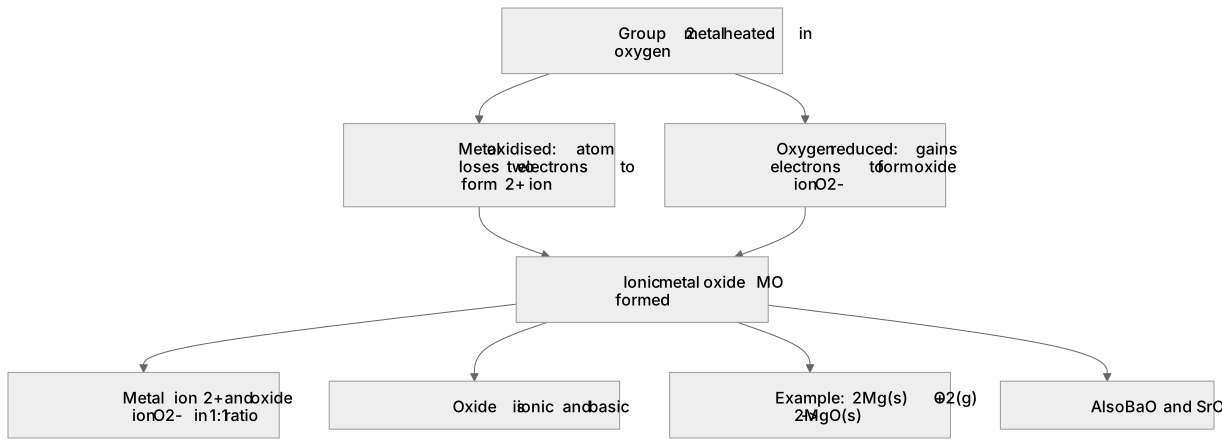
This item sits in the Group 2 section, where you study how the alkaline earth metals magnesium, calcium, strontium and barium react and how their compounds behave. The prompt names oxygen as the reagent, so the task is to identify what a Group 2 metal forms when it is heated in oxygen. Group 2 metals are oxidised here: each metal atom loses two electrons to form a 2⁺ ion, and oxygen gains electrons to form the oxide ion O²⁻. The product is a solid metal oxide with the general formula MO, for example magnesium oxide MgO or calcium oxide CaO. Write the balanced equation with state symbols, such as 2Mg(s) + O₂(g) → 2MgO(s), and note that the metal is oxidised while oxygen is reduced. Barium and strontium behave similarly, giving BaO and SrO. Recognise that the oxide is ionic and basic, and that this is a redox reaction rather than simple combination alone.
What earns the marks
- Identifies the product of heating a Group 2 metal in oxygen as the metal oxide with formula MO.
- Writes a balanced equation such as 2Mg(s) + O₂(g) → 2MgO(s) with correct state symbols.
- States that the metal is oxidised from oxidation state 0 to 2⁺ while oxygen is reduced to the oxide ion O²⁻.
- Names the ionic oxide as basic and links the 2⁺ charge on the metal ion to the O²⁻ ion in a 1:1 ratio.
Common mistakes and how to put them right
Writes the product as a peroxide or superoxide for a Group 2 metal.
Put it right by giving the simple oxide MO for the reaction with oxygen.
Omits state symbols or leaves the equation unbalanced.
Put it right by balancing atoms and adding (s), (g) and (s) symbols.
Describes the reaction as a simple combination with no electron transfer.
Put it right by identifying the redox change in oxidation states.
Exam tips
- Read the reagent named in the stem carefully and match the product formula to that reagent before choosing an option.
- Check that any equation you select is balanced in both atoms and charge.
- Recall that Group 2 oxides are ionic and basic, which helps eliminate options describing covalent or acidic products.
Try the lesson
The start of the Group 2: (i) oxygen lesson, made from teaching notes for this specification point.
Listen
This item sits in the Group 2 section, where you study how the alkaline earth metals magnesium, calcium, strontium and barium react and how their compounds behave. The prompt names oxygen as the reagent, so the task is to identify what a Group 2 metal forms when it is heated in oxygen. Group 2 metals are oxidised here: each metal atom loses two electrons to form a 2⁺ ion, and oxygen gains electrons to form the oxide ion O²⁻. The product is a solid metal oxide with the general formula MO, for example magnesium oxide MgO or calcium oxide CaO. Write the balanced equation with state symbols, such as 2Mg(s) + O₂(g) → 2MgO(s), and note that the metal is oxidised while oxygen is reduced. Barium and strontium behave similarly, giving BaO and SrO. Recognise that the oxide is ionic and basic, and that this is a redox reaction rather than simple combination alone. A strong answer earns marks for these points. Identifies the product of heating a Group 2 metal in oxygen as the metal oxide with formula MO. Writes a balanced equation such as 2Mg(s) + O₂(g) → 2MgO(s) with correct state symbols. States that the metal is oxidised from oxidation state 0 to 2⁺ while oxygen is reduced to the oxide ion O²⁻. Names the ionic oxide as basic and links the 2⁺ charge on the metal ion to the O²⁻ ion in a 1:1 ratio. A common slip: Writes the product as a peroxide or superoxide for a Group 2 metal. Instead, giving the simple oxide MO for the reaction with oxygen. Exam tip: Read the reagent named in the stem carefully and match the product formula to that reagent before choosing an option.
See it
Key words
Say what each word means before you turn the card.
Formation of metal oxides MO
Try answering aloud or in your head before turning the card.
Redox and oxidation states
Try answering aloud or in your head before turning the card.
Balanced equations with state symbols
Try answering aloud or in your head before turning the card.
See every definition
- Formation of metal oxides MO
- Heating a Group 2 metal in oxygen gives a solid metal oxide with the general formula MO, such as magnesium oxide MgO or calcium oxide CaO.
- Redox and oxidation states
- The metal is oxidised from oxidation state 0 to 2⁺ while oxygen is reduced to the oxide ion O²⁻, so this is a redox reaction.
- Balanced equations with state symbols
- The balanced equation is written with state symbols, such as 2Mg(s) + O₂(g) → 2MgO(s).
Label the diagram
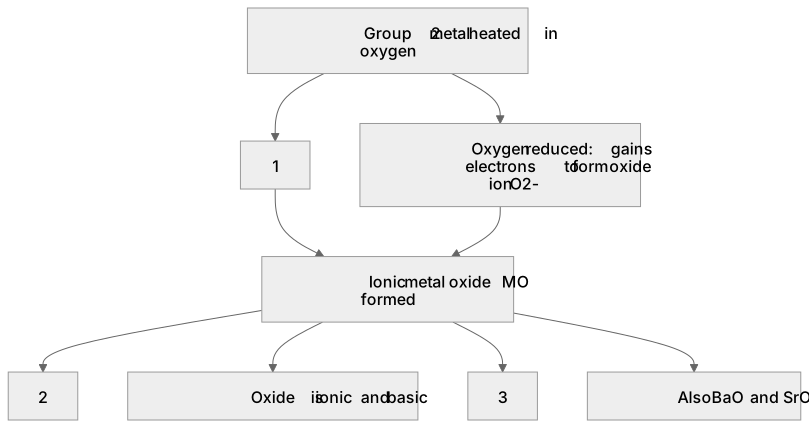
Some boxes have lost their names. Pick the right name for each number.
1Box 1
2Box 2
3Box 3
There is more to this lesson
The full lesson goes on to check your understanding and help you earn the marks. Create a free account to carry on, with your progress saved.
A week of Premium from your first lesson · Then the free plan continues · No card, no charge
Test your understanding of Group 2: (i) oxygen
Active recall beats re-reading. Take an instant quiz now to test what you’ve learned and lock it into long-term memory.
A week of Premium from your first lesson · Then the free plan continues · No card, no charge