OCR · A-Level · Chemistry
Course version: H432 · Version from Sept 2017
Haloalkanes: Environmental concerns from use of organohalogen compounds
Organohalogen compounds are useful as solvents, refrigerants, pesticides and in polymers, but their persistence and mobility create environmental problems.
- Point 8 of 11
- 4 key terms
Study notes
From the teaching notes for this specification point.
The idea
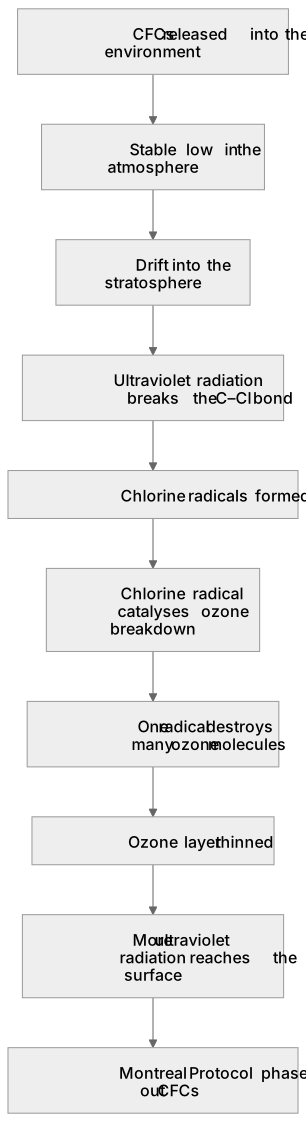
Organohalogen compounds are useful as solvents, refrigerants, pesticides and in polymers, but their persistence and mobility create environmental problems. Chlorofluorocarbons (CFCs) are unreactive near the ground, so they drift into the stratosphere, where ultraviolet radiation breaks the C–Cl bond to form chlorine radicals. A chlorine radical catalyses breakdown of ozone, and one radical can destroy many ozone molecules before it is removed, thinning the ozone layer that screens ultraviolet radiation. Organohalogens also accumulate in fatty tissue and can persist in soil and water. International agreements such as the Montreal Protocol phased out CFCs, replaced by HCFCs and then HFCs, though HFCs are potent greenhouse gases. Answers should name a specific compound class, the mechanism of harm and a management response.
What earns the marks
- Names a class of organohalogen compound, such as CFCs, and a use that releases it into the environment.
- Explains that CFCs are stable low in the atmosphere and travel to the stratosphere.
- Describes ultraviolet radiation breaking the carbon–chlorine bond to generate chlorine radicals.
- Explains that chlorine radicals catalyse ozone breakdown, so a small amount removes many ozone molecules.
- Links ozone depletion to increased ultraviolet radiation reaching the surface and identifies a control measure such as the Montreal Protocol.
Common mistakes and how to put them right
States that CFCs react directly with ozone as intact molecules.
Put it right by describing radical formation by ultraviolet radiation first.
Claims one chlorine radical destroys only one ozone molecule.
Put it right by explaining the catalytic cycle.
Lists a use of organohalogens without linking it to an environmental effect.
Put it right by naming the compound class, the harm and a control measure.
Exam tips
- Name the specific compound class and the bond broken by ultraviolet radiation.
- Use the word 'catalyses' and show the radical is regenerated.
- Finish with a named international response such as the Montreal Protocol.
Try the lesson
The start of the Haloalkanes: Environmental concerns from use of organohalogen compounds lesson, made from teaching notes for this specification point.
Listen
Organohalogen compounds are useful as solvents, refrigerants, pesticides and in polymers, but their persistence and mobility create environmental problems. Chlorofluorocarbons (CFCs) are unreactive near the ground, so they drift into the stratosphere, where ultraviolet radiation breaks the C–Cl bond to form chlorine radicals. A chlorine radical catalyses breakdown of ozone, and one radical can destroy many ozone molecules before it is removed, thinning the ozone layer that screens ultraviolet radiation. Organohalogens also accumulate in fatty tissue and can persist in soil and water. International agreements such as the Montreal Protocol phased out CFCs, replaced by HCFCs and then HFCs, though HFCs are potent greenhouse gases. Answers should name a specific compound class, the mechanism of harm and a management response. A strong answer earns marks for these points. Names a class of organohalogen compound, such as CFCs, and a use that releases it into the environment. Explains that CFCs are stable low in the atmosphere and travel to the stratosphere. Describes ultraviolet radiation breaking the carbon–chlorine bond to generate chlorine radicals. Explains that chlorine radicals catalyse ozone breakdown, so a small amount removes many ozone molecules. A common slip: States that CFCs react directly with ozone as intact molecules. Instead, describing radical formation by ultraviolet radiation first. Exam tip: Name the specific compound class and the bond broken by ultraviolet radiation.
See it
Key words
Say what each word means before you turn the card.
Persistence and mobility of organohalogens
Try answering aloud or in your head before turning the card.
Radical chemistry in the stratosphere
Try answering aloud or in your head before turning the card.
Ozone depletion and ultraviolet radiation
Try answering aloud or in your head before turning the card.
International environmental regulation
Try answering aloud or in your head before turning the card.
See every definition
- Persistence and mobility of organohalogens
- Organohalogen compounds persist in soil and water and accumulate in fatty tissue, and their mobility creates environmental problems.
- Radical chemistry in the stratosphere
- Ultraviolet radiation breaks the C–Cl bond to form chlorine radicals, and a chlorine radical catalyses breakdown of ozone.
- Ozone depletion and ultraviolet radiation
- One radical can destroy many ozone molecules before it is removed, thinning the ozone layer that screens ultraviolet radiation.
- International environmental regulation
- International agreements such as the Montreal Protocol phased out CFCs, replaced by HCFCs and then HFCs.
Label the diagram
Some boxes have lost their names. Pick the right name for each number.
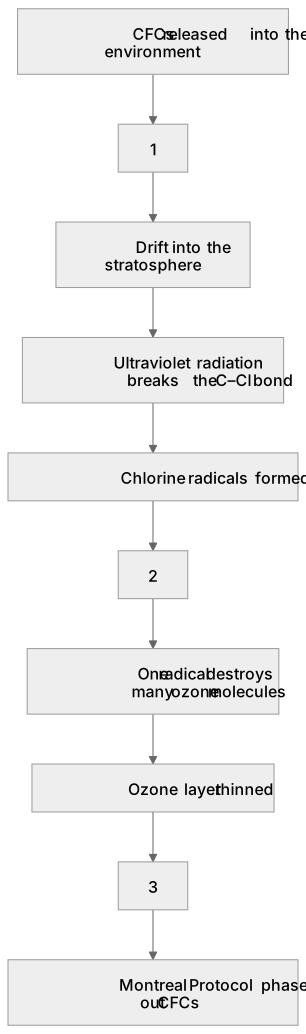
1Box 1
2Box 2
3Box 3
There is more to this lesson
The full lesson goes on to check your understanding and help you earn the marks. Create a free account to carry on, with your progress saved.
A week of Premium from your first lesson · Then the free plan continues · No card, no charge
Test your understanding of Haloalkanes: Environmental concerns from use of organohalogen compounds
Active recall beats re-reading. Take an instant quiz now to test what you’ve learned and lock it into long-term memory.
A week of Premium from your first lesson · Then the free plan continues · No card, no charge