OCR · A-Level · Chemistry
Course version: H432 · Version from Sept 2017
How far?: (a) use of the terms mole fraction and partial pressure
Mole fraction and partial pressure describe the composition of a gaseous equilibrium mixture.
- Point 1 of 9
- 3 key terms
Study notes
From the teaching notes for this specification point.
The idea
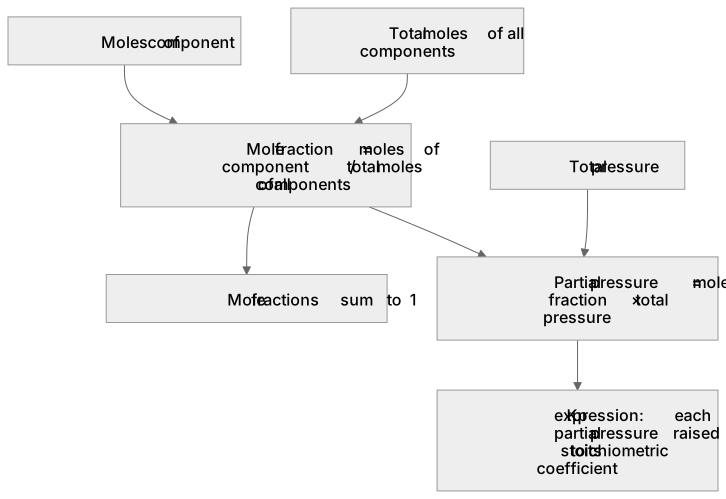
Mole fraction and partial pressure describe the composition of a gaseous equilibrium mixture. The mole fraction of a component is the number of moles of that component divided by the total number of moles of all components present; the fractions in a mixture sum to 1. Partial pressure is the pressure a gas would exert if it alone occupied the container, and for an ideal gas it equals its mole fraction multiplied by the total pressure: p(A) = x(A) × p(total). For the equilibrium aA(g) + bB(g) ⇌ cC(g) + dD(g), the equilibrium constant Kp is written using partial pressures, each raised to its stoichiometric coefficient. Worked example: a mixture contains 2 mol of A and 6 mol of B, total pressure 200 kPa; x(A) = 2/8 = 0.25, so p(A) = 0.25 × 200 kPa = 50 kPa, and p(B) = 0.75 × 200 kPa = 150 kPa.
What earns the marks
- Defines mole fraction as the number of moles of a component divided by the total number of moles of all components in the mixture.
- States that the mole fractions of all components in a mixture add up to 1.
- Defines partial pressure as the pressure a gas would exert if it alone occupied the container, equal to its mole fraction times the total pressure.
- Calculates a partial pressure by multiplying the mole fraction by the total pressure, for example 0.25 × 200 kPa = 50 kPa.
- Applies partial pressures in the Kp expression, raising each to its stoichiometric coefficient from the balanced equation.
Common mistakes and how to put them right
Divides by the number of components rather than by the total number of moles.
Put it right: Divide the moles of the component by the total moles of all components.
Treats partial pressure as a fixed fraction of 100 kPa regardless of the stated total pressure.
Put it right: Multiply the mole fraction by the actual total pressure given.
Omits the stoichiometric powers when writing Kp.
Put it right: Raise each partial pressure to the coefficient shown in the balanced equation.
Exam tips
- Check that your mole fractions sum to 1 before using them, which catches arithmetic slips early.
- Keep units consistent, converting all pressures to the same unit such as kPa before substituting into Kp.
- Write the Kp expression from the balanced equation first, then substitute partial pressures, so powers are not forgotten.
Try the lesson
The start of the How far?: (a) use of the terms mole fraction and partial pressure lesson, made from teaching notes for this specification point.
Listen
Mole fraction and partial pressure describe the composition of a gaseous equilibrium mixture. The mole fraction of a component is the number of moles of that component divided by the total number of moles of all components present; the fractions in a mixture sum to 1. Partial pressure is the pressure a gas would exert if it alone occupied the container, and for an ideal gas it equals its mole fraction multiplied by the total pressure: p(A) = x(A) × p(total). For the equilibrium aA(g) + bB(g) ⇌ cC(g) + dD(g), the equilibrium constant Kp is written using partial pressures, each raised to its stoichiometric coefficient. Worked example: a mixture contains 2 mol of A and 6 mol of B, total pressure 200 kPa; x(A) = 2/8 = 0.25, so p(A) = 0.25 × 200 kPa = 50 kPa, and p(B) = 0.75 × 200 kPa = 150 kPa. A strong answer earns marks for these points. Defines mole fraction as the number of moles of a component divided by the total number of moles of all components in the mixture. States that the mole fractions of all components in a mixture add up to 1. Defines partial pressure as the pressure a gas would exert if it alone occupied the container, equal to its mole fraction times the total pressure. Calculates a partial pressure by multiplying the mole fraction by the total pressure, for example 0.25 × 200 kPa = 50 kPa. Exam tip: Check that your mole fractions sum to 1 before using them, which catches arithmetic slips early.
See it
Key words
Say what each word means before you turn the card.
Mole fraction
Try answering aloud or in your head before turning the card.
Partial pressure
Try answering aloud or in your head before turning the card.
Kp
Try answering aloud or in your head before turning the card.
See every definition
- Mole fraction
- The number of moles of a component divided by the total number of moles of all components present, with the fractions in a mixture summing to 1.
- Partial pressure
- The pressure a gas would exert if it alone occupied the container, equal to its mole fraction multiplied by the total pressure.
- Kp
- The equilibrium constant written using partial pressures, each raised to its stoichiometric coefficient from the balanced equation.
Label the diagram
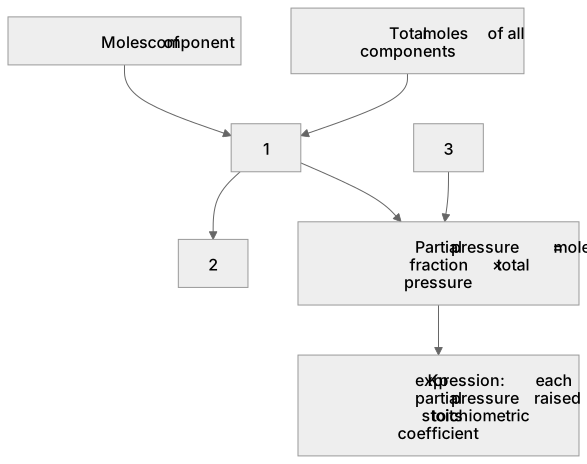
Some boxes have lost their names. Pick the right name for each number.
1Box 1
2Box 2
3Box 3
There is more to this lesson
The full lesson goes on to check your understanding and help you earn the marks. Create a free account to carry on, with your progress saved.
A week of Premium from your first lesson · Then the free plan continues · No card, no charge
Test your understanding of How far?: (a) use of the terms mole fraction and partial pressure
Active recall beats re-reading. Take an instant quiz now to test what you’ve learned and lock it into long-term memory.
A week of Premium from your first lesson · Then the free plan continues · No card, no charge