OCR · A-Level · Chemistry
Course version: H432 · Version from Sept 2017
(f) (i) the qualitative effect on equilibrium constants of changing…
Full specification wording
How far?: (f) (i) the qualitative effect on equilibrium constants of changing temperature for exothermic and endothermic reactions
This criterion concerns how temperature changes affect the value of an equilibrium constant, treated qualitatively rather than numerically.
- Point 6 of 9
- 3 key terms
Study notes
From the teaching notes for this specification point.
The idea
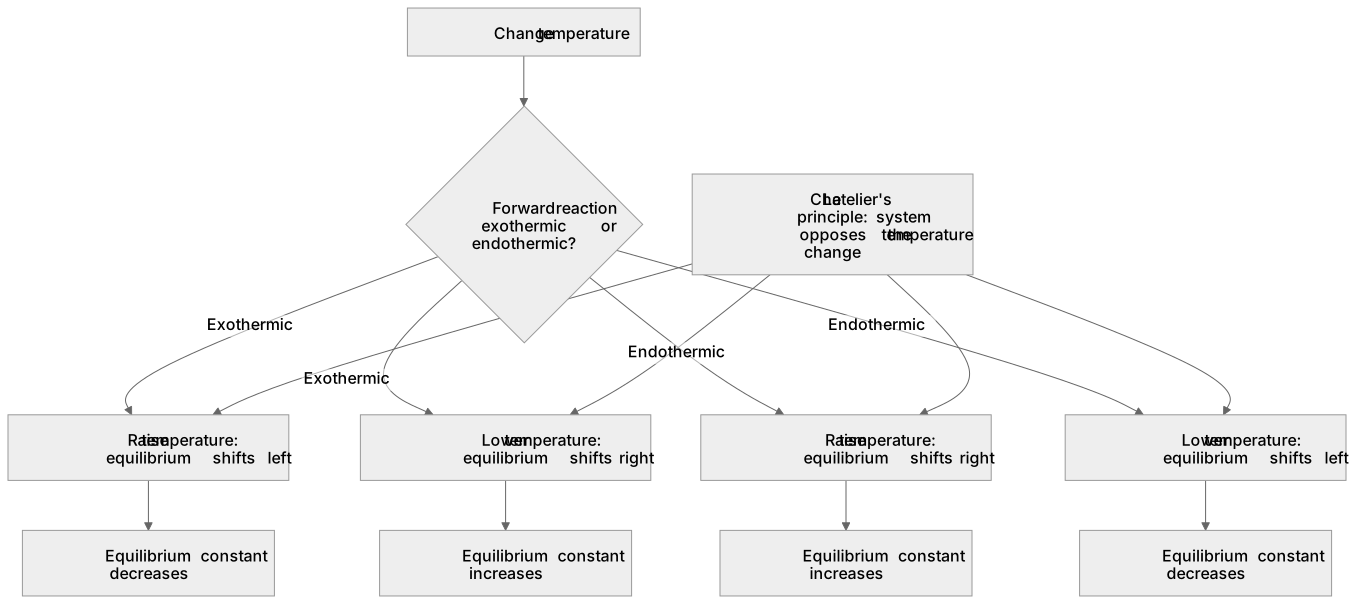
This criterion concerns how temperature changes affect the value of an equilibrium constant, treated qualitatively rather than numerically. For an exothermic forward reaction, raising the temperature shifts the position of equilibrium to the left, so the equilibrium constant decreases; lowering the temperature increases it. For an endothermic forward reaction, raising the temperature shifts equilibrium to the right, so the equilibrium constant increases; lowering the temperature decreases it. The reasoning links to Le Chatelier's principle: the system opposes the temperature change by favouring the direction that absorbs or releases heat. Note that a catalyst changes the rate of attainment but does not change the value of the equilibrium constant, and pressure changes do not alter K for a given reaction at constant temperature.
What earns the marks
- States that raising the temperature decreases the equilibrium constant for an exothermic forward reaction.
- States that raising the temperature increases the equilibrium constant for an endothermic forward reaction.
- Explains the effect by linking the shift in equilibrium position to Le Chatelier's principle opposing the temperature change.
- Recognises that a catalyst does not change the value of the equilibrium constant.
Common mistakes and how to put them right
Claims that raising temperature always increases the equilibrium constant.
Put it right: Distinguish exothermic from endothermic forward reactions.
States that a catalyst increases the equilibrium constant.
Put it right: Recognise that a catalyst only speeds attainment of equilibrium.
Confuses the effect of pressure with the effect of temperature on K.
Put it right: Note that K depends on temperature for a given reaction.
Assumes the equilibrium constant changes when concentration changes.
Put it right: Recognise that K is constant at a fixed temperature.
Exam tips
- Identify whether the forward reaction is exothermic or endothermic before predicting the effect on K.
- Link each prediction explicitly to the direction of the equilibrium shift.
- Remember that only temperature changes the value of the equilibrium constant for a given reaction.
Try the lesson
The start of the How far?: (f) (i) the qualitative effect on equilibrium constants of changing temperature for exothermic and endothermic reactions lesson, made from teaching notes for this specification point.
Listen
This criterion concerns how temperature changes affect the value of an equilibrium constant, treated qualitatively rather than numerically. For an exothermic forward reaction, raising the temperature shifts the position of equilibrium to the left, so the equilibrium constant decreases; lowering the temperature increases it. For an endothermic forward reaction, raising the temperature shifts equilibrium to the right, so the equilibrium constant increases; lowering the temperature decreases it. The reasoning links to Le Chatelier's principle: the system opposes the temperature change by favouring the direction that absorbs or releases heat. Note that a catalyst changes the rate of attainment but does not change the value of the equilibrium constant, and pressure changes do not alter K for a given reaction at constant temperature. A strong answer earns marks for these points. States that raising the temperature decreases the equilibrium constant for an exothermic forward reaction. States that raising the temperature increases the equilibrium constant for an endothermic forward reaction. Explains the effect by linking the shift in equilibrium position to Le Chatelier's principle opposing the temperature change. Recognises that a catalyst does not change the value of the equilibrium constant. Exam tip: Identify whether the forward reaction is exothermic or endothermic before predicting the effect on K.
See it
Key words
Say what each word means before you turn the card.
Effect of temperature on equilibrium position
Try answering aloud or in your head before turning the card.
Exothermic and endothermic forward reactions
Try answering aloud or in your head before turning the card.
Le Chatelier's principle
Try answering aloud or in your head before turning the card.
See every definition
- Effect of temperature on equilibrium position
- Raising the temperature shifts the position of equilibrium to the left for an exothermic forward reaction and to the right for an endothermic forward reaction.
- Exothermic and endothermic forward reactions
- For an exothermic forward reaction, raising the temperature decreases the equilibrium constant, while for an endothermic forward reaction, raising the temperature increases it.
- Le Chatelier's principle
- The system opposes the temperature change by favouring the direction that absorbs or releases heat.
There is more to this lesson
The full lesson goes on to check your understanding and help you earn the marks. Create a free account to carry on, with your progress saved.
A week of Premium from your first lesson · Then the free plan continues · No card, no charge
Test your understanding of How far?: (f) (i) the qualitative effect on equilibrium constants of changing temperature for exothermic and endothermic reactions
Active recall beats re-reading. Take an instant quiz now to test what you’ve learned and lock it into long-term memory.
A week of Premium from your first lesson · Then the free plan continues · No card, no charge