OCR · A-Level · Chemistry
Course version: H432 · Version from Sept 2017
(h) application of the above principles in 5.1.2 How far? for Kc, Kp to…
Full specification wording
How far?: (h) application of the above principles in 5.1.2 How far? for Kc, Kp to other equilibrium constants, where appropriate (see also 5.1.3 c etc.).
This criterion asks you to transfer the equilibrium-constant principles met for Kc and Kp to other equilibrium constants where appropriate.
- Point 9 of 9
- 4 key terms
Study notes
From the teaching notes for this specification point.
The idea
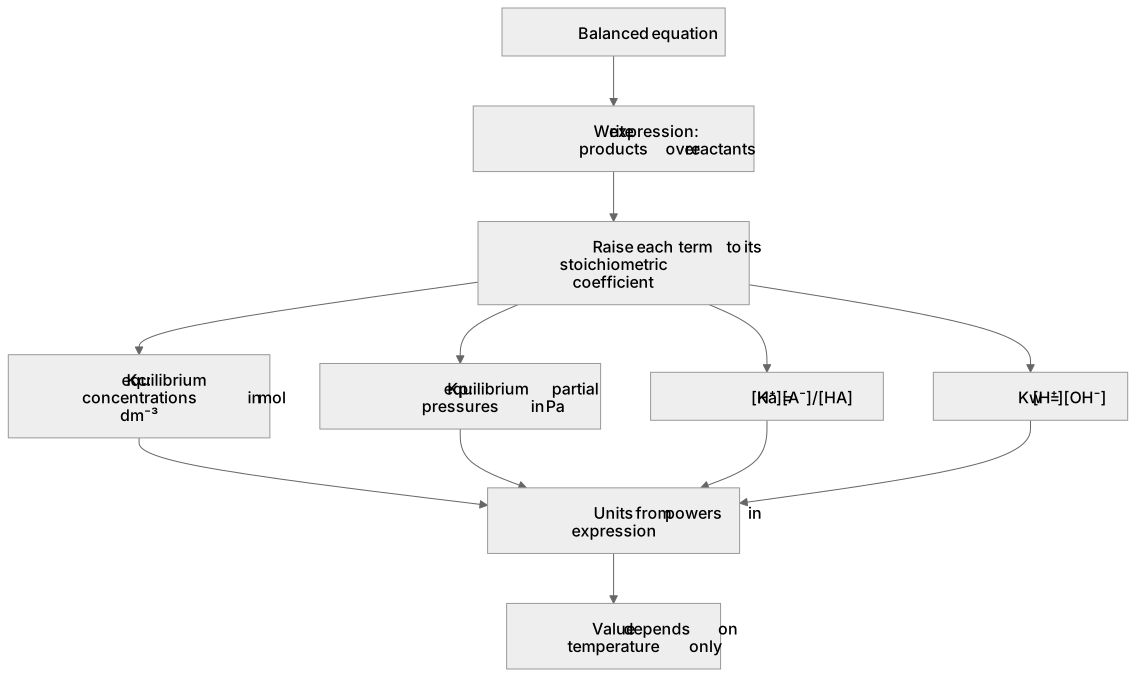
This criterion asks you to transfer the equilibrium-constant principles met for Kc and Kp to other equilibrium constants where appropriate. The core principles are: write the expression from the balanced equation, raise each concentration or partial pressure to its stoichiometric coefficient, and place products over reactants. For Kc you use equilibrium concentrations in mol dm⁻³; for Kp you use equilibrium partial pressures in Pa. The same logic extends to constants such as Ka for weak acids, where Ka = [H⁺][A⁻]/[HA], and to Kw = [H⁺][OH⁻]. Recognise that a constant's form follows its defining equation, that its value depends on temperature only, and that units depend on the powers in the expression.
What earns the marks
- Writes the equilibrium expression with product terms in the numerator and reactant terms in the denominator, each raised to its stoichiometric coefficient.
- Uses equilibrium concentrations in mol dm⁻³ for Kc and equilibrium partial pressures in Pa for Kp, keeping the two conventions distinct.
- Transfers the same construction to Ka for a weak acid, writing Ka = [H⁺][A⁻]/[HA] from the dissociation equation.
- States that the numerical value of an equilibrium constant changes with temperature and is unaffected by concentration or pressure changes at constant temperature.
- Determines the units of a constant by cancelling the concentration or pressure units raised to the powers in the expression.
Common mistakes and how to put them right
Places reactants over products in the expression.
Put it right: Write products in the numerator and reactants in the denominator.
Uses initial concentrations instead of equilibrium concentrations in a Kc expression.
Put it right: Substitute the equilibrium values.
Omits the power on a species whose coefficient is greater than one.
Put it right: Raise each term to its stoichiometric coefficient.
Claims the value of Kc changes when concentration is altered at constant temperature.
Put it right: State that only temperature changes the value.
Exam tips
- Write the balanced equation first, then build the expression term by term from the coefficients.
- Check units by cancelling powers of mol dm⁻³ or Pa before selecting an answer.
- For Ka and Kw questions, derive the expression from the defining dissociation or self-ionisation equation rather than memorising blindly.
- Eliminate options that change a constant's value with concentration or pressure at fixed temperature.
Try the lesson
The start of the How far?: (h) application of the above principles in 5.1.2 How far? for Kc, Kp to other equilibrium constants, where appropriate (see also 5.1.3 c etc.). lesson, made from teaching notes for this specification point.
Listen
This criterion asks you to transfer the equilibrium-constant principles met for Kc and Kp to other equilibrium constants where appropriate. The core principles are: write the expression from the balanced equation, raise each concentration or partial pressure to its stoichiometric coefficient, and place products over reactants. For Kc you use equilibrium concentrations in mol dm⁻³; for Kp you use equilibrium partial pressures in Pa. The same logic extends to constants such as Ka for weak acids, where Ka = [H⁺][A⁻]/[HA], and to Kw = [H⁺][OH⁻]. Recognise that a constant's form follows its defining equation, that its value depends on temperature only, and that units depend on the powers in the expression. A strong answer earns marks for these points. Writes the equilibrium expression with product terms in the numerator and reactant terms in the denominator, each raised to its stoichiometric coefficient. Uses equilibrium concentrations in mol dm⁻³ for Kc and equilibrium partial pressures in Pa for Kp, keeping the two conventions distinct. Transfers the same construction to Ka for a weak acid, writing Ka = [H⁺][A⁻]/[HA] from the dissociation equation. States that the numerical value of an equilibrium constant changes with temperature and is unaffected by concentration or pressure changes at constant temperature. Exam tip: Write the balanced equation first, then build the expression term by term from the coefficients.
See it
Key words
Say what each word means before you turn the card.
Equilibrium expressions from balanced equations
Try answering aloud or in your head before turning the card.
Kc and Kp conventions
Try answering aloud or in your head before turning the card.
Extension to Ka and Kw
Try answering aloud or in your head before turning the card.
Temperature dependence of equilibrium constants
Try answering aloud or in your head before turning the card.
See every definition
- Equilibrium expressions from balanced equations
- Written with product terms in the numerator and reactant terms in the denominator, each raised to its stoichiometric coefficient.
- Kc and Kp conventions
- Kc uses equilibrium concentrations in mol dm⁻³, while Kp uses equilibrium partial pressures in Pa, keeping the two conventions distinct.
- Extension to Ka and Kw
- The same construction transfers to Ka for a weak acid, written as [H⁺][A⁻]/[HA] from the dissociation equation, and to Kw = [H⁺][OH⁻].
- Temperature dependence of equilibrium constants
- The numerical value of an equilibrium constant changes with temperature and is unaffected by concentration or pressure changes at constant temperature.
Label the diagram
Some boxes have lost their names. Pick the right name for each number.
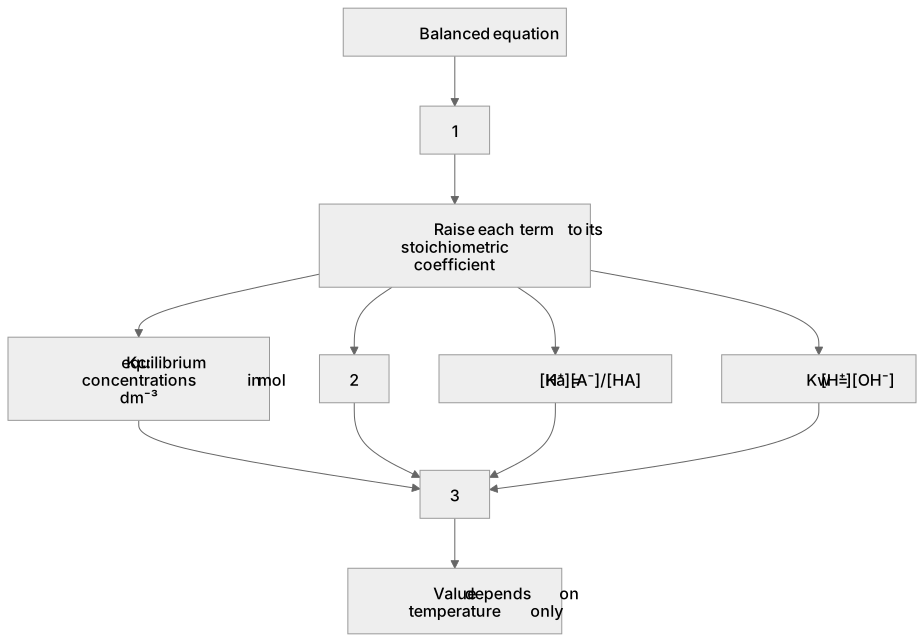
1Box 1
2Box 2
3Box 3
There is more to this lesson
The full lesson goes on to check your understanding and help you earn the marks. Create a free account to carry on, with your progress saved.
A week of Premium from your first lesson · Then the free plan continues · No card, no charge
Test your understanding of How far?: (h) application of the above principles in 5.1.2 How far? for Kc, Kp to other equilibrium constants, where appropriate (see also 5.1.3 c etc.).
Active recall beats re-reading. Take an instant quiz now to test what you’ve learned and lock it into long-term memory.
A week of Premium from your first lesson · Then the free plan continues · No card, no charge