OCR · A-Level · Chemistry
Course version: H432 · Version from Sept 2017
(i) deduction of the order (0, 1 or 2) with respect to a reactant from the…
Full specification wording
How fast?: (i) deduction of the order (0, 1 or 2) with respect to a reactant from the shape of the graph
Order with respect to a reactant is deduced from how the initial rate responds to changes in that reactant's concentration, with all other concentrations kept constant.
- Point 10 of 18
- 3 key terms
Study notes
From the teaching notes for this specification point.
The idea
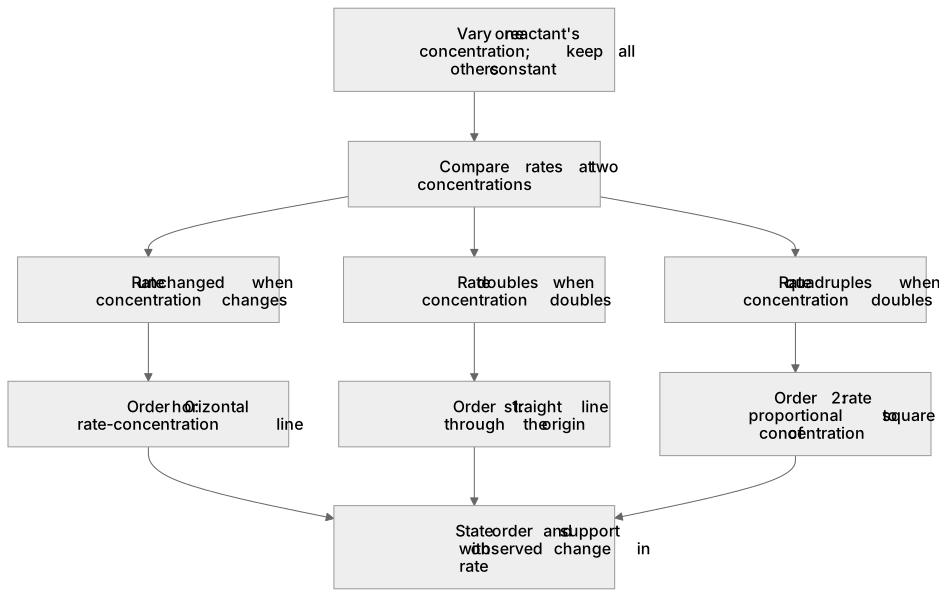
Order with respect to a reactant is deduced from how the initial rate responds to changes in that reactant's concentration, with all other concentrations kept constant. Zero order gives a horizontal rate–concentration line because rate is unaffected by concentration. First order gives a straight line through the origin because rate is directly proportional to concentration, so doubling concentration doubles rate. Second order gives a curve because rate is proportional to the square of concentration, so doubling concentration quadruples rate. To deduce order, compare rates at two concentrations: if rate is unchanged the order is 0, if rate doubles when concentration doubles the order is 1, and if rate quadruples the order is 2. State the order and support it with the observed change in rate.
What earns the marks
- Deduces zero order when the rate stays constant as the reactant concentration changes.
- Deduces first order when the rate is directly proportional to concentration, for example doubling when concentration doubles.
- Deduces second order when the rate is proportional to the square of concentration, for example quadrupling when concentration doubles.
- Supports the deduced order by comparing rates at two or more concentrations of the reactant.
- Keeps the concentrations of all other reactants constant so the deduction applies to the chosen reactant.
Common mistakes and how to put them right
Assigns second order whenever the graph curves.
Put it right: Check that rate rises with the square of concentration before deciding.
Ignores the need to hold other concentrations constant.
Put it right: Vary only one reactant so the order is attributed correctly.
Confuses a straight line not through the origin with first order.
Put it right: First order requires proportionality through the origin.
Exam tips
- Quote two rate–concentration pairs and show the ratio to justify the order.
- State the order explicitly as 0, 1 or 2 and follow it with the evidence from the graph.
- Check the doubling test: unchanged means 0, doubled means 1, quadrupled means 2.
Try the lesson
The start of the How fast?: (i) deduction of the order (0, 1 or 2) with respect to a reactant from the shape of the graph lesson, made from teaching notes for this specification point.
Listen
Order with respect to a reactant is deduced from how the initial rate responds to changes in that reactant's concentration, with all other concentrations kept constant. Zero order gives a horizontal rate–concentration line because rate is unaffected by concentration. First order gives a straight line through the origin because rate is directly proportional to concentration, so doubling concentration doubles rate. Second order gives a curve because rate is proportional to the square of concentration, so doubling concentration quadruples rate. To deduce order, compare rates at two concentrations: if rate is unchanged the order is 0, if rate doubles when concentration doubles the order is 1, and if rate quadruples the order is 2. State the order and support it with the observed change in rate. A strong answer earns marks for these points. Deduces zero order when the rate stays constant as the reactant concentration changes. Deduces first order when the rate is directly proportional to concentration, for example doubling when concentration doubles. Deduces second order when the rate is proportional to the square of concentration, for example quadrupling when concentration doubles. Supports the deduced order by comparing rates at two or more concentrations of the reactant. Exam tip: Quote two rate–concentration pairs and show the ratio to justify the order.
See it
Key words
Say what each word means before you turn the card.
Order of reaction
Try answering aloud or in your head before turning the card.
Rate–concentration relationship
Try answering aloud or in your head before turning the card.
Experimental control
Try answering aloud or in your head before turning the card.
See every definition
- Order of reaction
- A value of 0, 1 or 2 with respect to a reactant, deduced from the shape of the graph of rate against concentration.
- Rate–concentration relationship
- How the initial rate responds to changes in a reactant's concentration when all other concentrations are kept constant.
- Experimental control
- Keeping the concentrations of all other reactants constant so the deduction applies to the chosen reactant.
Label the diagram
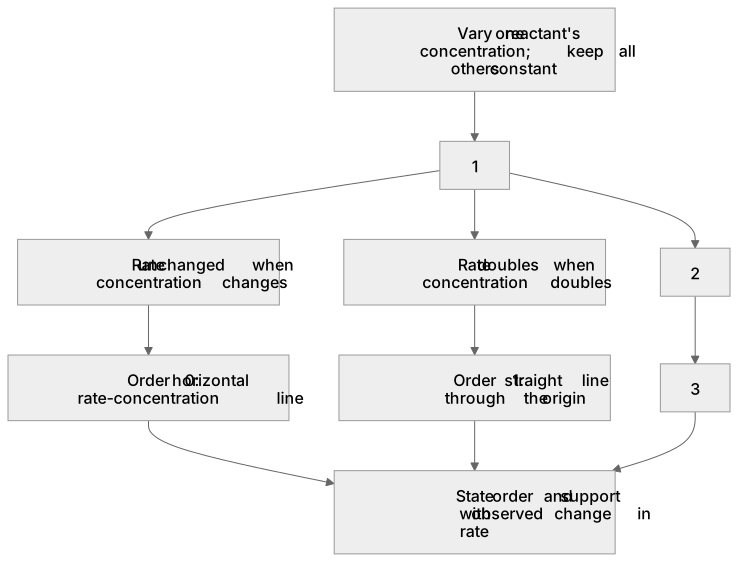
Some boxes have lost their names. Pick the right name for each number.
1Box 1
2Box 2
3Box 3
There is more to this lesson
The full lesson goes on to check your understanding and help you earn the marks. Create a free account to carry on, with your progress saved.
A week of Premium from your first lesson · Then the free plan continues · No card, no charge
Test your understanding of How fast?: (i) deduction of the order (0, 1 or 2) with respect to a reactant from the shape of the graph
Active recall beats re-reading. Take an instant quiz now to test what you’ve learned and lock it into long-term memory.
A week of Premium from your first lesson · Then the free plan continues · No card, no charge