OCR · A-Level · Chemistry
Course version: H432 · Version from Sept 2017
(ii) a rate equation from orders of the form: rate = k[A]ᵐ[B]ⁿ, where m…
Full specification wording
How fast?: (ii) a rate equation from orders of the form: rate = k[A]ᵐ[B]ⁿ, where m and n are 0, 1 or 2
A rate equation links the rate of reaction to the concentrations of reactants raised to their orders.
- Point 3 of 18
- 4 key terms
Study notes
From the teaching notes for this specification point.
The idea
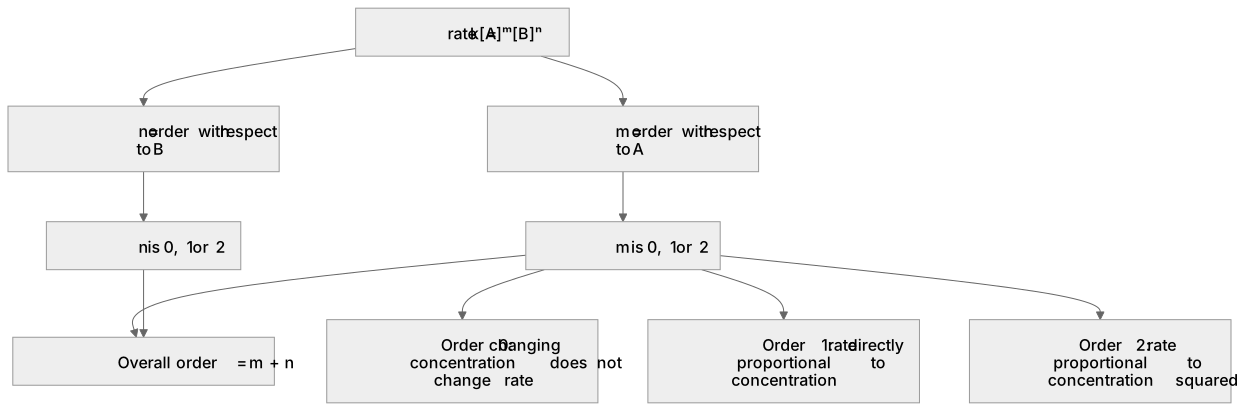
A rate equation links the rate of reaction to the concentrations of reactants raised to their orders. For rate = k[A]ᵐ[B]ⁿ, the symbol k is the rate constant, [A] and [B] are concentrations in mol dm⁻³, and the superscripts m and n are the orders with respect to A and B. Each order is 0, 1 or 2 and is found by experiment, not from the balanced equation. An order of 0 means concentration has no effect on rate; order 1 means rate is directly proportional to concentration; order 2 means rate is proportional to concentration squared. The overall order is m + n.
For example: If doubling [A] doubles the rate, m = 1; if doubling [B] leaves the rate unchanged, n = 0.
What earns the marks
- Identifies m and n as the orders with respect to A and B, each taking a value of 0, 1 or 2.
- States that the overall order of reaction equals the sum m + n.
- Explains that an order of 0 means changing that concentration does not change the rate.
- Explains that an order of 1 means the rate is directly proportional to that concentration.
- Explains that an order of 2 means the rate is proportional to the square of that concentration.
- Recognises that orders are determined by experiment and cannot be deduced from the stoichiometric equation.
Common mistakes and how to put them right
Reads m and n from the coefficients of the balanced equation.
Put it right: Determine the orders experimentally instead.
Treats an order of 0 as meaning the substance does not appear in the rate equation.
Put it right: Keep the term but recognise its concentration has no effect on rate.
Adds the orders incorrectly when asked for overall order.
Put it right: Sum m and n to give the overall order.
Assumes doubling concentration always doubles rate.
Put it right: Check the order, since order 2 quadruples the rate and order 0 leaves it unchanged.
Exam tips
- Write the general form rate = k[A]ᵐ[B]ⁿ before substituting any values so the meaning of each symbol is clear.
- Use the phrase 'with respect to' when naming an order, for example 'order 1 with respect to A'.
- Check whether the question asks for the order with respect to one reactant or the overall order before answering.
Try the lesson
The start of the How fast?: (ii) a rate equation from orders of the form: rate = k[A]ᵐ[B]ⁿ, where m and n are 0, 1 or 2 lesson, made from teaching notes for this specification point.
Listen
A rate equation links the rate of reaction to the concentrations of reactants raised to their orders. For rate = k[A]ᵐ[B]ⁿ, the symbol k is the rate constant, [A] and [B] are concentrations in mol dm⁻³, and the superscripts m and n are the orders with respect to A and B. Each order is 0, 1 or 2 and is found by experiment, not from the balanced equation. An order of 0 means concentration has no effect on rate; order 1 means rate is directly proportional to concentration; order 2 means rate is proportional to concentration squared. The overall order is m + n. For example, if doubling [A] doubles the rate, m = 1; if doubling [B] leaves the rate unchanged, n = 0. A strong answer earns marks for these points. Identifies m and n as the orders with respect to A and B, each taking a value of 0, 1 or 2. States that the overall order of reaction equals the sum m + n. Explains that an order of 0 means changing that concentration does not change the rate. Explains that an order of 1 means the rate is directly proportional to that concentration. Exam tip: Write the general form rate = k[A]ᵐ[B]ⁿ before substituting any values so the meaning of each symbol is clear.
See it
Key words
Say what each word means before you turn the card.
Rate equation
Try answering aloud or in your head before turning the card.
Order
Try answering aloud or in your head before turning the card.
Overall order
Try answering aloud or in your head before turning the card.
Rate constant
Try answering aloud or in your head before turning the card.
See every definition
- Rate equation
- An equation of the form rate = k[A]ᵐ[B]ⁿ, linking the rate of reaction to the concentrations of reactants raised to their orders.
- Order
- The superscript m or n with respect to a reactant, taking a value of 0, 1 or 2 and found by experiment, not from the balanced equation.
- Overall order
- The sum m + n of the individual orders in the rate equation.
- Rate constant
- The symbol k in the rate equation rate = k[A]ᵐ[B]ⁿ.
Label the diagram
Some boxes have lost their names. Pick the right name for each number.
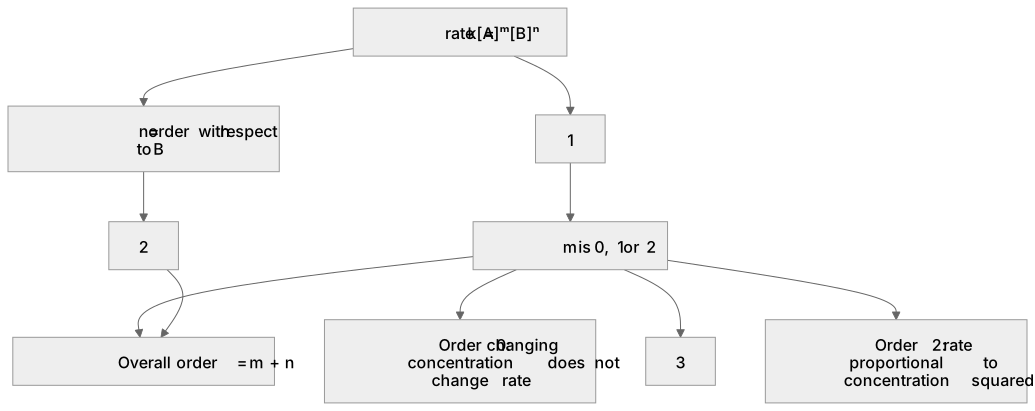
1Box 1
2Box 2
3Box 3
There is more to this lesson
The full lesson goes on to check your understanding and help you earn the marks. Create a free account to carry on, with your progress saved.
A week of Premium from your first lesson · Then the free plan continues · No card, no charge
Test your understanding of How fast?: (ii) a rate equation from orders of the form: rate = k[A]ᵐ[B]ⁿ, where m and n are 0, 1 or 2
Active recall beats re-reading. Take an instant quiz now to test what you’ve learned and lock it into long-term memory.
A week of Premium from your first lesson · Then the free plan continues · No card, no charge