OCR · A-Level · Chemistry
Course version: H432 · Version from Sept 2017
How fast?: Rate-determining step
A multi-step reaction proceeds through a sequence of steps, and the rate-determining step is the slowest step in that sequence.
- Point 13 of 18
- 3 key terms
Study notes
From the teaching notes for this specification point.
The idea
A multi-step reaction proceeds through a sequence of steps, and the rate-determining step is the slowest step in that sequence. Because it is the slowest, it limits the overall rate, so the experimental rate equation reflects the species involved up to and including this step. Species that appear in the rate equation must be involved in the rate-determining step or in a fast equilibrium before it; a species that only reacts in a later fast step does not appear in the rate equation. For example, if the rate equation is rate = k[A][B], then A and B (or species in equilibrium with them) take part in or before the slow step. A proposed mechanism is consistent with the rate equation only if this condition holds.
What earns the marks
- Defines the rate-determining step as the slowest step in a multi-step reaction mechanism.
- Explains that the rate-determining step limits the overall rate of reaction.
- States that species in the experimental rate equation are involved in the rate-determining step or in a fast equilibrium before it.
- Uses a given rate equation to judge whether a proposed mechanism is consistent with it.
- Recognises that a species reacting only in a later fast step does not appear in the rate equation.
Common mistakes and how to put them right
Assumes every species in the rate equation must collide directly in the slow step.
Put it right: Allow species formed in a fast pre-equilibrium before the slow step.
Treats the fastest step as rate-determining.
Put it right: Identify the slowest step instead.
Ignores the rate equation when judging a mechanism.
Put it right: Compare the species in the rate equation with those in or before the slow step.
Assumes a species that appears only in a later fast step affects the rate.
Put it right: It does not appear in the rate equation.
Exam tips
- Identify the slowest step first, then check which species are involved in it and in any preceding equilibrium.
- Compare the species in the experimental rate equation with those in the proposed mechanism to test consistency.
- Explain the reasoning in words: the slow step limits the rate, so its species control the rate equation.
Try the lesson
The start of the How fast?: Rate-determining step lesson, made from teaching notes for this specification point.
Listen
A multi-step reaction proceeds through a sequence of steps, and the rate-determining step is the slowest step in that sequence. Because it is the slowest, it limits the overall rate, so the experimental rate equation reflects the species involved up to and including this step. Species that appear in the rate equation must be involved in the rate-determining step or in a fast equilibrium before it; a species that only reacts in a later fast step does not appear in the rate equation. For example, if the rate equation is rate = k[A][B], then A and B (or species in equilibrium with them) take part in or before the slow step. A proposed mechanism is consistent with the rate equation only if this condition holds. A strong answer earns marks for these points. Defines the rate-determining step as the slowest step in a multi-step reaction mechanism. Explains that the rate-determining step limits the overall rate of reaction. States that species in the experimental rate equation are involved in the rate-determining step or in a fast equilibrium before it. Uses a given rate equation to judge whether a proposed mechanism is consistent with it. Exam tip: Identify the slowest step first, then check which species are involved in it and in any preceding equilibrium.
See it
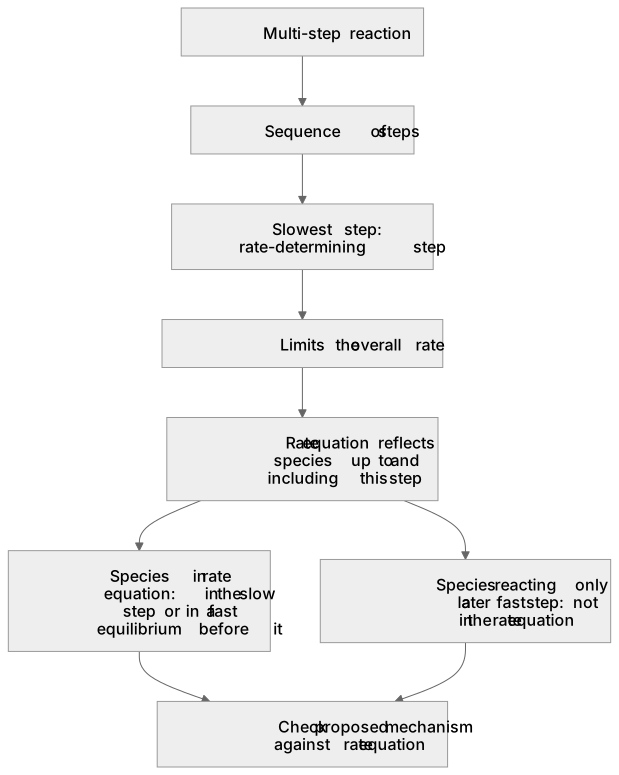
Key words
Say what each word means before you turn the card.
Rate-determining step
Try answering aloud or in your head before turning the card.
Multi-step reactions
Try answering aloud or in your head before turning the card.
Experimental rate equations
Try answering aloud or in your head before turning the card.
See every definition
- Rate-determining step
- The slowest step in a multi-step reaction mechanism, which limits the overall rate of reaction.
- Multi-step reactions
- Reactions that proceed through a sequence of steps, one of which is the slowest and limits the overall rate.
- Experimental rate equations
- Reflect the species involved up to and including the rate-determining step, or in a fast equilibrium before it.
Label the diagram
Some boxes have lost their names. Pick the right name for each number.
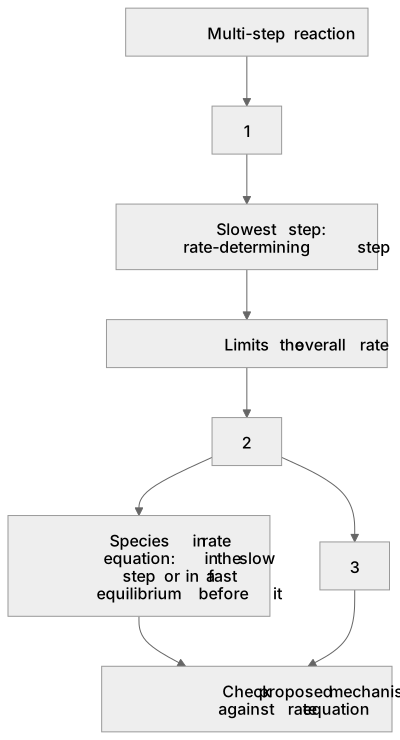
1Box 1
2Box 2
3Box 3
There is more to this lesson
The full lesson goes on to check your understanding and help you earn the marks. Create a free account to carry on, with your progress saved.
A week of Premium from your first lesson · Then the free plan continues · No card, no charge
Test your understanding of How fast?: Rate-determining step
Active recall beats re-reading. Take an instant quiz now to test what you’ve learned and lock it into long-term memory.
A week of Premium from your first lesson · Then the free plan continues · No card, no charge