OCR · A-Level · Chemistry
Course version: H432 · Version from Sept 2017
Lattice enthalpy: (ii) related calculations
Related calculations use the Born–Haber cycle to find an unknown enthalpy term, most often lattice enthalpy, from the other steps.
- Point 4 of 9
- 4 key terms
Study notes
From the teaching notes for this specification point.
The idea
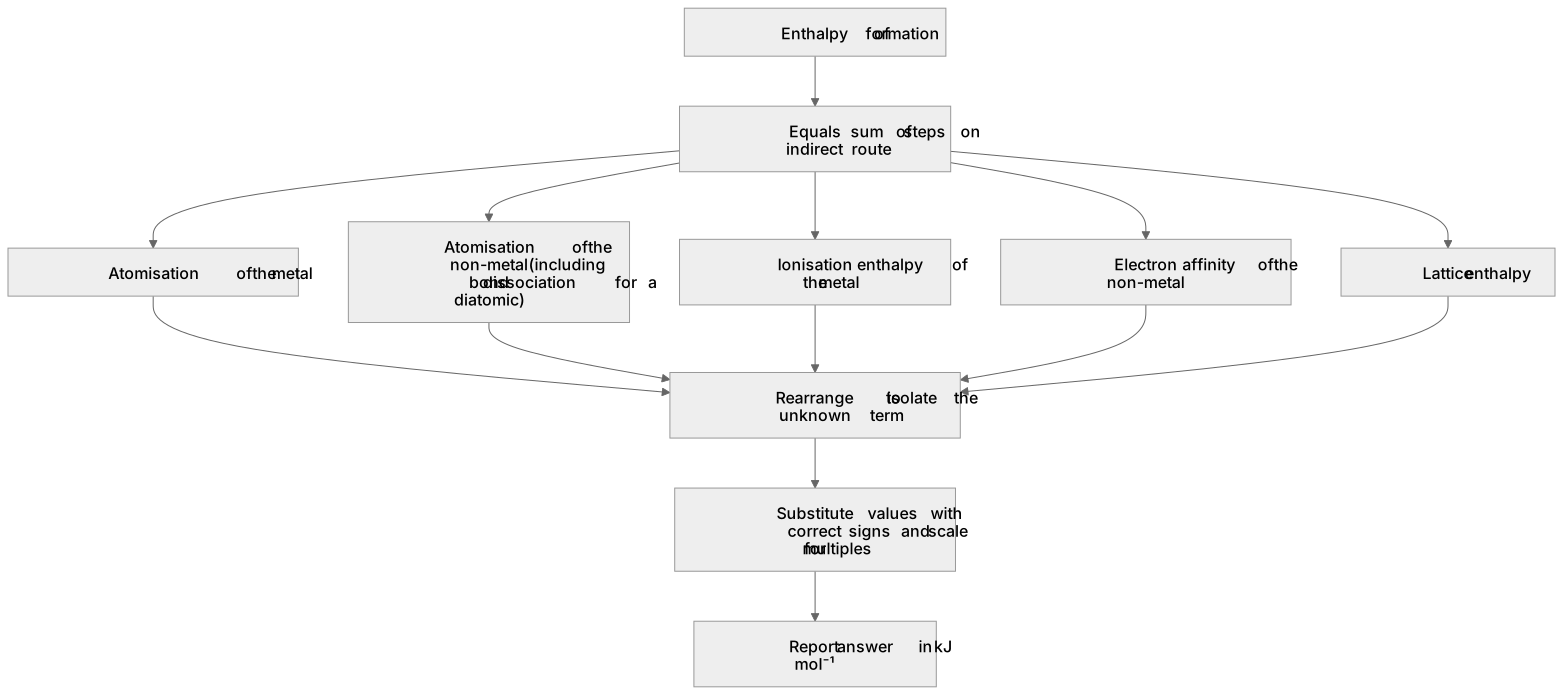
Related calculations use the Born–Haber cycle to find an unknown enthalpy term, most often lattice enthalpy, from the other steps. Set the enthalpy of formation equal to the sum of the steps on the indirect route: atomisation of the metal, atomisation of the non-metal (including bond dissociation for a diatomic), ionisation enthalpy of the metal, electron affinity of the non-metal and lattice enthalpy. Rearrange for the unknown and substitute values with correct signs. For example, for an MX compound the formation enthalpy equals the sum of these steps, so lattice enthalpy is found by subtracting the other terms. Watch for multiples when two ions form, and keep units consistent in kJ mol⁻¹. A multiple-choice item may test the sign, the rearrangement or the effect of a doubled formula.
What earns the marks
- Sets up the Hess's law relationship equating the enthalpy of formation to the sum of the individual steps in the cycle.
- Rearranges the relationship correctly to isolate the required unknown term before substituting numerical values.
- Substitutes values with the correct signs, treating lattice enthalpy and electron affinity as exothermic and ionisation and atomisation as endothermic.
- Scales terms correctly when the formula contains more than one of a given ion, for example doubling an ionisation or electron affinity term.
- Reports the answer in kJ mol⁻¹ with a sensible magnitude and sign consistent with the cycle.
Common mistakes and how to put them right
Adds all terms without regard to sign.
Put it right: Apply the correct sign to each endothermic and exothermic step before summing.
Forgets to scale a term when two ions of the same type form.
Put it right: Multiply the relevant ionisation or electron affinity by the number of ions.
Uses the wrong direction for lattice enthalpy.
Put it right: Keep it as the exothermic formation of solid from gaseous ions.
Mixes units between kJ and J.
Put it right: Convert all values to kJ mol⁻¹ before combining.
Exam tips
- Write the full cycle equation before substituting numbers to avoid a rearrangement error.
- Check the sign of the final answer against whether the process is expected to be exothermic or endothermic.
- Re-read the formula to confirm how many of each ion are involved before scaling any term.
Try the lesson
The start of the Lattice enthalpy: (ii) related calculations lesson, made from teaching notes for this specification point.
Listen
Related calculations use the Born–Haber cycle to find an unknown enthalpy term, most often lattice enthalpy, from the other steps. Set the enthalpy of formation equal to the sum of the steps on the indirect route: atomisation of the metal, atomisation of the non-metal (including bond dissociation for a diatomic), ionisation enthalpy of the metal, electron affinity of the non-metal and lattice enthalpy. Rearrange for the unknown and substitute values with correct signs. For example, for an MX compound the formation enthalpy equals the sum of these steps, so lattice enthalpy is found by subtracting the other terms. Watch for multiples when two ions form, and keep units consistent in kJ mol⁻¹. A multiple-choice item may test the sign, the rearrangement or the effect of a doubled formula. A strong answer earns marks for these points. Sets up the Hess's law relationship equating the enthalpy of formation to the sum of the individual steps in the cycle. Rearranges the relationship correctly to isolate the required unknown term before substituting numerical values. Substitutes values with the correct signs, treating lattice enthalpy and electron affinity as exothermic and ionisation and atomisation as endothermic. Scales terms correctly when the formula contains more than one of a given ion, for example doubling an ionisation or electron affinity term. Exam tip: Write the full cycle equation before substituting numbers to avoid a rearrangement error.
See it
Key words
Say what each word means before you turn the card.
Hess's law rearrangement
Try answering aloud or in your head before turning the card.
Sign conventions for enthalpy terms
Try answering aloud or in your head before turning the card.
Scaling for formula stoichiometry
Try answering aloud or in your head before turning the card.
Units and magnitude checks
Try answering aloud or in your head before turning the card.
See every definition
- Hess's law rearrangement
- Setting the enthalpy of formation equal to the sum of the steps on the indirect route, then rearranging for the unknown term before substituting values.
- Sign conventions for enthalpy terms
- Lattice enthalpy and electron affinity are treated as exothermic, while ionisation and atomisation are treated as endothermic, with the correct sign applied to each step before summing.
- Scaling for formula stoichiometry
- Terms are scaled correctly when the formula contains more than one of a given ion, for example doubling an ionisation or electron affinity term.
- Units and magnitude checks
- The answer is reported in kJ mol⁻¹ with a sensible magnitude and sign consistent with the cycle, keeping units consistent throughout.
Label the diagram
Some boxes have lost their names. Pick the right name for each number.
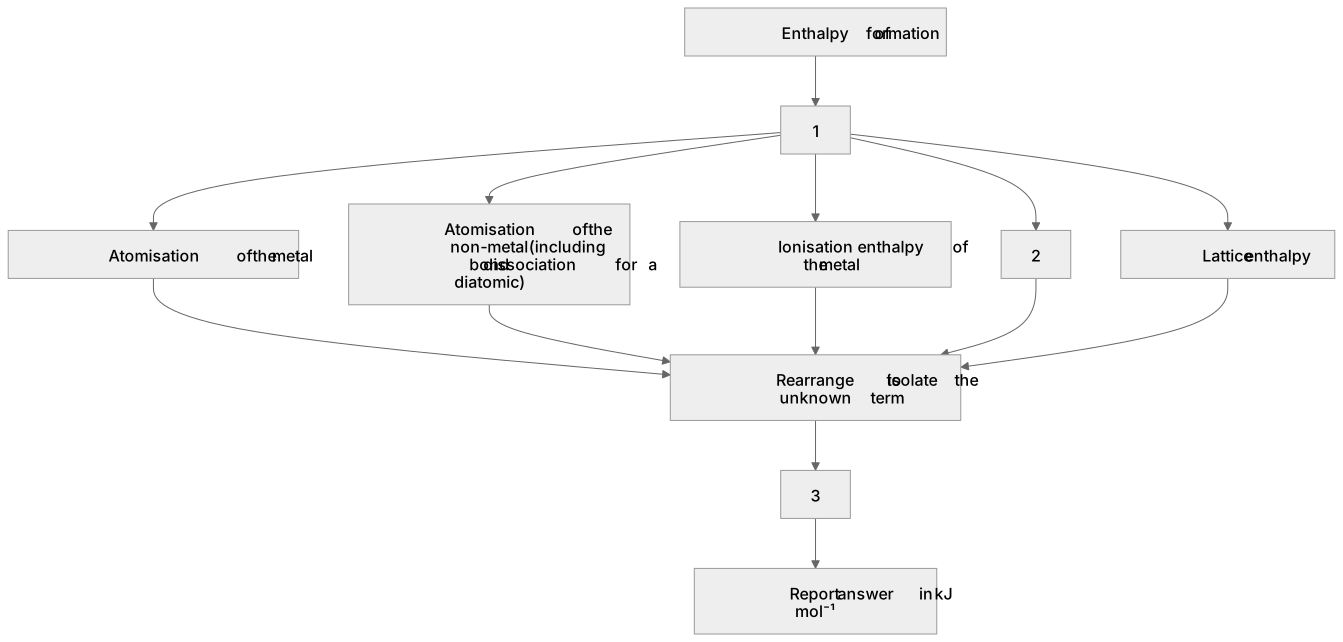
1Box 1
2Box 2
3Box 3
There is more to this lesson
The full lesson goes on to check your understanding and help you earn the marks. Create a free account to carry on, with your progress saved.
A week of Premium from your first lesson · Then the free plan continues · No card, no charge
Test your understanding of Lattice enthalpy: (ii) related calculations
Active recall beats re-reading. Take an instant quiz now to test what you’ve learned and lock it into long-term memory.
A week of Premium from your first lesson · Then the free plan continues · No card, no charge