OCR · A-Level · Chemistry
Course version: H432 · Version from Sept 2017
Periodicity: (i) by increasing atomic (proton) number
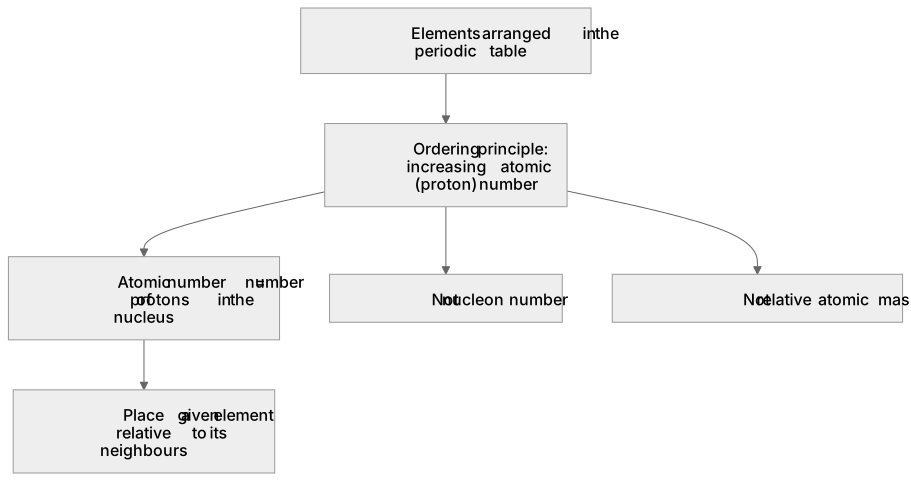
This sub-point states the ordering principle of the modern periodic table: elements are arranged by increasing atomic (proton) number, that is, the number of protons in the nucleus.
- Point 1 of 11
- 4 key terms
Study notes
From the teaching notes for this specification point.
The idea
This sub-point states the ordering principle of the modern periodic table: elements are arranged by increasing atomic (proton) number, that is, the number of protons in the nucleus. Atomic number is the same as proton number, so an element with 11 protons (sodium) comes after one with 10 (neon) and before one with 12 (magnesium). This replaced older orderings based on relative atomic mass, which placed some elements out of sequence. In a multiple-choice question you may be asked which quantity increases across the table, or to identify the correct ordering principle. Read each option carefully: proton number, nucleon number and relative atomic mass are different quantities, and only proton number gives the modern sequence.
What earns the marks
- States that elements are arranged in order of increasing atomic (proton) number.
- Identifies atomic number as the number of protons in the nucleus.
- Distinguishes proton number from nucleon number and relative atomic mass when selecting an option.
- Applies the ordering to place a given element correctly relative to its neighbours.
Common mistakes and how to put them right
Selects relative atomic mass as the ordering principle.
Put it right: Recognise that the modern table uses increasing atomic (proton) number.
Confuses atomic number with mass number.
Put it right: Keep proton count separate from the proton-plus-neutron total.
Assumes ordering follows the number of neutrons.
Put it right: Base the sequence on protons only.
Exam tips
- Read every option before choosing, because distractors often swap proton number for mass number.
- Recall that atomic number equals proton number, so the two phrases point to the same ordering.
- Check a specific example, such as argon and potassium, to confirm which quantity gives the correct sequence.
Try the lesson
The start of the Periodicity: (i) by increasing atomic (proton) number lesson, made from teaching notes for this specification point.
Listen
This sub-point states the ordering principle of the modern periodic table: elements are arranged by increasing atomic (proton) number, that is, the number of protons in the nucleus. Atomic number is the same as proton number, so an element with 11 protons (sodium) comes after one with 10 (neon) and before one with 12 (magnesium). This replaced older orderings based on relative atomic mass, which placed some elements out of sequence. In a multiple-choice question you may be asked which quantity increases across the table, or to identify the correct ordering principle. Read each option carefully: proton number, nucleon number and relative atomic mass are different quantities, and only proton number gives the modern sequence. A strong answer earns marks for these points. States that elements are arranged in order of increasing atomic (proton) number. Identifies atomic number as the number of protons in the nucleus. Distinguishes proton number from nucleon number and relative atomic mass when selecting an option. Applies the ordering to place a given element correctly relative to its neighbours. Exam tip: Read every option before choosing, because distractors often swap proton number for mass number.
See it
Key words
Say what each word means before you turn the card.
Ordering by atomic (proton) number
Try answering aloud or in your head before turning the card.
Definition of atomic number
Try answering aloud or in your head before turning the card.
Distinction from mass number and relative atomic mass
Try answering aloud or in your head before turning the card.
Applying the sequence to specific elements
Try answering aloud or in your head before turning the card.
See every definition
- Ordering by atomic (proton) number
- Elements are arranged in order of increasing atomic (proton) number, which is the ordering principle of the modern periodic table.
- Definition of atomic number
- Atomic number is the same as proton number, that is, the number of protons in the nucleus.
- Distinction from mass number and relative atomic mass
- Proton number, nucleon number and relative atomic mass are different quantities, and only proton number gives the modern sequence.
- Applying the sequence to specific elements
- An element with 11 protons comes after one with 10 and before one with 12, placing a given element correctly relative to its neighbours.
Label the diagram
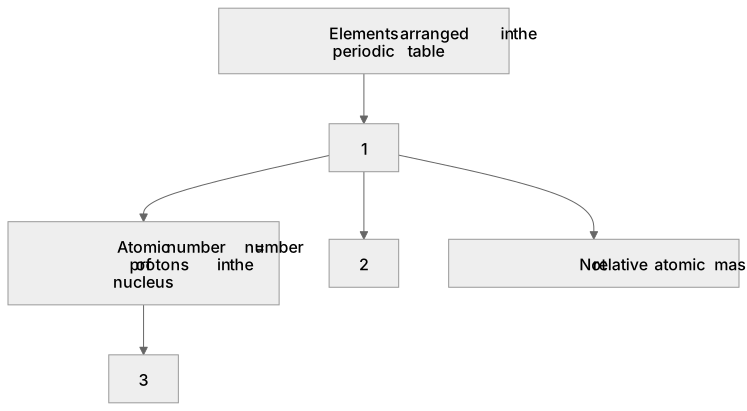
Some boxes have lost their names. Pick the right name for each number.
1Box 1
2Box 2
3Box 3
There is more to this lesson
The full lesson goes on to check your understanding and help you earn the marks. Create a free account to carry on, with your progress saved.
A week of Premium from your first lesson · Then the free plan continues · No card, no charge
Test your understanding of Periodicity: (i) by increasing atomic (proton) number
Active recall beats re-reading. Take an instant quiz now to test what you’ve learned and lock it into long-term memory.
A week of Premium from your first lesson · Then the free plan continues · No card, no charge