OCR · A-Level · Chemistry
Course version: H432 · Version from Sept 2017
Periodicity: (ii) a giant metallic lattice structure, e.g. all metals
A giant metallic lattice is a three-dimensional regular arrangement of metal cations surrounded by delocalised electrons, extending throughout the whole crystal with no discrete molecules.
- Point 10 of 11
- 3 key terms
Study notes
From the teaching notes for this specification point.
The idea
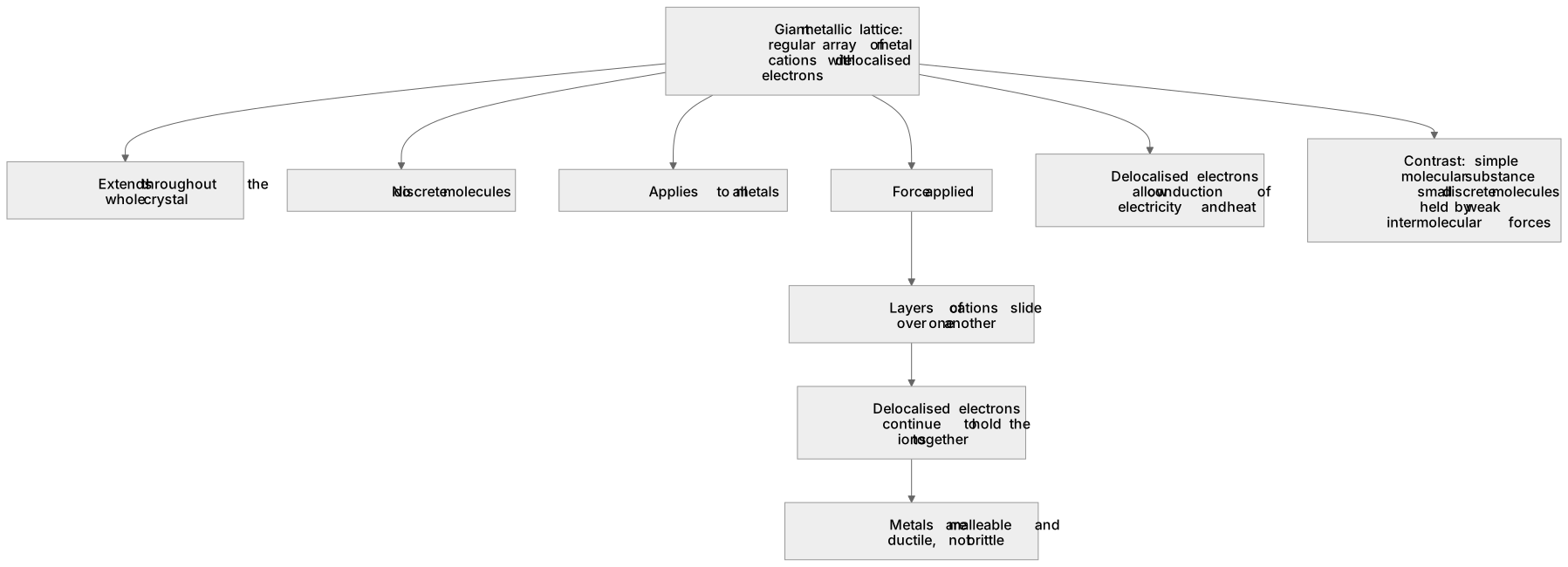
A giant metallic lattice is a three-dimensional regular arrangement of metal cations surrounded by delocalised electrons, extending throughout the whole crystal with no discrete molecules. Every metal, from sodium to iron, adopts some form of this giant lattice, so the structure is described as giant because it has no finite size and as a lattice because the ions sit in a repeating pattern. The regular packing means the layers of cations can slide over one another when a force is applied, because the delocalised electrons continue to hold the ions together in their new positions. This explains why metals are malleable and ductile rather than brittle. The same delocalised electrons allow conduction of electricity and heat. Contrast this with a simple molecular substance, which consists of small discrete molecules held by weak intermolecular forces.
What earns the marks
- Describes the structure as a giant three-dimensional lattice of cations with delocalised electrons.
- States that the lattice extends throughout the crystal and contains no discrete molecules.
- Explains that layers of cations can slide while the delocalised electrons maintain the attraction, giving malleability and ductility.
- Contrasts the giant metallic lattice with a simple molecular structure held by weak intermolecular forces.
- Applies the model to all metals as a general class rather than to one named example only.
Common mistakes and how to put them right
Describes a metal as made of small molecules.
Put it right by stating that the structure is a giant lattice of cations and delocalised electrons.
Says the lattice breaks easily when bent.
Put it right by explaining that layers slide and the delocalised electrons keep the ions attracted.
Treats the giant lattice as applying only to one metal.
Put it right by stating that all metals form giant metallic lattices.
Confuses the lattice with an ionic lattice of alternating oppositely charged ions.
Put it right by stating that the lattice contains metal cations and delocalised electrons only.
Exam tips
- Use the words 'giant' and 'lattice' together to describe the structure precisely.
- Link malleability to sliding cation layers and the continuing attraction from delocalised electrons.
- Contrast with a simple molecular structure to show understanding of why metals differ in melting point and conductivity.
Try the lesson
The start of the Periodicity: (ii) a giant metallic lattice structure, e.g. all metals lesson, made from teaching notes for this specification point.
Listen
A giant metallic lattice is a three-dimensional regular arrangement of metal cations surrounded by delocalised electrons, extending throughout the whole crystal with no discrete molecules. Every metal, from sodium to iron, adopts some form of this giant lattice, so the structure is described as giant because it has no finite size and as a lattice because the ions sit in a repeating pattern. The regular packing means the layers of cations can slide over one another when a force is applied, because the delocalised electrons continue to hold the ions together in their new positions. This explains why metals are malleable and ductile rather than brittle. The same delocalised electrons allow conduction of electricity and heat. Contrast this with a simple molecular substance, which consists of small discrete molecules held by weak intermolecular forces. A strong answer earns marks for these points. Describes the structure as a giant three-dimensional lattice of cations with delocalised electrons. States that the lattice extends throughout the crystal and contains no discrete molecules. Explains that layers of cations can slide while the delocalised electrons maintain the attraction, giving malleability and ductility. Contrasts the giant metallic lattice with a simple molecular structure held by weak intermolecular forces. A common slip: Describes a metal as made of small molecules. Instead, stating that the structure is a giant lattice of cations and delocalised electrons. Exam tip: Use the words 'giant' and 'lattice' together to describe the structure precisely.
See it
Key words
Say what each word means before you turn the card.
Delocalised electrons
Try answering aloud or in your head before turning the card.
Malleability and ductility
Try answering aloud or in your head before turning the card.
Structure–property links
Try answering aloud or in your head before turning the card.
See every definition
- Delocalised electrons
- Electrons that surround the metal cations and continue to hold the ions together in their new positions when layers slide.
- Malleability and ductility
- Properties of metals arising because layers of cations can slide over one another when a force is applied, rather than being brittle.
- Structure–property links
- The regular packing of cations and the delocalised electrons explain why metals are malleable and ductile and allow conduction of electricity and heat.
Label the diagram
Some boxes have lost their names. Pick the right name for each number.
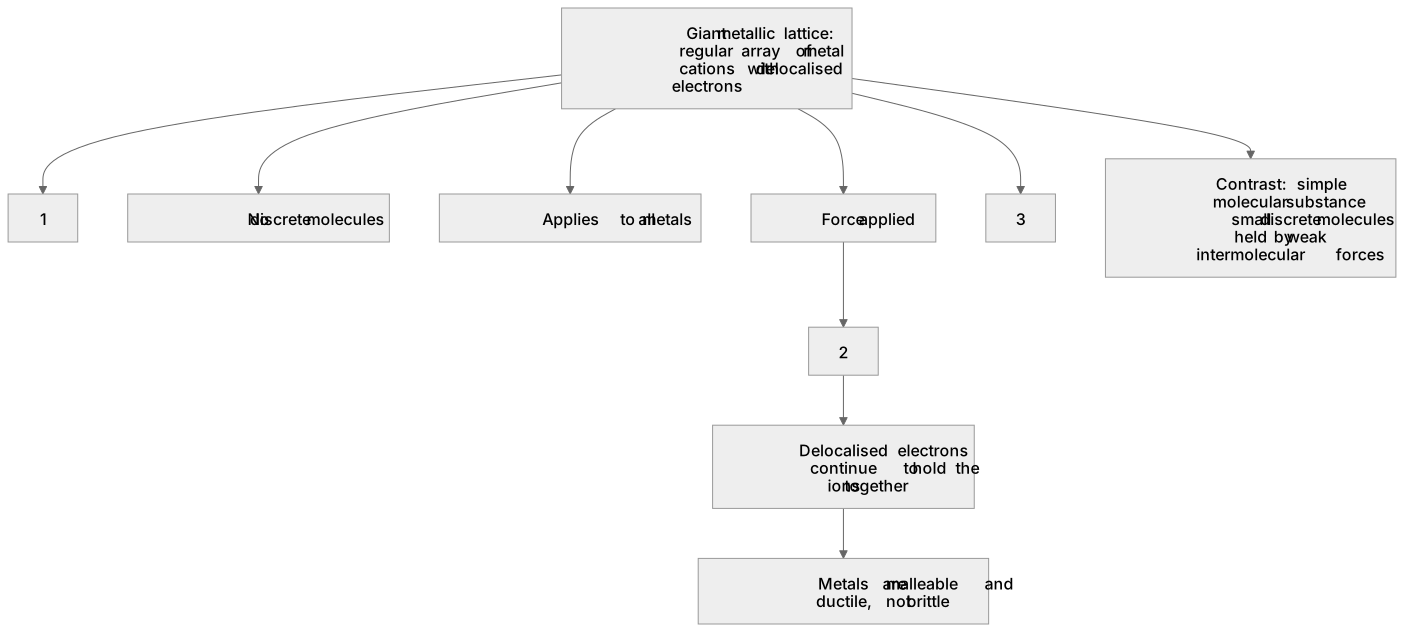
1Box 1
2Box 2
3Box 3
There is more to this lesson
The full lesson goes on to check your understanding and help you earn the marks. Create a free account to carry on, with your progress saved.
A week of Premium from your first lesson · Then the free plan continues · No card, no charge
Test your understanding of Periodicity: (ii) a giant metallic lattice structure, e.g. all metals
Active recall beats re-reading. Take an instant quiz now to test what you’ve learned and lock it into long-term memory.
A week of Premium from your first lesson · Then the free plan continues · No card, no charge