OCR · A-Level · Chemistry
Course version: H432 · Version from Sept 2017
Periodicity: (iii) in groups having similar chemical properties
Elements in the same group share the number of outer-shell electrons, so they show similar chemical properties that change gradually down the group.
- Point 3 of 11
- 4 key terms
Study notes
From the teaching notes for this specification point.
The idea
Elements in the same group share the number of outer-shell electrons, so they show similar chemical properties that change gradually down the group. In Group 2, reactivity increases down the group as the first and second ionisation energies fall and the atoms become larger, so the metals react more vigorously with water and oxygen. In Group 7, reactivity decreases down the group because the outer shell is further from the nucleus and more shielded, so oxidising power falls and displacement reactions show a more reactive halogen displacing a less reactive one from its salt. Down Group 2 the hydroxides become more soluble and the thermal stability of carbonates and nitrates increases; down Group 7 the boiling points rise as the molecules get larger and van der Waals forces strengthen.
What earns the marks
- Identifies that group members share the same number of outer-shell electrons, giving similar chemical properties.
- Explains the increase in Group 2 reactivity down the group through falling ionisation energy and larger atomic radius.
- Explains the decrease in Group 7 reactivity down the group through greater shielding and distance of the outer shell from the nucleus.
- Describes displacement reactions in which a more reactive halogen displaces a less reactive halide from solution.
- Links a gradual change in a physical property, such as boiling point down Group 7, to increasing molecular size and van der Waals forces.
Common mistakes and how to put them right
Assumes reactivity changes in the same direction in every group.
Put it right by noting Group 2 reactivity rises while Group 7 reactivity falls down the group.
Claims halogens become stronger oxidising agents down the group.
Put it right by placing the strongest oxidising power at the top of Group 7.
Ignores shielding when explaining group trends.
Put it right by including distance from the nucleus and electron shielding together.
Treats group similarity as identical behaviour.
Put it right by describing similar properties that change gradually down the group.
Exam tips
- Decide first whether the question concerns Group 2 or Group 7, because the reactivity direction differs.
- Use the words shielding and distance from the nucleus when justifying a group trend.
- For displacement questions, identify which halogen is more reactive before predicting the product.
- Check that any physical-property option is consistent with increasing molecular size down the group.
Try the lesson
The start of the Periodicity: (iii) in groups having similar chemical properties lesson, made from teaching notes for this specification point.
Listen
Elements in the same group share the number of outer-shell electrons, so they show similar chemical properties that change gradually down the group. In Group 2, reactivity increases down the group as the first and second ionisation energies fall and the atoms become larger, so the metals react more vigorously with water and oxygen. In Group 7, reactivity decreases down the group because the outer shell is further from the nucleus and more shielded, so oxidising power falls and displacement reactions show a more reactive halogen displacing a less reactive one from its salt. Down Group 2 the hydroxides become more soluble and the thermal stability of carbonates and nitrates increases; down Group 7 the boiling points rise as the molecules get larger and van der Waals forces strengthen. A strong answer earns marks for these points. Identifies that group members share the same number of outer-shell electrons, giving similar chemical properties. Explains the increase in Group 2 reactivity down the group through falling ionisation energy and larger atomic radius. Explains the decrease in Group 7 reactivity down the group through greater shielding and distance of the outer shell from the nucleus. Describes displacement reactions in which a more reactive halogen displaces a less reactive halide from solution. A common slip: Assumes reactivity changes in the same direction in every group. Instead, noting Group 2 reactivity rises while Group 7 reactivity falls down the group. Exam tip: Decide first whether the question concerns Group 2 or Group 7, because the reactivity direction differs.
See it
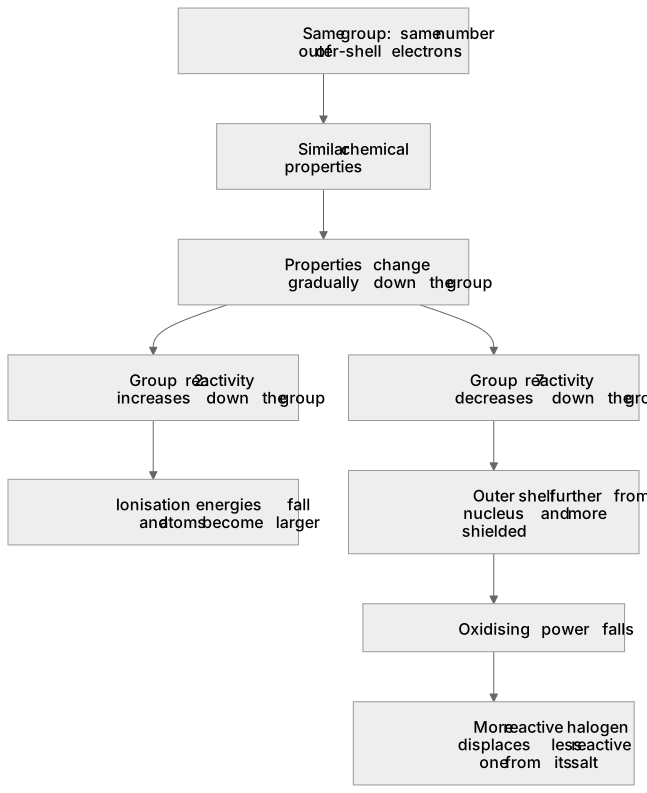
Key words
Say what each word means before you turn the card.
Shared outer-shell electron count
Try answering aloud or in your head before turning the card.
Group 2 reactivity increasing down the group
Try answering aloud or in your head before turning the card.
Group 7 reactivity decreasing down the group
Try answering aloud or in your head before turning the card.
Halogen displacement reactions
Try answering aloud or in your head before turning the card.
See every definition
- Shared outer-shell electron count
- Elements in the same group share the number of outer-shell electrons, so they show similar chemical properties that change gradually down the group.
- Group 2 reactivity increasing down the group
- Reactivity increases down the group as the first and second ionisation energies fall and the atoms become larger, so the metals react more vigorously with water and oxygen.
- Group 7 reactivity decreasing down the group
- Reactivity decreases down the group because the outer shell is further from the nucleus and more shielded, so oxidising power falls.
- Halogen displacement reactions
- These show a more reactive halogen displacing a less reactive one from its salt.
Label the diagram
Some boxes have lost their names. Pick the right name for each number.
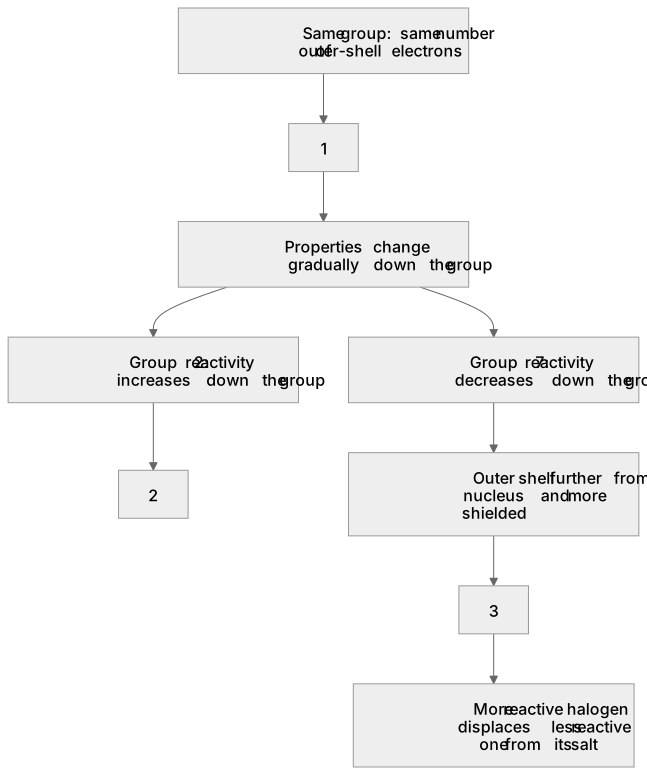
1Box 1
2Box 2
3Box 3
There is more to this lesson
The full lesson goes on to check your understanding and help you earn the marks. Create a free account to carry on, with your progress saved.
A week of Premium from your first lesson · Then the free plan continues · No card, no charge
Test your understanding of Periodicity: (iii) in groups having similar chemical properties
Active recall beats re-reading. Take an instant quiz now to test what you’ve learned and lock it into long-term memory.
A week of Premium from your first lesson · Then the free plan continues · No card, no charge