OCR · A-Level · Chemistry
Course version: H432 · Version from Sept 2017
(b) identification of variables that must be controlled, where appropriate
Full specification wording
Planning: (b) identification of variables that must be controlled, where appropriate
A controlled variable is a factor that could affect the outcome but is deliberately kept the same across all trials so that any change in the dependent variable can be attributed to the…
- 3 key terms
Study notes
From the teaching notes for this specification point.
The idea
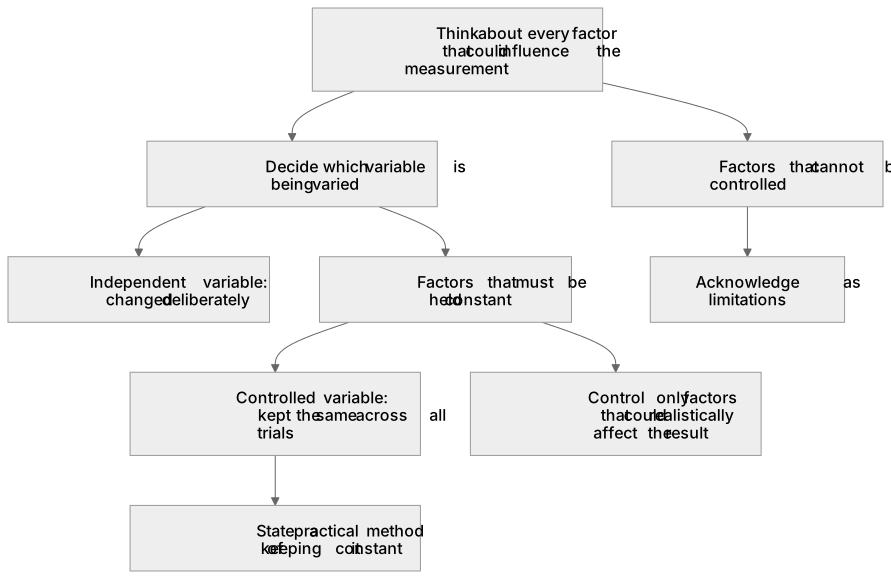
A controlled variable is a factor that could affect the outcome but is deliberately kept the same across all trials so that any change in the dependent variable can be attributed to the independent variable. In a rates experiment, for example, temperature, concentration and particle size might all influence the rate, so the ones not being investigated must be fixed. Identifying which variables need controlling requires you to think about every factor that could influence the measurement, then decide which are being varied and which must be held constant. Some factors cannot be controlled, such as ambient room temperature, and these should be acknowledged as limitations. The phrase 'where appropriate' matters: you control only variables that could realistically affect the result, not every conceivable factor.
What earns the marks
- Defines a controlled variable as a factor kept constant so it cannot affect the dependent variable.
- Identifies factors that could influence the outcome in the given practical context.
- Distinguishes the variable being investigated from those that must be held constant.
- Selects the option that names a genuine confounding factor and a realistic method of controlling it.
- Recognises that some factors cannot be controlled and should be acknowledged as limitations.
Common mistakes and how to put them right
Confuses the controlled variable with the independent variable.
Put it right: The independent variable is changed deliberately, the controlled variable is held constant.
Names a factor that cannot affect the result.
Put it right: Choose only factors that could genuinely influence the measurement.
Suggests controlling every conceivable factor.
Put it right: Control only those that could realistically affect the outcome.
Gives a control without a method.
Put it right: State how the variable is kept constant, for example by using a water bath.
Exam tips
- Ask which factors could change the dependent variable, then decide which are being varied and which must be fixed.
- Check that each suggested control includes a practical method of keeping it constant.
- Remember that 'where appropriate' means controlling only realistic confounding factors.
- Acknowledge factors that cannot be controlled as limitations rather than ignoring them.
Try the lesson
The start of the Planning: (b) identification of variables that must be controlled, where appropriate lesson, made from teaching notes for this specification point.
Listen
A controlled variable is a factor that could affect the outcome but is deliberately kept the same across all trials so that any change in the dependent variable can be attributed to the independent variable. In a rates experiment, for example, temperature, concentration and particle size might all influence the rate, so the ones not being investigated must be fixed. Identifying which variables need controlling requires you to think about every factor that could influence the measurement, then decide which are being varied and which must be held constant. Some factors cannot be controlled, such as ambient room temperature, and these should be acknowledged as limitations. The phrase 'where appropriate' matters: you control only variables that could realistically affect the result, not every conceivable factor. A strong answer earns marks for these points. Defines a controlled variable as a factor kept constant so it cannot affect the dependent variable. Identifies factors that could influence the outcome in the given practical context. Distinguishes the variable being investigated from those that must be held constant. Selects the option that names a genuine confounding factor and a realistic method of controlling it. Exam tip: Ask which factors could change the dependent variable, then decide which are being varied and which must be fixed.
See it
Key words
Say what each word means before you turn the card.
Controlled variables
Try answering aloud or in your head before turning the card.
Confounding factors
Try answering aloud or in your head before turning the card.
Experimental limitations
Try answering aloud or in your head before turning the card.
See every definition
- Controlled variables
- Factors that could affect the outcome but are deliberately kept the same across all trials so that any change in the dependent variable can be attributed to the independent variable.
- Confounding factors
- Factors that could influence the measurement and must be held constant, chosen only where they could realistically affect the result.
- Experimental limitations
- Factors that cannot be controlled, such as ambient room temperature, which should be acknowledged rather than ignored.
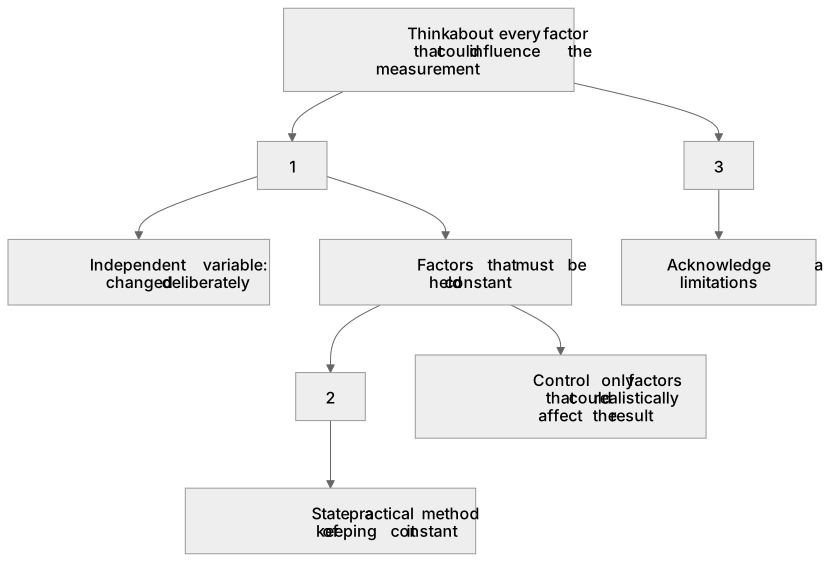
Label the diagram
Some boxes have lost their names. Pick the right name for each number.
1Box 1
2Box 2
3Box 3
There is more to this lesson
The full lesson goes on to check your understanding and help you earn the marks. Create a free account to carry on, with your progress saved.
A week of Premium from your first lesson · Then the free plan continues · No card, no charge
Test your understanding of Planning: (b) identification of variables that must be controlled, where appropriate
Active recall beats re-reading. Take an instant quiz now to test what you’ve learned and lock it into long-term memory.
A week of Premium from your first lesson · Then the free plan continues · No card, no charge