OCR · A-Level · Chemistry
Course version: H432 · Version from Sept 2017
Reaction rates: Catalysts
A catalyst increases the rate of a reaction by providing an alternative reaction pathway of lower activation energy.
- Point 4 of 14
- 3 key terms
Study notes
From the teaching notes for this specification point.
The idea
A catalyst increases the rate of a reaction by providing an alternative reaction pathway of lower activation energy. It is not used up overall and is regenerated, so a small amount can catalyse a large amount of reaction. Because the activation energy is lower, a greater proportion of collisions has energy at or above the activation energy, so more frequent successful collisions occur and the rate rises. A catalyst does not change the position of equilibrium or the enthalpy change of the reaction; it only speeds the approach to equilibrium, helping both forward and reverse reactions equally. A homogeneous catalyst is in the same phase as the reactants, for example aqueous acid; a heterogeneous catalyst is in a different phase, usually a solid with gaseous or liquid reactants, and works by adsorption onto its surface.
What earns the marks
- States that a catalyst provides an alternative reaction pathway with a lower activation energy.
- Explains that a greater proportion of collisions has energy at or above the activation energy, increasing the rate of successful collisions.
- States that the catalyst is not used up overall and is regenerated during the reaction.
- Distinguishes a homogeneous catalyst, in the same phase as the reactants, from a heterogeneous catalyst, in a different phase.
- States that a catalyst does not change the position of equilibrium or the enthalpy change of the reaction.
Common mistakes and how to put them right
Claims a catalyst increases the yield or shifts the equilibrium position.
Put it right: State that it speeds the forward and reverse reactions equally and leaves the equilibrium position unchanged.
Says a catalyst lowers the enthalpy change of reaction.
Put it right: State that it lowers only the activation energy.
Describes a catalyst as being used up.
Put it right: State that it is regenerated and not consumed overall.
Confuses homogeneous and heterogeneous catalysts.
Put it right: Match each term to whether the catalyst shares the phase of the reactants.
Exam tips
- Link the lower activation energy explicitly to the proportion of collisions with sufficient energy.
- Use the words 'alternative pathway' and 'regenerated' to hit the key ideas.
- When asked about equilibrium, state that the catalyst affects rate only, not position.
Try the lesson
The start of the Reaction rates: Catalysts lesson, made from teaching notes for this specification point.
Listen
A catalyst increases the rate of a reaction by providing an alternative reaction pathway of lower activation energy. It is not used up overall and is regenerated, so a small amount can catalyse a large amount of reaction. Because the activation energy is lower, a greater proportion of collisions has energy at or above the activation energy, so more frequent successful collisions occur and the rate rises. A catalyst does not change the position of equilibrium or the enthalpy change of the reaction; it only speeds the approach to equilibrium, helping both forward and reverse reactions equally. A homogeneous catalyst is in the same phase as the reactants, for example aqueous acid; a heterogeneous catalyst is in a different phase, usually a solid with gaseous or liquid reactants, and works by adsorption onto its surface. A strong answer earns marks for these points. States that a catalyst provides an alternative reaction pathway with a lower activation energy. Explains that a greater proportion of collisions has energy at or above the activation energy, increasing the rate of successful collisions. States that the catalyst is not used up overall and is regenerated during the reaction. Distinguishes a homogeneous catalyst, in the same phase as the reactants, from a heterogeneous catalyst, in a different phase. Exam tip: Link the lower activation energy explicitly to the proportion of collisions with sufficient energy.
See it
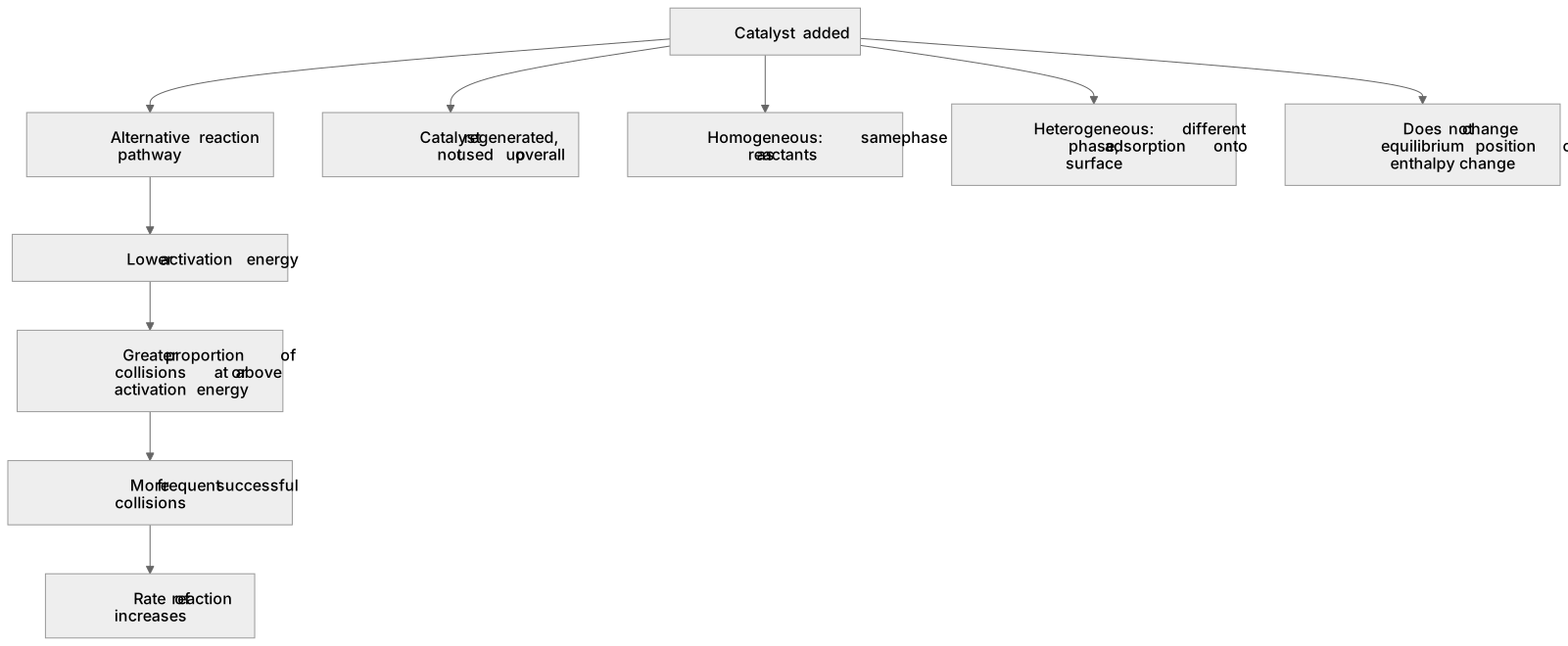
Key words
Say what each word means before you turn the card.
Alternative pathway and lower activation energy
Try answering aloud or in your head before turning the card.
Effect on collision frequency and successful collisions
Try answering aloud or in your head before turning the card.
Catalyst regenerated, not consumed
Try answering aloud or in your head before turning the card.
See every definition
- Alternative pathway and lower activation energy
- A catalyst increases the rate of a reaction by providing an alternative reaction pathway of lower activation energy.
- Effect on collision frequency and successful collisions
- Because the activation energy is lower, a greater proportion of collisions has energy at or above the activation energy, so more frequent successful collisions occur and the rate rises.
- Catalyst regenerated, not consumed
- A catalyst is not used up overall and is regenerated, so a small amount can catalyse a large amount of reaction.
Label the diagram
Some boxes have lost their names. Pick the right name for each number.
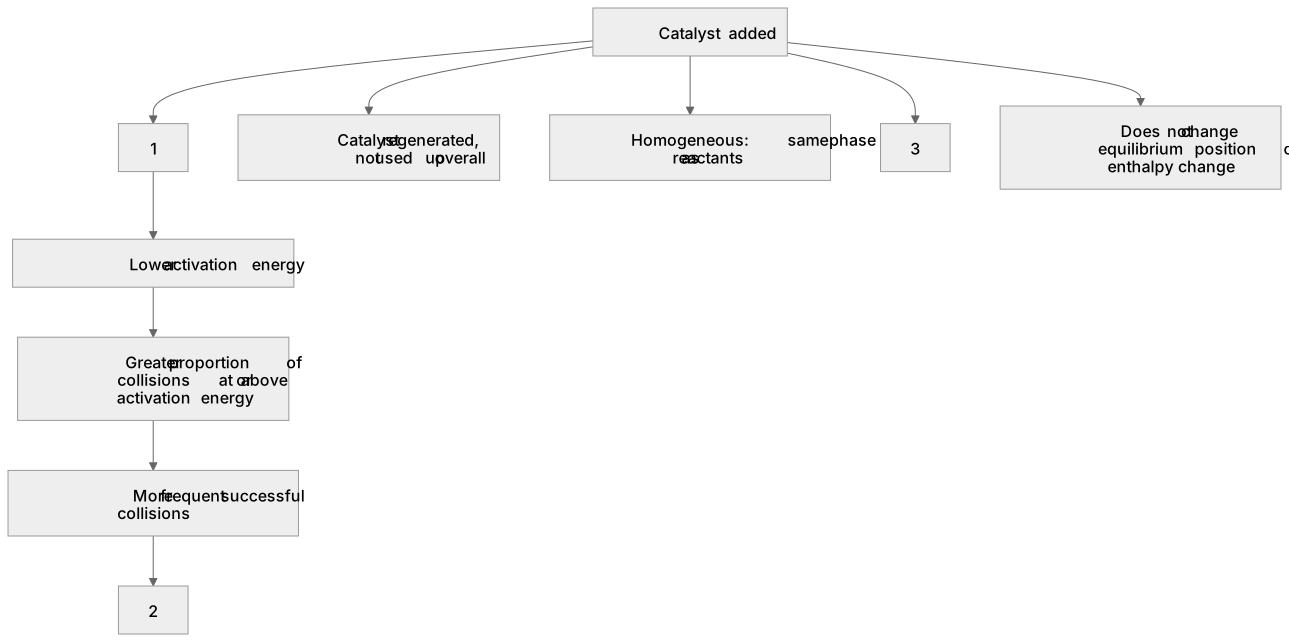
1Box 1
2Box 2
3Box 3
There is more to this lesson
The full lesson goes on to check your understanding and help you earn the marks. Create a free account to carry on, with your progress saved.
A week of Premium from your first lesson · Then the free plan continues · No card, no charge
Test your understanding of Reaction rates: Catalysts
Active recall beats re-reading. Take an instant quiz now to test what you’ve learned and lock it into long-term memory.
A week of Premium from your first lesson · Then the free plan continues · No card, no charge