OCR · A-Level · Chemistry
Course version: H432 · Version from Sept 2017
(b) construction of redox equations using half-equations and oxidation…
Full specification wording
Redox and electrode potentials: (b) construction of redox equations using half-equations and oxidation numbers
Redox equations balance both atoms and charge.
- Point 2 of 14
- 4 key terms
Study notes
From the teaching notes for this specification point.
The idea
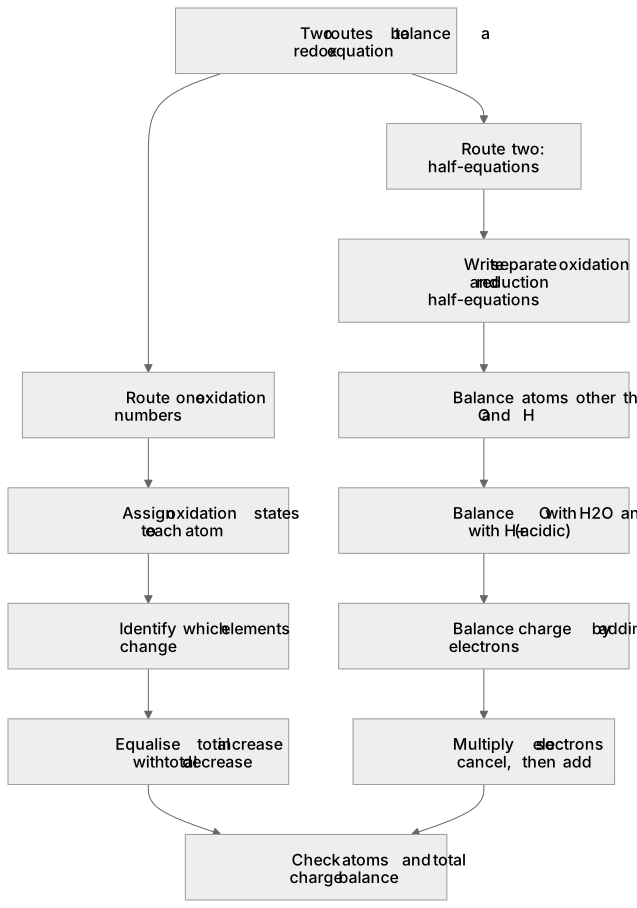
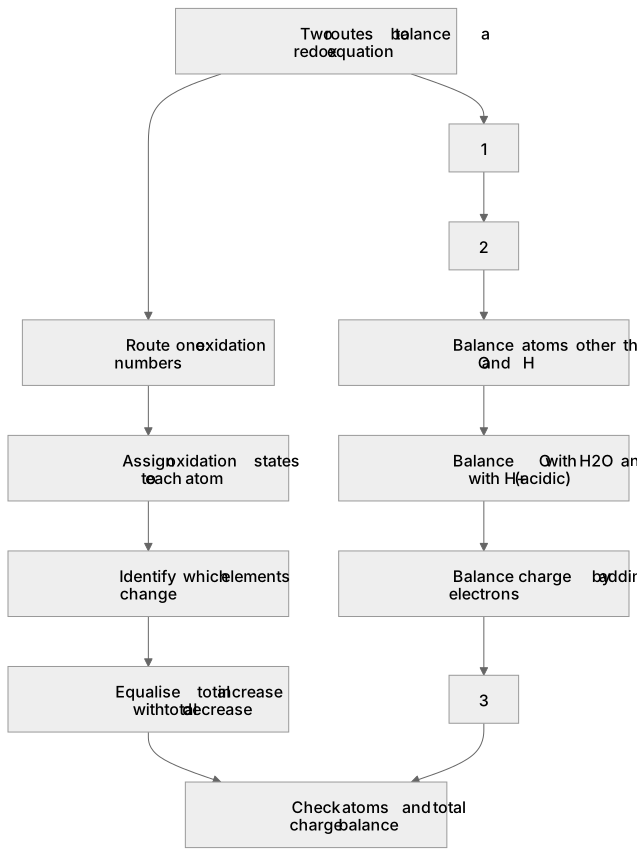
Redox equations balance both atoms and charge. Two routes are examined. Route one uses oxidation numbers: assign oxidation states to each atom, identify which elements change, and balance the change in oxidation number by equalising the total increase in oxidation number with the total decrease. Route two uses half-equations: write separate oxidation and reduction half-equations, balance atoms other than O and H, balance O by adding H₂O, balance H by adding H⁺ (in acidic conditions), balance charge by adding electrons, then multiply each half-equation so the electrons cancel before adding them. For example, MnO₄⁻ + 8H⁺ + 5e⁻ → Mn²⁺ + 4H₂O combined with Fe²⁺ → Fe³⁺ + e⁻ gives MnO₄⁻ + 8H⁺ + 5Fe²⁺ → Mn²⁺ + 4H₂O + 5Fe³⁺. Check that atoms and total charge balance on both sides.
What earns the marks
- Balances atoms other than oxygen and hydrogen before adjusting oxygen and hydrogen.
- Adds H₂O to balance oxygen atoms and H⁺ to balance hydrogen atoms in acidic conditions.
- Adds electrons to the more positive side to balance charge in each half-equation.
- Multiplies each half-equation so the number of electrons lost equals the number gained before adding them.
- Checks that the final equation balances both atoms and total charge on each side.
- Assigns oxidation numbers correctly and equalises the total increase with the total decrease.
Common mistakes and how to put them right
Adds electrons to the wrong side of a half-equation.
Put it right: Place electrons on the side that makes charge balance, remembering reduction gains electrons.
Forgets to multiply half-equations so electrons cancel.
Put it right: Scale each half-equation until the electron counts match.
Omits the state symbols or the H⁺/H₂O terms.
Put it right: Include them so atoms and charge balance.
Balances atoms but ignores charge.
Put it right: Verify total charge on each side of the final equation.
Exam tips
- Work through the half-equation steps in a fixed order: atoms, oxygen, hydrogen, charge.
- Show the separate half-equations before combining them so the method is visible.
- Do a final atom-and-charge audit of the combined equation before selecting an answer.
- In multiple-choice items, eliminate options that fail the charge balance even if atoms balance.
Try the lesson
The start of the Redox and electrode potentials: (b) construction of redox equations using half-equations and oxidation numbers lesson, made from teaching notes for this specification point.
Listen
Redox equations balance both atoms and charge. Two routes are examined. Route one uses oxidation numbers: assign oxidation states to each atom, identify which elements change, and balance the change in oxidation number by equalising the total increase in oxidation number with the total decrease. Route two uses half-equations: write separate oxidation and reduction half-equations, balance atoms other than O and H, balance O by adding H₂O, balance H by adding H⁺ (in acidic conditions), balance charge by adding electrons, then multiply each half-equation so the electrons cancel before adding them. For example, MnO₄⁻ + 8H⁺ + 5e⁻ → Mn²⁺ + 4H₂O combined with Fe²⁺ → Fe³⁺ + e⁻ gives MnO₄⁻ + 8H⁺ + 5Fe²⁺ → Mn²⁺ + 4H₂O + 5Fe³⁺. Check that atoms and total charge balance on both sides. A strong answer earns marks for these points. Balances atoms other than oxygen and hydrogen before adjusting oxygen and hydrogen. Adds H₂O to balance oxygen atoms and H⁺ to balance hydrogen atoms in acidic conditions. Adds electrons to the more positive side to balance charge in each half-equation. Multiplies each half-equation so the number of electrons lost equals the number gained before adding them. Exam tip: Work through the half-equation steps in a fixed order: atoms, oxygen, hydrogen, charge.
See it
Key words
Say what each word means before you turn the card.
Oxidation numbers
Try answering aloud or in your head before turning the card.
Half-equations
Try answering aloud or in your head before turning the card.
Balancing atoms and charge
Try answering aloud or in your head before turning the card.
Electron transfer in redox
Try answering aloud or in your head before turning the card.
See every definition
- Oxidation numbers
- Values assigned to each atom so that the elements which change can be identified and the total increase equalised with the total decrease.
- Half-equations
- Separate oxidation and reduction equations in which atoms other than O and H are balanced first, then O with H₂O, H with H⁺ in acidic conditions, and charge with electrons.
- Balancing atoms and charge
- Checking that the final equation balances both atoms and total charge on each side.
- Electron transfer in redox
- Each half-equation is multiplied so the number of electrons lost equals the number gained before the half-equations are added.
Label the diagram
Some boxes have lost their names. Pick the right name for each number.
1Box 1
2Box 2
3Box 3
There is more to this lesson
The full lesson goes on to check your understanding and help you earn the marks. Create a free account to carry on, with your progress saved.
A week of Premium from your first lesson · Then the free plan continues · No card, no charge
Test your understanding of Redox and electrode potentials: (b) construction of redox equations using half-equations and oxidation numbers
Active recall beats re-reading. Take an instant quiz now to test what you’ve learned and lock it into long-term memory.
A week of Premium from your first lesson · Then the free plan continues · No card, no charge