OCR · A-Level · Chemistry
Course version: H432 · Version from Sept 2017
(f) interpretation of redox equations in (e), and unfamiliar redox…
Full specification wording
Redox: (f) interpretation of redox equations in (e), and unfamiliar redox reactions, to make predictions in terms of oxidation numbers and electron loss/gain.
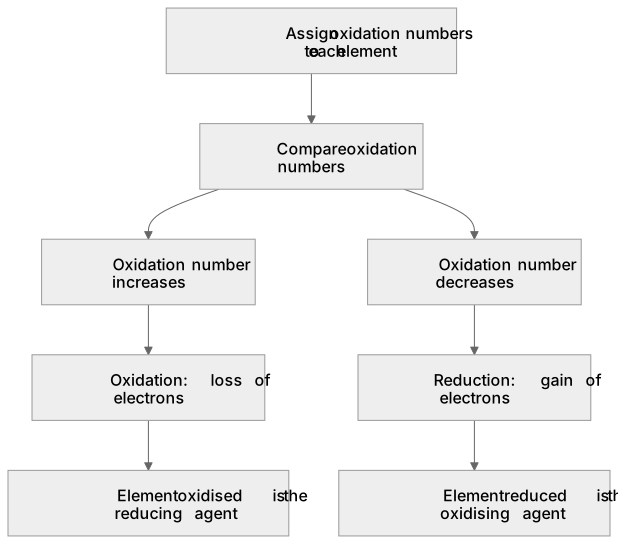
To interpret a redox equation, assign oxidation numbers to each element and track how they change.
- Point 10 of 10
- 4 key terms
Study notes
From the teaching notes for this specification point.
The idea
To interpret a redox equation, assign oxidation numbers to each element and track how they change. An increase in oxidation number means oxidation (loss of electrons); a decrease means reduction (gain of electrons). In Mg + 2HCl → MgCl₂ + H₂, magnesium goes from 0 to 2⁺ (oxidised) and hydrogen in HCl goes from 1⁺ to 0 (reduced). Apply the same method to unfamiliar reactions: work out oxidation numbers from the rules, spot which element changes, and predict the direction of electron transfer. Remember that oxidation numbers are a bookkeeping tool, and that the element oxidised is the reducing agent while the element reduced is the oxidising agent.
What earns the marks
- Assigns oxidation numbers correctly to each element in the equation using the standard rules.
- Identifies oxidation as an increase in oxidation number and reduction as a decrease.
- Links the change in oxidation number to loss or gain of electrons.
- Predicts which species is oxidised and which is reduced in an unfamiliar reaction.
- Names the oxidising agent and reducing agent from the changes observed.
Common mistakes and how to put them right
Reverses the definitions so that a decrease in oxidation number is called oxidation.
Put it right: Correct it because oxidation is an increase.
Treats oxidation number change as unrelated to electrons.
Put it right: Link each change to electron loss or gain.
Assigns a fixed oxidation number to an element in a compound without applying the rules.
Put it right: Derive it from the surrounding atoms and overall charge.
Confuses the oxidising agent with the species oxidised.
Put it right: The oxidising agent is itself reduced.
Exam tips
- Write oxidation numbers above each element before comparing.
- State clearly which number rises and which falls, then name oxidation or reduction.
- For unfamiliar reactions, apply the rules step by step rather than guessing.
Try the lesson
The start of the Redox: (f) interpretation of redox equations in (e), and unfamiliar redox reactions, to make predictions in terms of oxidation numbers and electron loss/gain. lesson, made from teaching notes for this specification point.
Listen
To interpret a redox equation, assign oxidation numbers to each element and track how they change. An increase in oxidation number means oxidation (loss of electrons); a decrease means reduction (gain of electrons). In Mg + 2HCl → MgCl₂ + H₂, magnesium goes from 0 to 2⁺ (oxidised) and hydrogen in HCl goes from 1⁺ to 0 (reduced). Apply the same method to unfamiliar reactions: work out oxidation numbers from the rules, spot which element changes, and predict the direction of electron transfer. Remember that oxidation numbers are a bookkeeping tool, and that the element oxidised is the reducing agent while the element reduced is the oxidising agent. A strong answer earns marks for these points. Assigns oxidation numbers correctly to each element in the equation using the standard rules. Identifies oxidation as an increase in oxidation number and reduction as a decrease. Links the change in oxidation number to loss or gain of electrons. Predicts which species is oxidised and which is reduced in an unfamiliar reaction. Exam tip: Write oxidation numbers above each element before comparing.
See it
Key words
Say what each word means before you turn the card.
Oxidation numbers
Try answering aloud or in your head before turning the card.
Oxidation
Try answering aloud or in your head before turning the card.
Reduction
Try answering aloud or in your head before turning the card.
Oxidising and reducing agents
Try answering aloud or in your head before turning the card.
See every definition
- Oxidation numbers
- A bookkeeping tool assigned to each element in an equation using the standard rules, and tracked to see how they change.
- Oxidation
- An increase in oxidation number, which means loss of electrons.
- Reduction
- A decrease in oxidation number, which means gain of electrons.
- Oxidising and reducing agents
- The element oxidised is the reducing agent while the element reduced is the oxidising agent.
Label the diagram
Some boxes have lost their names. Pick the right name for each number.
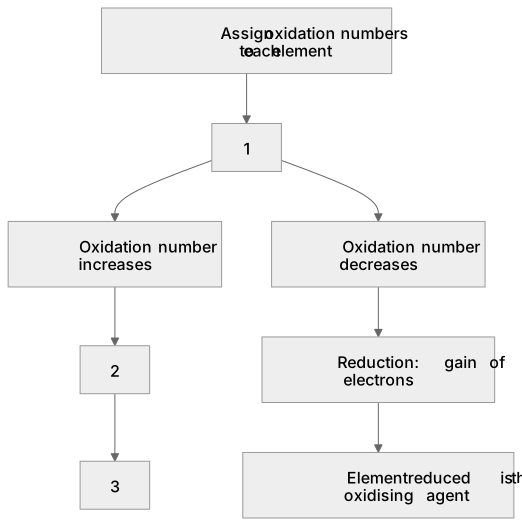
1Box 1
2Box 2
3Box 3
There is more to this lesson
The full lesson goes on to check your understanding and help you earn the marks. Create a free account to carry on, with your progress saved.
A week of Premium from your first lesson · Then the free plan continues · No card, no charge
Test your understanding of Redox: (f) interpretation of redox equations in (e), and unfamiliar redox reactions, to make predictions in terms of oxidation numbers and electron loss/gain.
Active recall beats re-reading. Take an instant quiz now to test what you’ve learned and lock it into long-term memory.
A week of Premium from your first lesson · Then the free plan continues · No card, no charge