OCR · A-Level · Chemistry
Course version: H432 · Version from Sept 2017
Redox: (ii) changes in oxidation number
Oxidation number tracks the apparent charge on an atom and gives a second way to recognise redox.
- Point 8 of 10
- 4 key terms
Study notes
From the teaching notes for this specification point.
The idea
Oxidation number tracks the apparent charge on an atom and gives a second way to recognise redox. An increase in oxidation number is oxidation and a decrease is reduction. Assign oxidation numbers using the rules: an uncombined element has oxidation number 0; a monatomic ion has its charge; oxygen is usually −2 and hydrogen usually +1 in compounds; the sum of oxidation numbers equals the overall charge. In manganate(VII) the manganese has oxidation number +7, and it falls to +2 in Mn²⁺, so manganese is reduced. In a multiple-choice question, work out the oxidation number of the element before and after, then decide whether it rose or fell.
What earns the marks
- States that an increase in oxidation number corresponds to oxidation and a decrease to reduction.
- Applies the rule that the sum of oxidation numbers equals the overall charge of the species.
- Calculates the oxidation number of an element in a compound or ion using the standard rules.
- Compares oxidation numbers before and after a reaction to decide whether oxidation or reduction occurs.
Common mistakes and how to put them right
Treats a decrease in oxidation number as oxidation.
Put it right: Correct this so a decrease is reduction.
Assigns oxygen an oxidation number other than −2 in a normal compound.
Put it right: Apply the usual rule unless a peroxide is specified.
Ignores the overall charge when summing oxidation numbers in a polyatomic ion.
Put it right: Include the charge in the sum.
Exam tips
- Write the oxidation number above each element before and after the change.
- Use the overall charge of a polyatomic ion in the sum rather than assuming it is zero.
- Decide oxidation or reduction from the direction of the change, not from the sign of the final number alone.
Try the lesson
The start of the Redox: (ii) changes in oxidation number lesson, made from teaching notes for this specification point.
Listen
Oxidation number tracks the apparent charge on an atom and gives a second way to recognise redox. An increase in oxidation number is oxidation and a decrease is reduction. Assign oxidation numbers using the rules: an uncombined element has oxidation number 0; a monatomic ion has its charge; oxygen is usually −2 and hydrogen usually +1 in compounds; the sum of oxidation numbers equals the overall charge. In manganate(VII) the manganese has oxidation number +7, and it falls to +2 in Mn²⁺, so manganese is reduced. In a multiple-choice question, work out the oxidation number of the element before and after, then decide whether it rose or fell. A strong answer earns marks for these points. States that an increase in oxidation number corresponds to oxidation and a decrease to reduction. Applies the rule that the sum of oxidation numbers equals the overall charge of the species. Calculates the oxidation number of an element in a compound or ion using the standard rules. Compares oxidation numbers before and after a reaction to decide whether oxidation or reduction occurs. Exam tip: Write the oxidation number above each element before and after the change.
See it
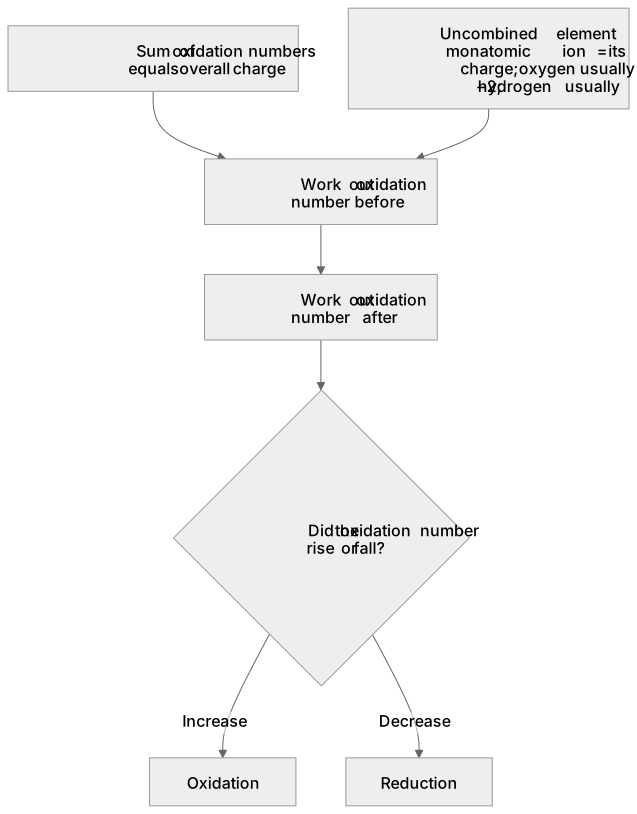
Key words
Say what each word means before you turn the card.
Oxidation number rules
Try answering aloud or in your head before turning the card.
Increase means oxidation
Try answering aloud or in your head before turning the card.
Decrease means reduction
Try answering aloud or in your head before turning the card.
Using overall charge in calculations
Try answering aloud or in your head before turning the card.
See every definition
- Oxidation number rules
- An uncombined element has oxidation number 0, a monatomic ion has its charge, oxygen is usually −2 and hydrogen usually +1 in compounds.
- Increase means oxidation
- A rise in oxidation number is oxidation.
- Decrease means reduction
- A fall in oxidation number is reduction.
- Using overall charge in calculations
- The sum of oxidation numbers equals the overall charge of the species.
Label the diagram
Some boxes have lost their names. Pick the right name for each number.
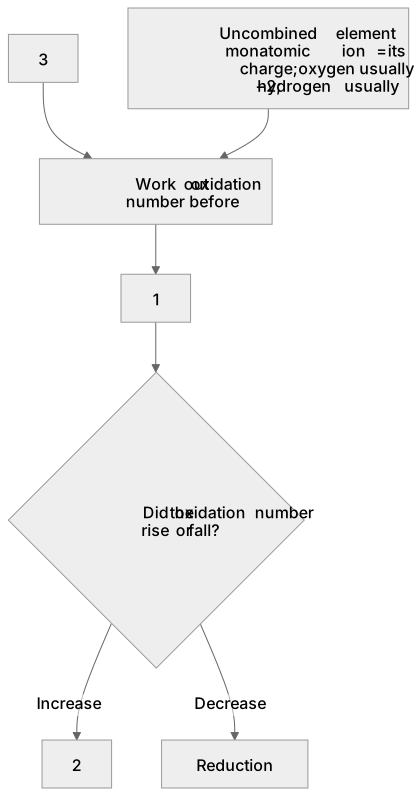
1Box 1
2Box 2
3Box 3
There is more to this lesson
The full lesson goes on to check your understanding and help you earn the marks. Create a free account to carry on, with your progress saved.
A week of Premium from your first lesson · Then the free plan continues · No card, no charge
Test your understanding of Redox: (ii) changes in oxidation number
Active recall beats re-reading. Take an instant quiz now to test what you’ve learned and lock it into long-term memory.
A week of Premium from your first lesson · Then the free plan continues · No card, no charge