OCR · A-Level · Chemistry
Course version: H432 · Version from Sept 2017
Redox: Oxidation number
An oxidation number (oxidation state) is a bookkeeping value that tracks electron control in a species.
- Point 1 of 10
- 3 key terms
Study notes
From the teaching notes for this specification point.
The idea
An oxidation number (oxidation state) is a bookkeeping value that tracks electron control in a species. For an uncombined element each atom has oxidation number 0, as in Fe, O₂ and S₈. For a monatomic ion the oxidation number equals the ion charge, so Na⁺ is +1 and O²⁻ is −2. In compounds, hydrogen is usually +1 and oxygen usually −2, with exceptions such as metal hydrides (H = −1) and peroxides (O = −1). Fluorine is always −1. The sum of oxidation numbers equals the overall charge: zero for a neutral compound, the ion charge for a polyatomic ion. In H₂SO₄, hydrogen contributes 2 × (+1) = +2 and oxygen 4 × (−2) = −8, so sulfur must be +6 to give a total of 0. Write oxidation numbers sign-first, for example +6, never as a charge superscript.
What earns the marks
- States that the oxidation number of an atom in an uncombined element is 0.
- Assigns the oxidation number of a monatomic ion as equal to its charge, for example +1 for Na⁺.
- Applies the usual values H = +1 and O = −2 while recognising exceptions such as metal hydrides and peroxides.
- Sets the sum of oxidation numbers equal to the overall charge of the species, zero for a neutral compound.
- Calculates an unknown oxidation number by subtracting known contributions, for example +6 for sulfur in H₂SO₄.
- Writes oxidation numbers sign-first, for example +6 and −2, distinguishing them from ionic charges.
Common mistakes and how to put them right
Writes oxidation numbers as charge superscripts after the symbol.
Put it right: Write them sign-first, for example +6 rather than a postfixed form.
Treats the oxidation number of an element in a compound as always 0.
Put it right: Reserve 0 for uncombined elements and monatomic species.
Ignores the overall charge when summing oxidation numbers in a polyatomic ion.
Put it right: Set the total equal to the ion charge.
Applies H = +1 and O = −2 without checking exceptions such as metal hydrides and peroxides.
Put it right: Verify the species first.
Exam tips
- Write the known contributions under each element before solving for the unknown, so the arithmetic is visible and checkable.
- Check the total against the overall charge as a final step; a neutral compound must sum to 0.
- Keep oxidation numbers sign-first and distinct from ionic charges, since the two notations mean different things.
Try the lesson
The start of the Redox: Oxidation number lesson, made from teaching notes for this specification point.
Listen
An oxidation number (oxidation state) is a bookkeeping value that tracks electron control in a species. For an uncombined element each atom has oxidation number 0, as in Fe, O₂ and S₈. For a monatomic ion the oxidation number equals the ion charge, so Na⁺ is +1 and O²⁻ is −2. In compounds, hydrogen is usually +1 and oxygen usually −2, with exceptions such as metal hydrides (H = −1) and peroxides (O = −1). Fluorine is always −1. The sum of oxidation numbers equals the overall charge: zero for a neutral compound, the ion charge for a polyatomic ion. In H₂SO₄, hydrogen contributes 2 × (+1) = +2 and oxygen 4 × (−2) = −8, so sulfur must be +6 to give a total of 0. Write oxidation numbers sign-first, for example +6, never as a charge superscript. A strong answer earns marks for these points. States that the oxidation number of an atom in an uncombined element is 0. Assigns the oxidation number of a monatomic ion as equal to its charge, for example +1 for Na⁺. Applies the usual values H = +1 and O = −2 while recognising exceptions such as metal hydrides and peroxides. Sets the sum of oxidation numbers equal to the overall charge of the species, zero for a neutral compound. Exam tip: Write the known contributions under each element before solving for the unknown, so the arithmetic is visible and checkable.
See it
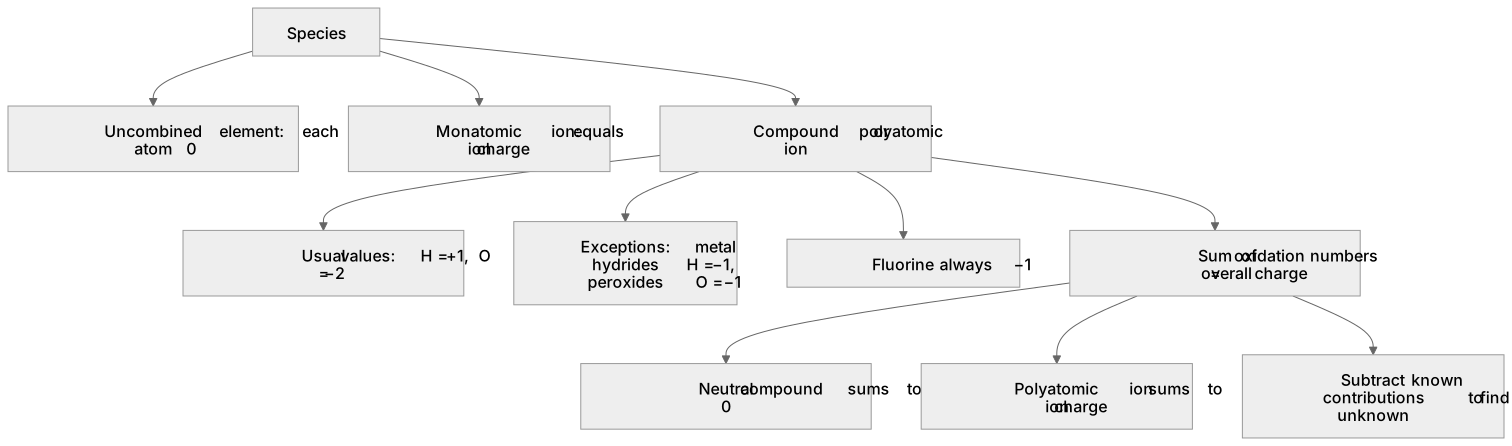
Key words
Say what each word means before you turn the card.
Oxidation number
Try answering aloud or in your head before turning the card.
Sum of oxidation numbers equals overall species charge
Try answering aloud or in your head before turning the card.
Sign-first notation and its distinction from ionic charge
Try answering aloud or in your head before turning the card.
See every definition
- Oxidation number
- A bookkeeping value that tracks electron control in a species, also called the oxidation state.
- Sum of oxidation numbers equals overall species charge
- The sum of oxidation numbers is zero for a neutral compound and the ion charge for a polyatomic ion, so an unknown value can be calculated by subtracting known contributions.
- Sign-first notation and its distinction from ionic charge
- Oxidation numbers are written sign-first, for example +6, never as a charge superscript.
Label the diagram
Some boxes have lost their names. Pick the right name for each number.
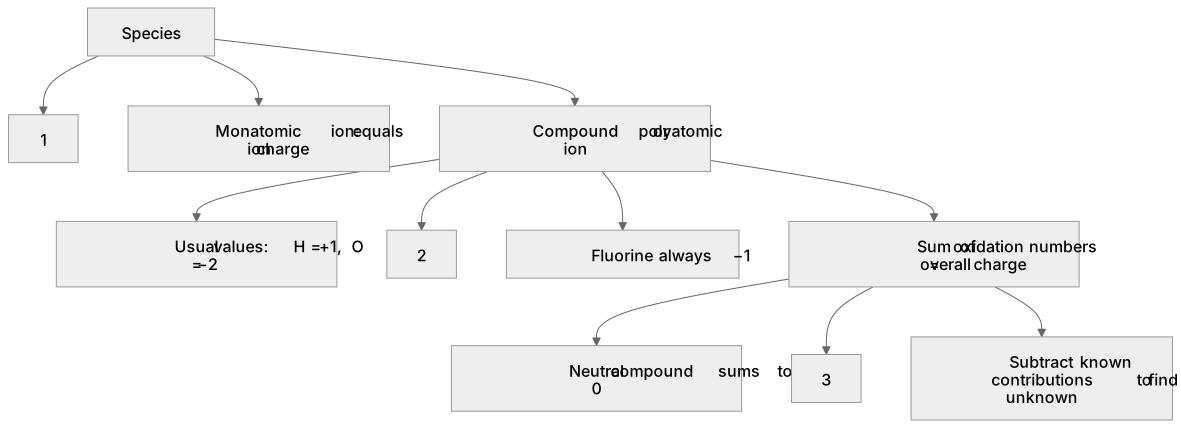
1Box 1
2Box 2
3Box 3
There is more to this lesson
The full lesson goes on to check your understanding and help you earn the marks. Create a free account to carry on, with your progress saved.
A week of Premium from your first lesson · Then the free plan continues · No card, no charge
Test your understanding of Redox: Oxidation number
Active recall beats re-reading. Take an instant quiz now to test what you’ve learned and lock it into long-term memory.
A week of Premium from your first lesson · Then the free plan continues · No card, no charge