OCR · A-Level · Chemistry
Course version: H432 · Version from Sept 2017
(d) (i) the use of tetramethylsilane, TMS, as the standard for chemical…
Full specification wording
Spectroscopy: (d) (i) the use of tetramethylsilane, TMS, as the standard for chemical shift measurements
In ¹H NMR, chemical shift is measured relative to a reference so that values from different machines and samples can be compared.
- Point 10 of 16
- 4 key terms
Study notes
From the teaching notes for this specification point.
The idea
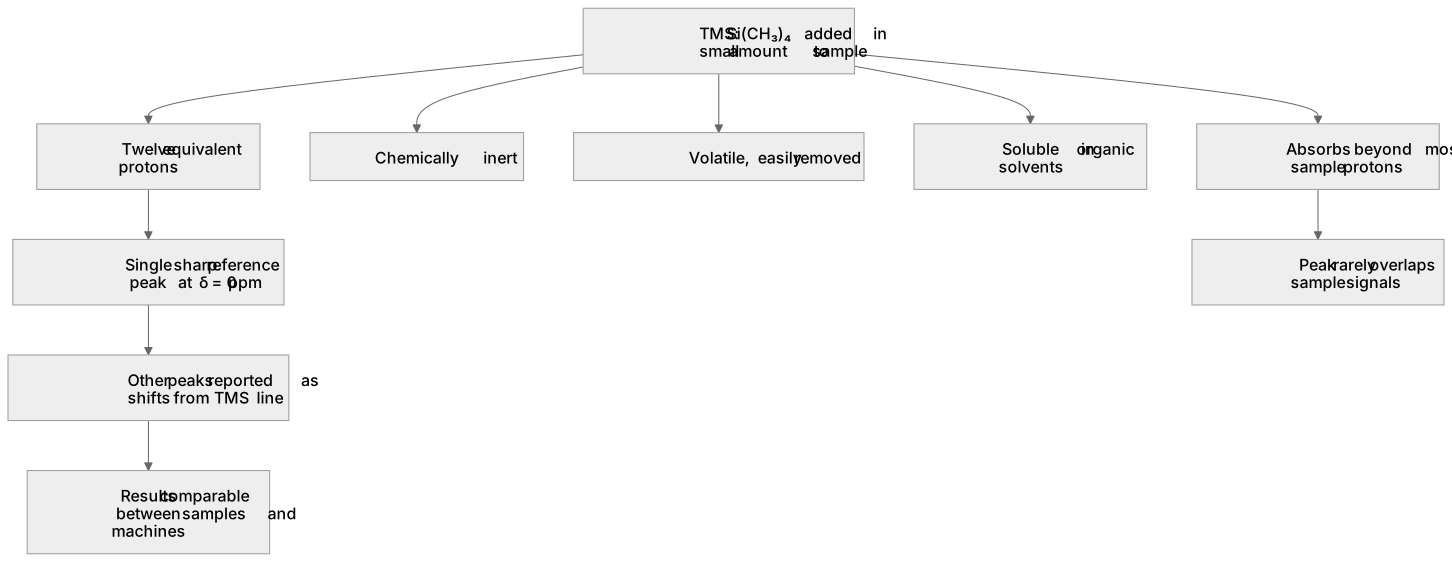
In ¹H NMR, chemical shift is measured relative to a reference so that values from different machines and samples can be compared. Tetramethylsilane, Si(CH₃)₄, is that standard: its twelve equivalent protons give one sharp signal, set at δ = 0 ppm. TMS is chemically inert, volatile (so it is easily removed) and soluble in organic solvents, and it absorbs at a shift beyond that of most sample protons, so its peak rarely overlaps theirs. A small amount is added to the sample, and every other peak is reported as a shift from the TMS line. Because all twelve protons are equivalent, TMS produces a single reference peak rather than a cluster.
What earns the marks
- States that TMS gives a single sharp reference peak set at δ = 0 ppm.
- Explains that the twelve protons of TMS are equivalent, so only one signal appears.
- Identifies that TMS is inert, volatile and soluble in organic solvents, making it convenient and easily removed.
- Explains that TMS absorbs away from most sample peaks, so its signal rarely overlaps the sample signals.
- Describes chemical shift as measured relative to the TMS reference so results are comparable between samples and machines.
Common mistakes and how to put them right
Claims that TMS gives several peaks.
Put it right by noting that its twelve protons are equivalent and give one signal.
States that TMS is the sample being analysed.
Put it right by describing it as a small amount of reference standard added to the sample.
Asserts that TMS absorbs within the region of typical sample protons.
Put it right by noting its peak lies beyond most sample signals, avoiding overlap.
Exam tips
- Link each property of TMS (single peak, inert, volatile, soluble, non-overlapping) to why it is a good standard rather than listing properties alone.
- Quote the reference value as δ = 0 ppm and explain that other shifts are measured from it.
- Use the structure Si(CH₃)₄ to justify the equivalence of the twelve protons when explaining the single peak.
Try the lesson
The start of the Spectroscopy: (d) (i) the use of tetramethylsilane, TMS, as the standard for chemical shift measurements lesson, made from teaching notes for this specification point.
Listen
In ¹H NMR, chemical shift is measured relative to a reference so that values from different machines and samples can be compared. Tetramethylsilane, Si(CH₃)₄, is that standard: its twelve equivalent protons give one sharp signal, set at δ = 0 ppm. TMS is chemically inert, volatile (so it is easily removed) and soluble in organic solvents, and it absorbs at a shift beyond that of most sample protons, so its peak rarely overlaps theirs. A small amount is added to the sample, and every other peak is reported as a shift from the TMS line. Because all twelve protons are equivalent, TMS produces a single reference peak rather than a cluster. A strong answer earns marks for these points. States that TMS gives a single sharp reference peak set at δ = 0 ppm. Explains that the twelve protons of TMS are equivalent, so only one signal appears. Identifies that TMS is inert, volatile and soluble in organic solvents, making it convenient and easily removed. Explains that TMS absorbs away from most sample peaks, so its signal rarely overlaps the sample signals. A common slip: Claims that TMS gives several peaks. Instead, noting that its twelve protons are equivalent and give one signal. Exam tip: Link each property of TMS (single peak, inert, volatile, soluble, non-overlapping) to why it is a good standard rather than listing properties alone.
See it
Key words
Say what each word means before you turn the card.
Reference standards in NMR
Try answering aloud or in your head before turning the card.
Chemical shift scale
Try answering aloud or in your head before turning the card.
Equivalent protons and signal number
Try answering aloud or in your head before turning the card.
Properties of a good standard
Try answering aloud or in your head before turning the card.
See every definition
- Reference standards in NMR
- A small amount of tetramethylsilane, TMS, is added to the sample so that every other peak is reported as a shift from the TMS line.
- Chemical shift scale
- Chemical shift is measured relative to a reference so that values from different machines and samples can be compared, with the TMS signal set at δ = 0 ppm.
- Equivalent protons and signal number
- The twelve protons of TMS are equivalent, so TMS produces a single reference peak rather than a cluster.
- Properties of a good standard
- TMS is chemically inert, volatile so it is easily removed, soluble in organic solvents, and absorbs beyond most sample protons so its peak rarely overlaps theirs.
Label the diagram
Some boxes have lost their names. Pick the right name for each number.
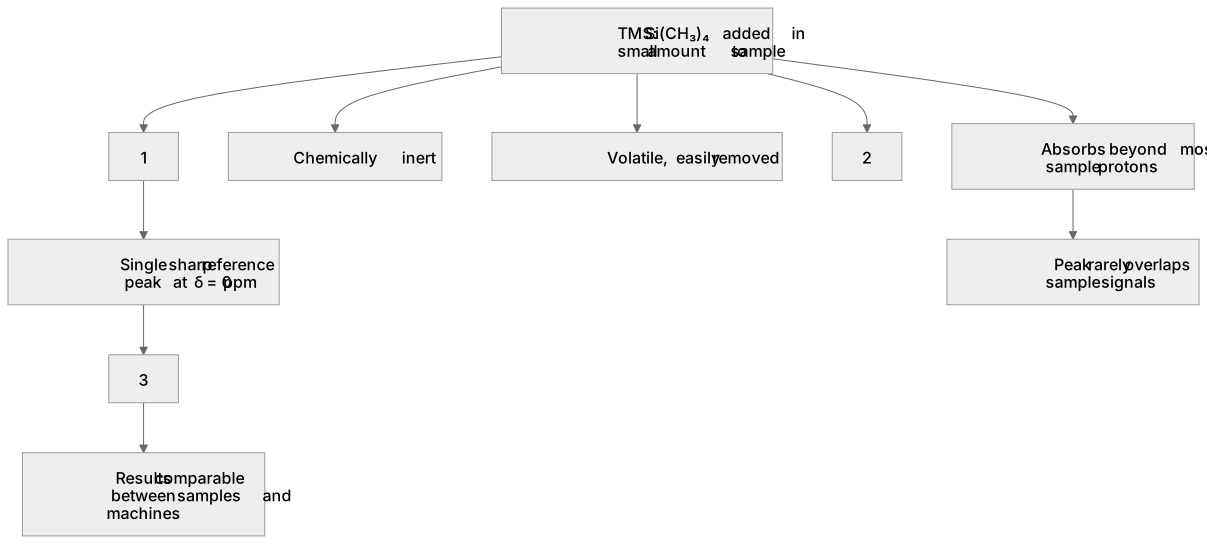
1Box 1
2Box 2
3Box 3
There is more to this lesson
The full lesson goes on to check your understanding and help you earn the marks. Create a free account to carry on, with your progress saved.
A week of Premium from your first lesson · Then the free plan continues · No card, no charge
Test your understanding of Spectroscopy: (d) (i) the use of tetramethylsilane, TMS, as the standard for chemical shift measurements
Active recall beats re-reading. Take an instant quiz now to test what you’ve learned and lock it into long-term memory.
A week of Premium from your first lesson · Then the free plan continues · No card, no charge