OCR · A-Level · Chemistry
Course version: H432 · Version from Sept 2017
(ii) the different types of proton environment present, from chemical…
Full specification wording
Spectroscopy: (ii) the different types of proton environment present, from chemical shift values
Chemical shift values, measured in parts per million (ppm) on the δ scale, tell you what kind of proton environment is present because each type of hydrogen absorbs at a characteristic shift.
- Point 5 of 16
- 4 key terms
Study notes
From the teaching notes for this specification point.
The idea
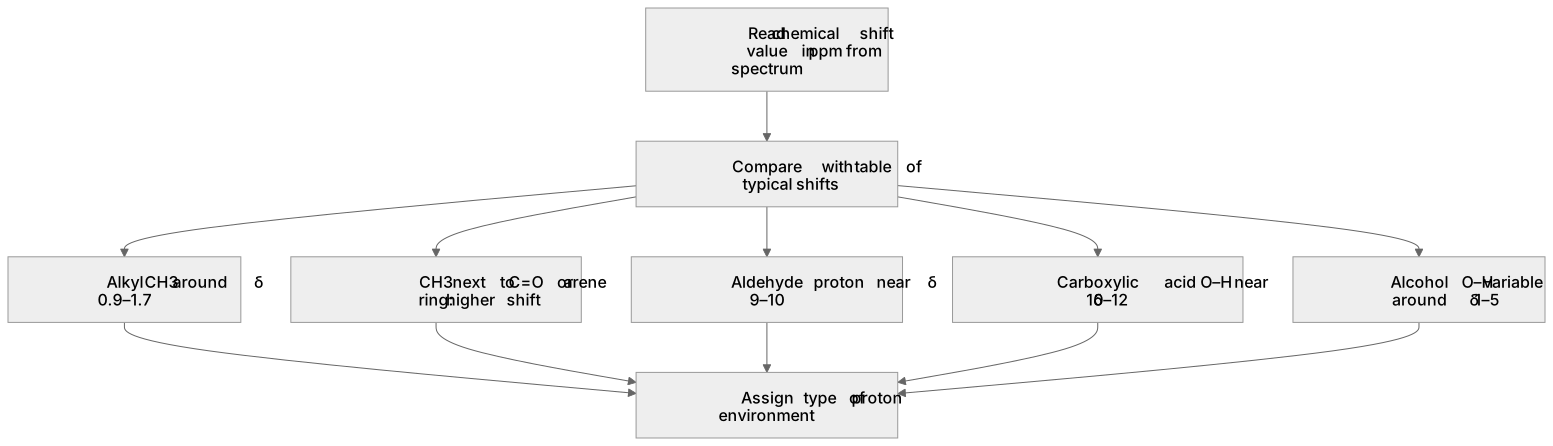
Chemical shift values, measured in parts per million (ppm) on the δ scale, tell you what kind of proton environment is present because each type of hydrogen absorbs at a characteristic shift. Use a data table of typical shifts: alkyl CH₃ hydrogens appear around δ 0.9–1.7, hydrogens on a carbon next to a C=O or arene ring appear higher, an aldehyde hydrogen (RCHO) appears near δ 9–10, a carboxylic acid O–H near δ 10–12 and an alcohol O–H is variable around δ 1–5. For example, a peak near δ 9.8 signals an aldehyde proton, while a peak near δ 2.1 fits a CH₃ next to a carbonyl. Match each observed shift to the closest entry in the table to assign the environment type.
What earns the marks
- Reads each chemical shift value in ppm from the spectrum and compares it with a table of typical shifts.
- Assigns a peak near δ 9–10 to an aldehyde proton environment.
- Assigns a peak near δ 10–12 to a carboxylic acid O–H environment.
- Recognises that an alcohol O–H shift is variable and appears over a broad range.
- Uses the shift value to name the type of proton environment rather than only counting peaks.
Common mistakes and how to put them right
Uses peak height to identify the type of environment.
Put it right: Use the chemical shift value instead.
Assumes every O–H proton appears at the same fixed shift.
Put it right: Treat the alcohol O–H as variable and broad.
Confuses an aldehyde proton near δ 9–10 with a carboxylic acid proton near δ 10–12.
Put it right: Check the exact value against the table.
Exam tips
- Quote the observed shift and the matching table range when assigning an environment.
- Learn the key landmark shifts: aldehyde near δ 9–10 and carboxylic acid near δ 10–12.
- Remember that the area under a peak gives the number of hydrogens, not the type of environment.
Try the lesson
The start of the Spectroscopy: (ii) the different types of proton environment present, from chemical shift values lesson, made from teaching notes for this specification point.
Listen
Chemical shift values, measured in parts per million (ppm) on the δ scale, tell you what kind of proton environment is present because each type of hydrogen absorbs at a characteristic shift. Use a data table of typical shifts: alkyl CH₃ hydrogens appear around δ 0.9–1.7, hydrogens on a carbon next to a C=O or arene ring appear higher, an aldehyde hydrogen (RCHO) appears near δ 9–10, a carboxylic acid O–H near δ 10–12 and an alcohol O–H is variable around δ 1–5. For example, a peak near δ 9.8 signals an aldehyde proton, while a peak near δ 2.1 fits a CH₃ next to a carbonyl. Match each observed shift to the closest entry in the table to assign the environment type. A strong answer earns marks for these points. Reads each chemical shift value in ppm from the spectrum and compares it with a table of typical shifts. Assigns a peak near δ 9–10 to an aldehyde proton environment. Assigns a peak near δ 10–12 to a carboxylic acid O–H environment. Recognises that an alcohol O–H shift is variable and appears over a broad range. Exam tip: Quote the observed shift and the matching table range when assigning an environment.
See it
Key words
Say what each word means before you turn the card.
Chemical shift scale in ppm
Try answering aloud or in your head before turning the card.
Characteristic shifts of proton environments
Try answering aloud or in your head before turning the card.
Use of data tables
Try answering aloud or in your head before turning the card.
Assignment of NMR peaks
Try answering aloud or in your head before turning the card.
See every definition
- Chemical shift scale in ppm
- Measured in parts per million on the δ scale, it tells you what kind of proton environment is present because each type of hydrogen absorbs at a characteristic shift.
- Characteristic shifts of proton environments
- Each type of hydrogen absorbs at a characteristic shift, such as alkyl CH₃ hydrogens around δ 0.9–1.7 and an aldehyde hydrogen near δ 9–10.
- Use of data tables
- A data table of typical shifts is used by matching each observed shift to the closest entry in the table to assign the environment type.
- Assignment of NMR peaks
- The shift value is used to name the type of proton environment rather than only counting peaks.
Label the diagram
Some boxes have lost their names. Pick the right name for each number.
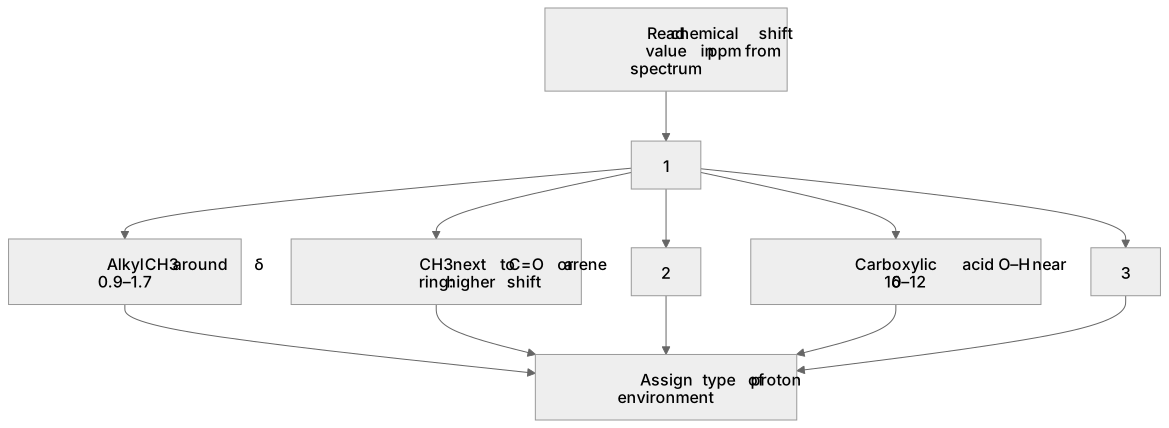
1Box 1
2Box 2
3Box 3
There is more to this lesson
The full lesson goes on to check your understanding and help you earn the marks. Create a free account to carry on, with your progress saved.
A week of Premium from your first lesson · Then the free plan continues · No card, no charge
Test your understanding of Spectroscopy: (ii) the different types of proton environment present, from chemical shift values
Active recall beats re-reading. Take an instant quiz now to test what you’ve learned and lock it into long-term memory.
A week of Premium from your first lesson · Then the free plan continues · No card, no charge