OCR · A-Level · Chemistry
Course version: H432 · Version from Sept 2017
(a) existence of halogens as diatomic molecules and explanation of the…
Full specification wording
The halogens: (a) existence of halogens as diatomic molecules and explanation of the trend in the boiling points of Cl₂, Br₂ and I₂, in terms of induced dipole–dipole interactions (London forces) (see also 2.2.2 k)
Halogens exist as diatomic molecules (F₂, Cl₂, Br₂, I₂) because two halogen atoms share one pair of electrons in a single covalent bond, giving each atom a full outer shell.
- Point 1 of 11
- 4 key terms
Study notes
From the teaching notes for this specification point.
The idea
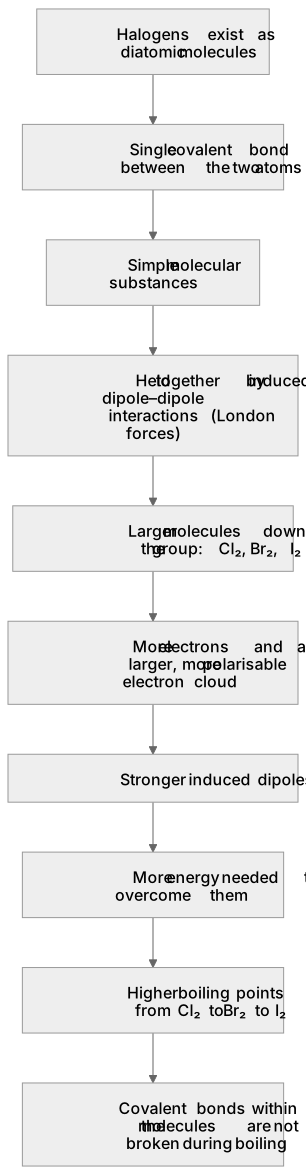
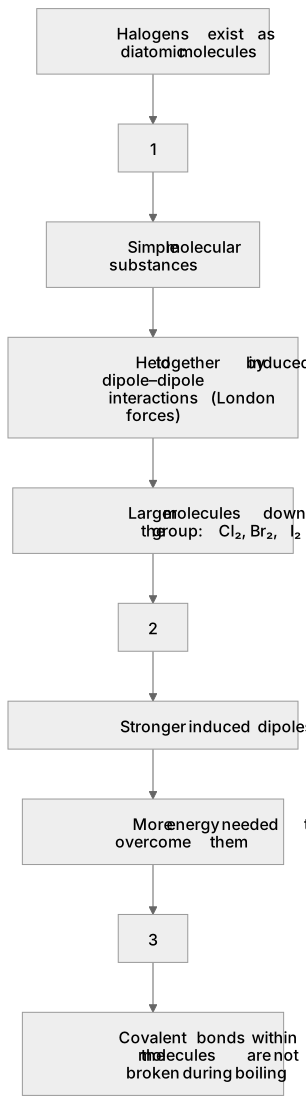
Halogens exist as diatomic molecules (F₂, Cl₂, Br₂, I₂) because two halogen atoms share one pair of electrons in a single covalent bond, giving each atom a full outer shell. The trend to teach is the rise in boiling point from Cl₂ to Br₂ to I₂. All three are simple molecular substances held together in the liquid or solid by induced dipole–dipole interactions, also called London forces. These arise from temporary, fluctuating dipoles in the electron clouds. As the molecules get larger down the group, they have more electrons and a larger, more polarisable electron cloud, so the induced dipoles are stronger and more energy is needed to overcome them. The covalent bonds are not broken during boiling.
What earns the marks
- States that halogens exist as diatomic molecules with a single covalent bond between the two atoms.
- Identifies induced dipole–dipole interactions (London forces) as the intermolecular forces overcome on boiling.
- Explains that larger molecules down the group have more electrons and a more polarisable electron cloud.
- Links stronger induced dipole–dipole interactions to the higher boiling points of Br₂ and I₂ compared with Cl₂.
- Recognises that covalent bonds within the molecules are not broken during boiling.
Common mistakes and how to put them right
Claims that boiling breaks the covalent bonds within the halogen molecules.
Put it right: State that only the intermolecular London forces are overcome.
Describes the intermolecular forces as permanent dipole–dipole or hydrogen bonding.
Put it right: Identify them as induced dipole–dipole (London) forces.
Says boiling point rises because the molecules have a greater relative atomic mass alone.
Put it right: Explain the link through more electrons and greater polarisability giving stronger induced dipoles.
Exam tips
- Name the force precisely as induced dipole–dipole interactions (London forces) rather than a vague reference to intermolecular forces.
- Make the causal chain explicit: more electrons, more polarisable cloud, stronger induced dipoles, more energy to boil.
- Check the order of the trend runs Cl₂ then Br₂ then I₂, matching increasing boiling point.
Try the lesson
The start of the The halogens: (a) existence of halogens as diatomic molecules and explanation of the trend in the boiling points of Cl₂, Br₂ and I₂, in terms of induced dipole–dipole interactions (London forces) (see also 2.2.2 k) lesson, made from teaching notes for this specification point.
Listen
Halogens exist as diatomic molecules (F₂, Cl₂, Br₂, I₂) because two halogen atoms share one pair of electrons in a single covalent bond, giving each atom a full outer shell. The trend to teach is the rise in boiling point from Cl₂ to Br₂ to I₂. All three are simple molecular substances held together in the liquid or solid by induced dipole–dipole interactions, also called London forces. These arise from temporary, fluctuating dipoles in the electron clouds. As the molecules get larger down the group, they have more electrons and a larger, more polarisable electron cloud, so the induced dipoles are stronger and more energy is needed to overcome them. The covalent bonds are not broken during boiling. A strong answer earns marks for these points. States that halogens exist as diatomic molecules with a single covalent bond between the two atoms. Identifies induced dipole–dipole interactions (London forces) as the intermolecular forces overcome on boiling. Explains that larger molecules down the group have more electrons and a more polarisable electron cloud. Links stronger induced dipole–dipole interactions to the higher boiling points of Br₂ and I₂ compared with Cl₂. Exam tip: Name the force precisely as induced dipole–dipole interactions (London forces) rather than a vague reference to intermolecular forces.
See it
Key words
Say what each word means before you turn the card.
Diatomic molecular structure of halogens
Try answering aloud or in your head before turning the card.
Induced dipole–dipole (London) forces
Try answering aloud or in your head before turning the card.
Polarisability and number of electrons
Try answering aloud or in your head before turning the card.
Trend in boiling points down Group 17
Try answering aloud or in your head before turning the card.
See every definition
- Diatomic molecular structure of halogens
- Halogens exist as diatomic molecules because two halogen atoms share one pair of electrons in a single covalent bond, giving each atom a full outer shell.
- Induced dipole–dipole (London) forces
- These are the intermolecular forces, also called London forces, that hold simple molecular substances together in the liquid or solid and arise from temporary, fluctuating dipoles in the electron clouds.
- Polarisability and number of electrons
- As the molecules get larger down the group they have more electrons and a larger, more polarisable electron cloud, so the induced dipoles are stronger.
- Trend in boiling points down Group 17
- The boiling point rises from Cl₂ to Br₂ to I₂ because stronger induced dipole–dipole interactions mean more energy is needed to overcome them, while the covalent bonds are not broken during boiling.
Label the diagram
Some boxes have lost their names. Pick the right name for each number.
1Box 1
2Box 2
3Box 3
There is more to this lesson
The full lesson goes on to check your understanding and help you earn the marks. Create a free account to carry on, with your progress saved.
A week of Premium from your first lesson · Then the free plan continues · No card, no charge
Test your understanding of The halogens: (a) existence of halogens as diatomic molecules and explanation of the trend in the boiling points of Cl₂, Br₂ and I₂, in terms of induced dipole–dipole interactions (London forces) (see also 2.2.2 k)
Active recall beats re-reading. Take an instant quiz now to test what you’ve learned and lock it into long-term memory.
A week of Premium from your first lesson · Then the free plan continues · No card, no charge