OCR · A-Level · Chemistry
Course version: H432 · Version from Sept 2017
(c) the trend in reactivity of the halogens Cl₂, Br₂ and I₂, illustrated…
Full specification wording
The halogens: (c) the trend in reactivity of the halogens Cl₂, Br₂ and I₂, illustrated by reaction with other halide ions
Reactivity decreases down Group 17 from chlorine to bromine to iodine.
- Point 3 of 11
- 4 key terms
Study notes
From the teaching notes for this specification point.
The idea
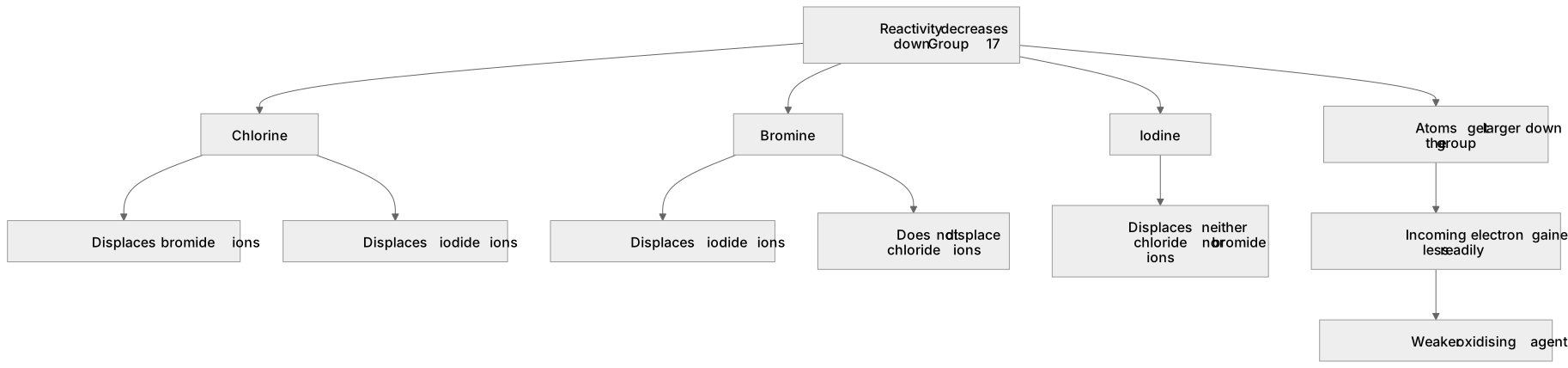
Reactivity decreases down Group 17 from chlorine to bromine to iodine. A more reactive halogen displaces a less reactive halide ion from solution: chlorine displaces bromide and iodide ions, bromine displaces iodide ions, but iodine displaces neither chloride nor bromide ions. For example, chlorine water added to potassium bromide solution turns the solution orange-brown as bromine forms, while adding iodine to potassium chloride gives no reaction. The trend arises because the atoms get larger down the group, so the incoming electron is gained less readily and the halogen is a weaker oxidising agent.
What earns the marks
- States that reactivity decreases from chlorine to bromine to iodine down Group 17.
- Describes chlorine displacing bromide ions and iodide ions from their solutions.
- States that bromine displaces iodide ions but not chloride ions, and iodine displaces neither.
- Explains the trend in terms of increasing atomic size making electron gain less favourable down the group.
Common mistakes and how to put them right
Claims iodine displaces chloride ions.
Put it right: State that iodine is less reactive and displaces neither chloride nor bromide ions.
Reverses the trend by saying reactivity increases down the group.
Put it right: State that reactivity decreases from chlorine to iodine.
Describes displacement without naming the colour change or product formed.
Put it right: Identify the halogen released, such as bromine giving an orange-brown solution.
Exam tips
- Predict displacement outcomes by ranking the halogens chlorine, then bromine, then iodine in decreasing reactivity.
- Name the halogen formed as the product when writing a displacement observation.
- Explain the trend using atomic size and ease of gaining an electron rather than stating it without reason.
Try the lesson
The start of the The halogens: (c) the trend in reactivity of the halogens Cl₂, Br₂ and I₂, illustrated by reaction with other halide ions lesson, made from teaching notes for this specification point.
Listen
Reactivity decreases down Group 17 from chlorine to bromine to iodine. A more reactive halogen displaces a less reactive halide ion from solution: chlorine displaces bromide and iodide ions, bromine displaces iodide ions, but iodine displaces neither chloride nor bromide ions. For example, chlorine water added to potassium bromide solution turns the solution orange-brown as bromine forms, while adding iodine to potassium chloride gives no reaction. The trend arises because the atoms get larger down the group, so the incoming electron is gained less readily and the halogen is a weaker oxidising agent. A strong answer earns marks for these points. States that reactivity decreases from chlorine to bromine to iodine down Group 17. Describes chlorine displacing bromide ions and iodide ions from their solutions. States that bromine displaces iodide ions but not chloride ions, and iodine displaces neither. Explains the trend in terms of increasing atomic size making electron gain less favourable down the group. Exam tip: Predict displacement outcomes by ranking the halogens chlorine, then bromine, then iodine in decreasing reactivity.
See it
Key words
Say what each word means before you turn the card.
Trend in reactivity down Group 17
Try answering aloud or in your head before turning the card.
Displacement reactions of halogens with halide ions
Try answering aloud or in your head before turning the card.
Oxidising power of halogens
Try answering aloud or in your head before turning the card.
Effect of atomic size on electron gain
Try answering aloud or in your head before turning the card.
See every definition
- Trend in reactivity down Group 17
- Reactivity decreases from chlorine to bromine to iodine down Group 17.
- Displacement reactions of halogens with halide ions
- A more reactive halogen displaces a less reactive halide ion from solution, so chlorine displaces bromide and iodide ions, bromine displaces iodide ions, and iodine displaces neither chloride nor bromide ions.
- Oxidising power of halogens
- The halogen is a weaker oxidising agent down the group because the incoming electron is gained less readily.
- Effect of atomic size on electron gain
- The atoms get larger down the group, so the incoming electron is gained less readily.
There is more to this lesson
The full lesson goes on to check your understanding and help you earn the marks. Create a free account to carry on, with your progress saved.
A week of Premium from your first lesson · Then the free plan continues · No card, no charge
Test your understanding of The halogens: (c) the trend in reactivity of the halogens Cl₂, Br₂ and I₂, illustrated by reaction with other halide ions
Active recall beats re-reading. Take an instant quiz now to test what you’ve learned and lock it into long-term memory.
A week of Premium from your first lesson · Then the free plan continues · No card, no charge