OCR · A-Level · Chemistry
Course version: H432 · Version from Sept 2017
(ii) cations: NH₄⁺, by reaction with warm NaOH(aq) forming NH₃.
Full specification wording
The periodic table - 3.1.4 Qualitative analysis: (ii) cations: NH₄⁺, by reaction with warm NaOH(aq) forming NH₃.
The ammonium ion, NH₄⁺, is identified by adding warm sodium hydroxide solution, NaOH(aq), to the sample.
- Point 7 of 7
- 3 key terms
Study notes
From the teaching notes for this specification point.
The idea
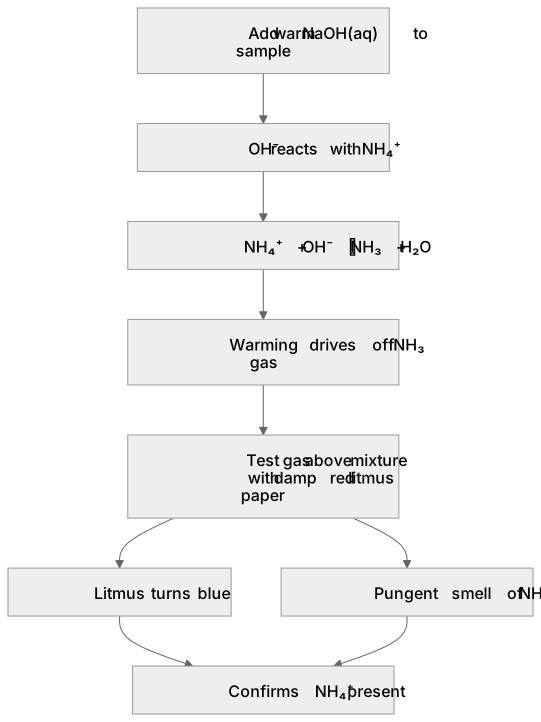
The ammonium ion, NH₄⁺, is identified by adding warm sodium hydroxide solution, NaOH(aq), to the sample. The hydroxide ions react with the ammonium ion in a reversible acid–base step: NH₄⁺ + OH⁻ ⇌ NH₃ + H₂O. Warming shifts the equilibrium and lowers the solubility of ammonia, so NH₃ gas is released. The gas is detected by its pungent smell and by turning damp red litmus paper blue, because NH₃ is an alkaline gas that dissolves to form OH⁻ ions. The test therefore depends on warming, on using NaOH(aq) rather than a dilute acid, and on testing the gas above the mixture rather than the solution itself. A positive result confirms NH₄⁺; no precipitate is expected, which distinguishes it from many metal cations.
What earns the marks
- Identifies NH₄⁺ as the cation tested by reaction with warm NaOH(aq).
- States that warming the mixture with NaOH(aq) releases ammonia gas, NH₃.
- Describes testing the gas with damp red litmus paper turning blue, or notes the pungent smell.
- Explains that OH⁻ reacts with NH₄⁺ to form NH₃ and H₂O, and that warming drives off the gas.
Common mistakes and how to put them right
Expects a coloured precipitate from NH₄⁺.
Put it right: Recognise that the positive result is a gas, not a precipitate.
Uses cold rather than warm NaOH(aq).
Put it right: Warm the mixture so NH₃ is released and detected.
Tests the solution with litmus rather than the gas above it.
Put it right: Hold damp red litmus in the gas.
Confuses NH₃ with an acidic gas.
Put it right: NH₃ turns damp red litmus blue.
Exam tips
- Name both the reagent (NaOH(aq)) and the condition (warm) in your answer.
- State the observation on damp red litmus paper, not just 'a gas is given off'.
- Link the observation to the ion present, writing NH₄⁺ clearly with its charge.
Try the lesson
The start of the The periodic table - 3.1.4 Qualitative analysis: (ii) cations: NH₄⁺, by reaction with warm NaOH(aq) forming NH₃. lesson, made from teaching notes for this specification point.
Listen
The ammonium ion, NH₄⁺, is identified by adding warm sodium hydroxide solution, NaOH(aq), to the sample. The hydroxide ions react with the ammonium ion in a reversible acid–base step: NH₄⁺ + OH⁻ ⇌ NH₃ + H₂O. Warming shifts the equilibrium and lowers the solubility of ammonia, so NH₃ gas is released. The gas is detected by its pungent smell and by turning damp red litmus paper blue, because NH₃ is an alkaline gas that dissolves to form OH⁻ ions. The test therefore depends on warming, on using NaOH(aq) rather than a dilute acid, and on testing the gas above the mixture rather than the solution itself. A positive result confirms NH₄⁺; no precipitate is expected, which distinguishes it from many metal cations. A strong answer earns marks for these points. Identifies NH₄⁺ as the cation tested by reaction with warm NaOH(aq). States that warming the mixture with NaOH(aq) releases ammonia gas, NH₃. Describes testing the gas with damp red litmus paper turning blue, or notes the pungent smell. Explains that OH⁻ reacts with NH₄⁺ to form NH₃ and H₂O, and that warming drives off the gas. Exam tip: Name both the reagent (NaOH(aq)) and the condition (warm) in your answer.
See it
Key words
Say what each word means before you turn the card.
Ammonium ion identification
Try answering aloud or in your head before turning the card.
Acid–base reaction with hydroxide
Try answering aloud or in your head before turning the card.
Gas detection using litmus
Try answering aloud or in your head before turning the card.
See every definition
- Ammonium ion identification
- The ammonium ion, NH₄⁺, is identified by adding warm sodium hydroxide solution, NaOH(aq), to the sample, which releases ammonia gas, NH₃.
- Acid–base reaction with hydroxide
- The hydroxide ions react with the ammonium ion in a reversible acid–base step: NH₄⁺ + OH⁻ ⇌ NH₃ + H₂O.
- Gas detection using litmus
- The gas is detected by its pungent smell and by turning damp red litmus paper blue, because NH₃ is an alkaline gas that dissolves to form OH⁻ ions.
Label the diagram
Some boxes have lost their names. Pick the right name for each number.
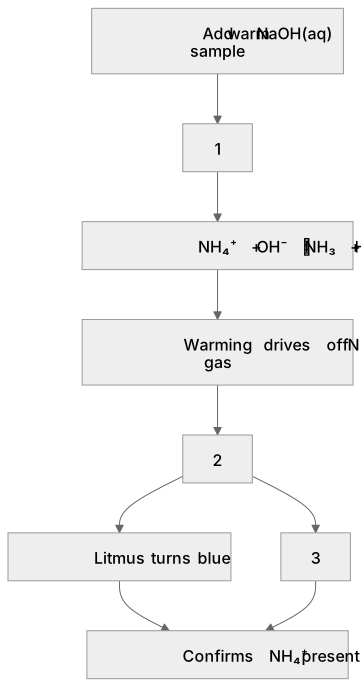
1Box 1
2Box 2
3Box 3
There is more to this lesson
The full lesson goes on to check your understanding and help you earn the marks. Create a free account to carry on, with your progress saved.
A week of Premium from your first lesson · Then the free plan continues · No card, no charge
Test your understanding of The periodic table - 3.1.4 Qualitative analysis: (ii) cations: NH₄⁺, by reaction with warm NaOH(aq) forming NH₃.
Active recall beats re-reading. Take an instant quiz now to test what you’ve learned and lock it into long-term memory.
A week of Premium from your first lesson · Then the free plan continues · No card, no charge