OCR · A-Level · Chemistry
Course version: H432 · Version from Sept 2017
(i) cis–trans isomerism e.g. Pt(NH₃)₂Cl₂ (see also 4.1.3 c–d)
Full specification wording
Transition elements: (i) cis–trans isomerism e.g. Pt(NH₃)₂Cl₂ (see also 4.1.3 c–d)
cis–trans isomerism arises in square-planar complexes of the type Pt(NH₃)₂Cl₂ because the four ligands occupy positions in one plane around the Pt²⁺ centre and two different ligands are each…
- Point 11 of 24
- 3 key terms
Study notes
From the teaching notes for this specification point.
The idea
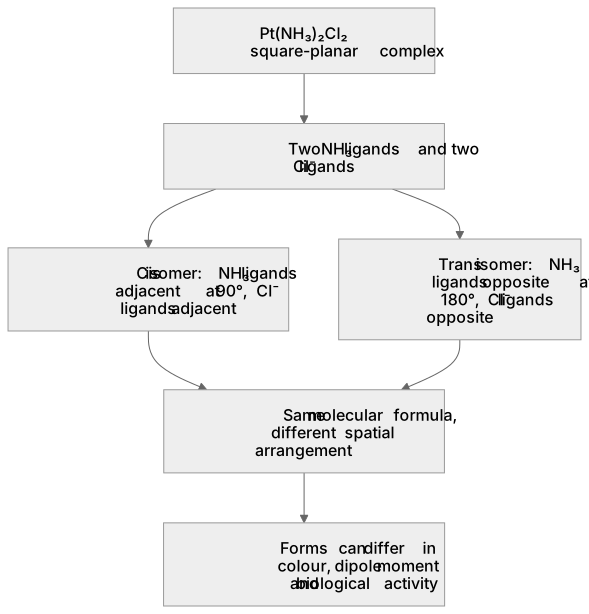
cis–trans isomerism arises in square-planar complexes of the type Pt(NH₃)₂Cl₂ because the four ligands occupy positions in one plane around the Pt²⁺ centre and two different ligands are each present twice. In the cis isomer the two NH₃ ligands sit adjacent at 90°, and the two Cl⁻ ligands also sit adjacent; in the trans isomer the two NH₃ ligands lie opposite at 180°, with the two Cl⁻ ligands opposite each other. Both isomers share the same molecular formula, so isomerism is a difference in spatial arrangement, not in composition. To decide which label applies, pick one ligand type and check whether its two copies are next to each other (cis) or on opposite corners (trans). The two forms can differ in properties such as colour, dipole moment and biological activity, which is why the distinction matters. Link this to the broader idea from 4.1.
What earns the marks
- Identifies that cis–trans isomerism in Pt(NH₃)₂Cl₂ requires a square-planar geometry with two of each ligand.
- States that the cis isomer places the two NH₃ ligands at 90° to each other and the two Cl⁻ ligands likewise adjacent.
- States that the trans isomer places the two NH₃ ligands at 180° opposite each other and the two Cl⁻ ligands likewise opposite.
- Explains that both isomers share the same formula and differ only in the spatial arrangement of ligands.
- Links the square-planar case to the general 4.1.3 idea that cis–trans isomerism needs restricted rotation or rigid geometry.
Common mistakes and how to put them right
Assumes Pt(NH₃)₂Cl₂ is tetrahedral.
Put it right: Treat the complex as square planar so the 90° and 180° positions are meaningful.
Labels the isomer with adjacent identical ligands as trans.
Put it right: Assign cis to adjacent ligands and trans to opposite ligands.
Claims the two isomers have different molecular formulae.
Put it right: State that the formula is identical and only the arrangement differs.
Exam tips
- Sketch both isomers with the Pt at the centre and label the 90° and 180° angles before choosing cis or trans.
- Check one ligand type at a time: if its two copies are adjacent the complex is cis, if opposite it is trans.
- Read the option carefully for the words adjacent/opposite rather than relying on a remembered picture.
Try the lesson
The start of the Transition elements: (i) cis–trans isomerism e.g. Pt(NH₃)₂Cl₂ (see also 4.1.3 c–d) lesson, made from teaching notes for this specification point.
Listen
cis–trans isomerism arises in square-planar complexes of the type Pt(NH₃)₂Cl₂ because the four ligands occupy positions in one plane around the Pt²⁺ centre and two different ligands are each present twice. In the cis isomer the two NH₃ ligands sit adjacent at 90°, and the two Cl⁻ ligands also sit adjacent; in the trans isomer the two NH₃ ligands lie opposite at 180°, with the two Cl⁻ ligands opposite each other. Both isomers share the same molecular formula, so isomerism is a difference in spatial arrangement, not in composition. To decide which label applies, pick one ligand type and check whether its two copies are next to each other (cis) or on opposite corners (trans). The two forms can differ in properties such as colour, dipole moment and biological activity, which is why the distinction matters. Link this to the broader idea from 4.1. A strong answer earns marks for these points. Identifies that cis–trans isomerism in Pt(NH₃)₂Cl₂ requires a square-planar geometry with two of each ligand. States that the cis isomer places the two NH₃ ligands at 90° to each other and the two Cl⁻ ligands likewise adjacent. States that the trans isomer places the two NH₃ ligands at 180° opposite each other and the two Cl⁻ ligands likewise opposite. Explains that both isomers share the same formula and differ only in the spatial arrangement of ligands. Exam tip: Sketch both isomers with the Pt at the centre and label the 90° and 180° angles before choosing cis or trans.
See it
Key words
Say what each word means before you turn the card.
Square-planar geometry of Pt(II) complexes
Try answering aloud or in your head before turning the card.
Same formula, different spatial arrangement
Try answering aloud or in your head before turning the card.
Link to general cis–trans isomerism from 4.1.3
Try answering aloud or in your head before turning the card.
See every definition
- Square-planar geometry of Pt(II) complexes
- The four ligands occupy positions in one plane around the Pt²⁺ centre, so the 90° and 180° positions are meaningful.
- Same formula, different spatial arrangement
- Both isomers share the same molecular formula, so isomerism is a difference in spatial arrangement, not in composition.
- Link to general cis–trans isomerism from 4.1.3
- The square-planar case links to the broader idea from 4.1.3 that cis–trans isomerism needs restricted rotation or rigid geometry.
Label the diagram
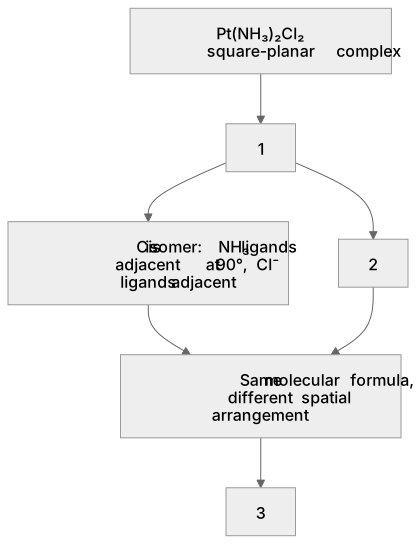
Some boxes have lost their names. Pick the right name for each number.
1Box 1
2Box 2
3Box 3
There is more to this lesson
The full lesson goes on to check your understanding and help you earn the marks. Create a free account to carry on, with your progress saved.
A week of Premium from your first lesson · Then the free plan continues · No card, no charge
Test your understanding of Transition elements: (i) cis–trans isomerism e.g. Pt(NH₃)₂Cl₂ (see also 4.1.3 c–d)
Active recall beats re-reading. Take an instant quiz now to test what you’ve learned and lock it into long-term memory.
A week of Premium from your first lesson · Then the free plan continues · No card, no charge