OCR · A-Level · Chemistry
Course version: H432 · Version from Sept 2017
Transition elements: (i) precipitation reactions
Precipitation reactions of transition metal ions in aqueous solution are tested by adding a small volume of aqueous sodium hydroxide or aqueous ammonia and observing the hydroxide precipitate that…
- Point 20 of 24
- 4 key terms
Study notes
From the teaching notes for this specification point.
The idea
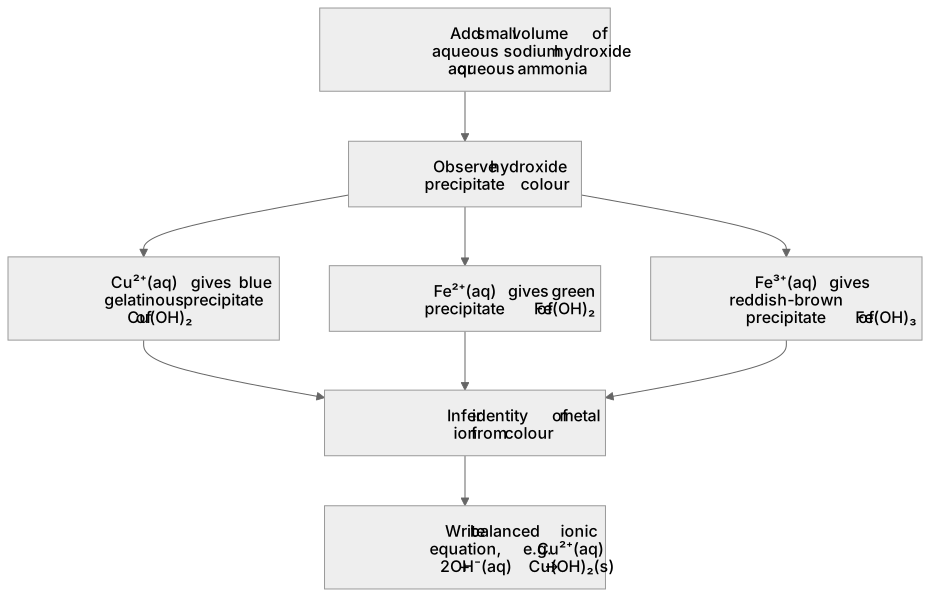
Precipitation reactions of transition metal ions in aqueous solution are tested by adding a small volume of aqueous sodium hydroxide or aqueous ammonia and observing the hydroxide precipitate that forms. For example, Cu²⁺(aq) with OH⁻(aq) gives a blue gelatinous precipitate of Cu(OH)₂, while Fe²⁺(aq) gives a green precipitate of Fe(OH)₂ and Fe³⁺(aq) gives a reddish-brown precipitate of Fe(OH)₃. The identity of the metal ion is inferred from the colour of the precipitate and, where relevant, its behaviour in excess reagent. A multiple-choice question may ask you to select the correct ion–precipitate colour pairing or the correct ionic equation, so learn each colour and balance the charges and atoms in the equation.
What earns the marks
- Selects the correct precipitate colour for the named transition metal ion, for example a blue precipitate for Cu²⁺ with aqueous sodium hydroxide.
- Writes a balanced ionic equation for the precipitation, for example Cu²⁺(aq) + 2OH⁻(aq) → Cu(OH)₂(s).
- Distinguishes Fe²⁺ from Fe³⁺ by the green colour of Fe(OH)₂ against the reddish-brown colour of Fe(OH)₃.
- Identifies that the precipitate forms because the hydroxide ion concentration exceeds the solubility product of the metal hydroxide.
Common mistakes and how to put them right
Confuses the green Fe(OH)₂ precipitate with the reddish-brown Fe(OH)₃ precipitate.
Put it right: Learn each colour with its oxidation state.
Omits the state symbols or the charges in the ionic equation.
Put it right: Write Cu²⁺(aq) + 2OH⁻(aq) → Cu(OH)₂(s) with all symbols present.
Assumes every transition metal hydroxide precipitate is the same colour.
Put it right: Record the specific colour for each ion tested.
Exam tips
- Learn a colour table for Cu²⁺, Fe²⁺, Fe³⁺, Mn²⁺ and Cr³⁺ hydroxides before the exam.
- Check that the ionic equation balances both atoms and charge on each side.
- Read the question carefully to see whether it asks for the colour, the formula or the ionic equation.
Try the lesson
The start of the Transition elements: (i) precipitation reactions lesson, made from teaching notes for this specification point.
Listen
Precipitation reactions of transition metal ions in aqueous solution are tested by adding a small volume of aqueous sodium hydroxide or aqueous ammonia and observing the hydroxide precipitate that forms. For example, Cu²⁺(aq) with OH⁻(aq) gives a blue gelatinous precipitate of Cu(OH)₂, while Fe²⁺(aq) gives a green precipitate of Fe(OH)₂ and Fe³⁺(aq) gives a reddish-brown precipitate of Fe(OH)₃. The identity of the metal ion is inferred from the colour of the precipitate and, where relevant, its behaviour in excess reagent. A multiple-choice question may ask you to select the correct ion–precipitate colour pairing or the correct ionic equation, so learn each colour and balance the charges and atoms in the equation. A strong answer earns marks for these points. Selects the correct precipitate colour for the named transition metal ion, for example a blue precipitate for Cu²⁺ with aqueous sodium hydroxide. Writes a balanced ionic equation for the precipitation, for example Cu²⁺(aq) + 2OH⁻(aq) → Cu(OH)₂(s). Distinguishes Fe²⁺ from Fe³⁺ by the green colour of Fe(OH)₂ against the reddish-brown colour of Fe(OH)₃. Identifies that the precipitate forms because the hydroxide ion concentration exceeds the solubility product of the metal hydroxide. Exam tip: Learn a colour table for Cu²⁺, Fe²⁺, Fe³⁺, Mn²⁺ and Cr³⁺ hydroxides before the exam.
See it
Key words
Say what each word means before you turn the card.
Colours of transition metal hydroxide precipitates
Try answering aloud or in your head before turning the card.
Balanced ionic equations for precipitation
Try answering aloud or in your head before turning the card.
Distinguishing oxidation states by precipitate colour
Try answering aloud or in your head before turning the card.
Solubility and formation of sparingly soluble hydroxides
Try answering aloud or in your head before turning the card.
See every definition
- Colours of transition metal hydroxide precipitates
- The identity of the metal ion is inferred from the colour of the hydroxide precipitate that forms when aqueous sodium hydroxide or aqueous ammonia is added.
- Balanced ionic equations for precipitation
- Equations such as Cu²⁺(aq) + 2OH⁻(aq) → Cu(OH)₂(s) must balance both atoms and charge on each side, with all state symbols present.
- Distinguishing oxidation states by precipitate colour
- Fe²⁺ is distinguished from Fe³⁺ by the green colour of Fe(OH)₂ against the reddish-brown colour of Fe(OH)₃.
- Solubility and formation of sparingly soluble hydroxides
- The precipitate forms because the hydroxide ion concentration exceeds the solubility product of the metal hydroxide.
Label the diagram
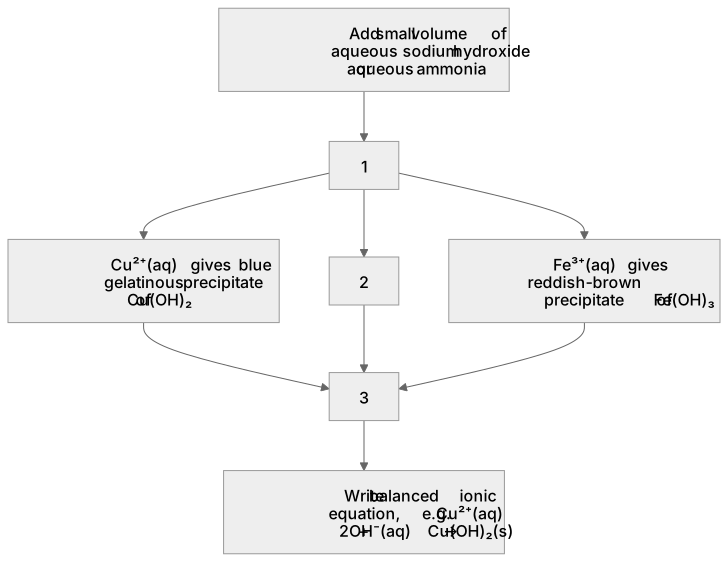
Some boxes have lost their names. Pick the right name for each number.
1Box 1
2Box 2
3Box 3
There is more to this lesson
The full lesson goes on to check your understanding and help you earn the marks. Create a free account to carry on, with your progress saved.
A week of Premium from your first lesson · Then the free plan continues · No card, no charge
Test your understanding of Transition elements: (i) precipitation reactions
Active recall beats re-reading. Take an instant quiz now to test what you’ve learned and lock it into long-term memory.
A week of Premium from your first lesson · Then the free plan continues · No card, no charge