OCR · A-Level · Chemistry
Course version: H432 · Version from Sept 2017
(ii) four-fold coordination with either a planar or tetrahedral shape (see…
Full specification wording
Transition elements: (ii) four-fold coordination with either a planar or tetrahedral shape (see also 2.2.2 g–h)
Four-fold coordination means a central metal ion is bonded to four donor atoms.
- Point 9 of 24
- 4 key terms
Study notes
From the teaching notes for this specification point.
The idea
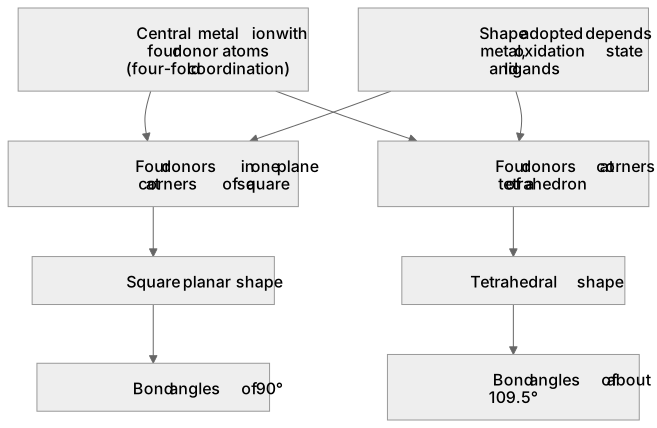
Four-fold coordination means a central metal ion is bonded to four donor atoms. Those four donors can lie in one plane at the corners of a square, giving a square planar shape with bond angles of 90°, or they can sit at the corners of a tetrahedron, giving a tetrahedral shape with bond angles of about 109.5°. The shape adopted depends on the metal, its oxidation state and the ligands: for example, [Cu(NH₃)₄]²⁺ and cisplatin, [Pt(NH₃)₂Cl₂], are square planar, whereas [CuCl₄]²⁻ and [CoCl₄]²⁻ are tetrahedral. The cross-reference to 2.2.2 g–h reminds you to apply the same VSEPR-style shape reasoning and bond-angle vocabulary used for simple molecules. When answering, count the donor atoms bonded to the metal, decide whether they are coplanar or three-dimensional, and state the shape and angle together.
What earns the marks
- Counts four donor atoms bonded to the central metal ion to establish four-fold coordination.
- Distinguishes a square planar arrangement, with the four donors in one plane and 90° bond angles, from a tetrahedral arrangement.
- States that a tetrahedral complex has bond angles of about 109.5°.
- Links the shape adopted to the identity of the metal ion, its oxidation state and the ligands present.
- Applies the shape and bond-angle reasoning from simple molecules to complexes.
Common mistakes and how to put them right
Confuses four-fold coordination with an octahedral complex.
Put it right: Count the donor atoms and confirm there are exactly four.
Describes a tetrahedral complex as having 90° bond angles.
Put it right: State approximately 109.5° instead.
Assumes every four-coordinate complex is tetrahedral.
Put it right: Recognise that square planar is also possible and depends on the metal and ligands.
Treats the number of ligands as the number of donor atoms when a ligand is multidentate.
Put it right: Count donor atoms, not ligand molecules.
Exam tips
- Always state both the shape and a bond angle, because the two together show you understand the geometry.
- Name a specific example such as [CuCl₄]²⁻ for tetrahedral or cisplatin for square planar to support your reasoning.
- Read the question carefully to see whether it asks for the shape, the bond angle or both before writing.
Try the lesson
The start of the Transition elements: (ii) four-fold coordination with either a planar or tetrahedral shape (see also 2.2.2 g–h) lesson, made from teaching notes for this specification point.
Listen
Four-fold coordination means a central metal ion is bonded to four donor atoms. Those four donors can lie in one plane at the corners of a square, giving a square planar shape with bond angles of 90°, or they can sit at the corners of a tetrahedron, giving a tetrahedral shape with bond angles of about 109.5°. The shape adopted depends on the metal, its oxidation state and the ligands: for example, [Cu(NH₃)₄]²⁺ and cisplatin, [Pt(NH₃)₂Cl₂], are square planar, whereas [CuCl₄]²⁻ and [CoCl₄]²⁻ are tetrahedral. The cross-reference to 2.2.2 g–h reminds you to apply the same VSEPR-style shape reasoning and bond-angle vocabulary used for simple molecules. When answering, count the donor atoms bonded to the metal, decide whether they are coplanar or three-dimensional, and state the shape and angle together. A strong answer earns marks for these points. Counts four donor atoms bonded to the central metal ion to establish four-fold coordination. Distinguishes a square planar arrangement, with the four donors in one plane and 90° bond angles, from a tetrahedral arrangement. States that a tetrahedral complex has bond angles of about 109.5°. Links the shape adopted to the identity of the metal ion, its oxidation state and the ligands present. Exam tip: Always state both the shape and a bond angle, because the two together show you understand the geometry.
See it
Key words
Say what each word means before you turn the card.
Four-fold coordination
Try answering aloud or in your head before turning the card.
Square planar geometry
Try answering aloud or in your head before turning the card.
Tetrahedral geometry
Try answering aloud or in your head before turning the card.
Bond angles and shape prediction
Try answering aloud or in your head before turning the card.
See every definition
- Four-fold coordination
- A central metal ion is bonded to four donor atoms, which can lie in one plane or sit at the corners of a tetrahedron.
- Square planar geometry
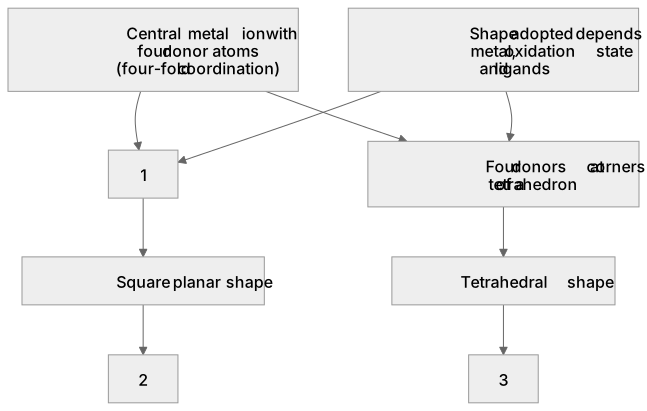
- The four donors lie in one plane at the corners of a square, giving bond angles of 90°.
- Tetrahedral geometry
- The four donors sit at the corners of a tetrahedron, giving bond angles of about 109.5°.
- Bond angles and shape prediction
- Count the donor atoms bonded to the metal, decide whether they are coplanar or three-dimensional, and state the shape and angle together.
Label the diagram
Some boxes have lost their names. Pick the right name for each number.
1Box 1
2Box 2
3Box 3
There is more to this lesson
The full lesson goes on to check your understanding and help you earn the marks. Create a free account to carry on, with your progress saved.
A week of Premium from your first lesson · Then the free plan continues · No card, no charge
Test your understanding of Transition elements: (ii) four-fold coordination with either a planar or tetrahedral shape (see also 2.2.2 g–h)
Active recall beats re-reading. Take an instant quiz now to test what you’ve learned and lock it into long-term memory.
A week of Premium from your first lesson · Then the free plan continues · No card, no charge