OCR · A-Level · Chemistry
Course version: H432 · Version from Sept 2017
(e) use of a volumetric flask, including accurate technique for making up…
Full specification wording
Use of apparatus and techniques: (e) use of a volumetric flask, including accurate technique for making up a standard solution
A standard solution is one of accurately known concentration, made in a volumetric flask of fixed capacity, such as 250 cm³.
- Point 8 of 17
- 4 key terms
Study notes
From the teaching notes for this specification point.
The idea
A standard solution is one of accurately known concentration, made in a volumetric flask of fixed capacity, such as 250 cm³. Weigh the solid accurately, dissolve it in a small volume of solvent in a beaker, and transfer the solution to the flask through a funnel, rinsing the beaker and glassware into the flask so no solute is lost. Add solvent until the level is near the graduation mark, then add it dropwise with a dropping pipette until the bottom of the meniscus sits on the mark, with the eye level with the mark. Stopper and invert the flask repeatedly to mix thoroughly. The flask is calibrated to contain its stated volume at a specified temperature, so read it at room temperature.
What earns the marks
- States that a volumetric flask is calibrated to contain a fixed, accurately known volume at a stated temperature, so it is used to prepare a solution of known concentration.
- Describes transferring the dissolved solid quantitatively, rinsing the beaker and funnel into the flask so that no solute is left behind.
- Adds solvent dropwise near the graduation mark until the bottom of the meniscus is level with the mark, viewed at eye level.
- Stops and inverts the flask several times after making up to the mark so the solution is homogeneous.
- Recognises that the volume is fixed by the flask, so concentration is calculated from the accurately known amount of substance and the flask volume.
Common mistakes and how to put them right
Fills the flask straight to the mark before the solid has fully dissolved.
Put it right by dissolving the solid in a small volume first, then making up to the mark.
Leaves the beaker or funnel unrinsed after transfer.
Put it right by rinsing the beaker and funnel into the flask so all the solute reaches the flask.
Reads the graduation mark from above or below.
Put it right by aligning the eye with the mark so the bottom of the meniscus sits on it.
Skips mixing after making up to the mark.
Put it right by stoppering and inverting the flask repeatedly to give a uniform concentration.
Exam tips
- Sequence the steps in order: weigh, dissolve, transfer with rinsing, make up to the mark dropwise, then mix.
- Explain why each step matters, for example that rinsing prevents loss of solute and that dropwise addition prevents overshooting the mark.
- State that the flask volume is fixed and accurate, which is why concentration is calculated from the amount of substance and that volume.
Try the lesson
The start of the Use of apparatus and techniques: (e) use of a volumetric flask, including accurate technique for making up a standard solution lesson, made from teaching notes for this specification point.
Listen
A standard solution is one of accurately known concentration, made in a volumetric flask of fixed capacity, such as 250 cm³. Weigh the solid accurately, dissolve it in a small volume of solvent in a beaker, and transfer the solution to the flask through a funnel, rinsing the beaker and glassware into the flask so no solute is lost. Add solvent until the level is near the graduation mark, then add it dropwise with a dropping pipette until the bottom of the meniscus sits on the mark, with the eye level with the mark. Stopper and invert the flask repeatedly to mix thoroughly. The flask is calibrated to contain its stated volume at a specified temperature, so read it at room temperature. A strong answer earns marks for these points. States that a volumetric flask is calibrated to contain a fixed, accurately known volume at a stated temperature, so it is used to prepare a solution of known concentration. Describes transferring the dissolved solid quantitatively, rinsing the beaker and funnel into the flask so that no solute is left behind. Adds solvent dropwise near the graduation mark until the bottom of the meniscus is level with the mark, viewed at eye level. Stops and inverts the flask several times after making up to the mark so the solution is homogeneous. A common slip: Fills the flask straight to the mark before the solid has fully dissolved. Instead, dissolving the solid in a small volume first, then making up to the mark. Exam tip: Sequence the steps in order: weigh, dissolve, transfer with rinsing, make up to the mark dropwise, then mix.
See it
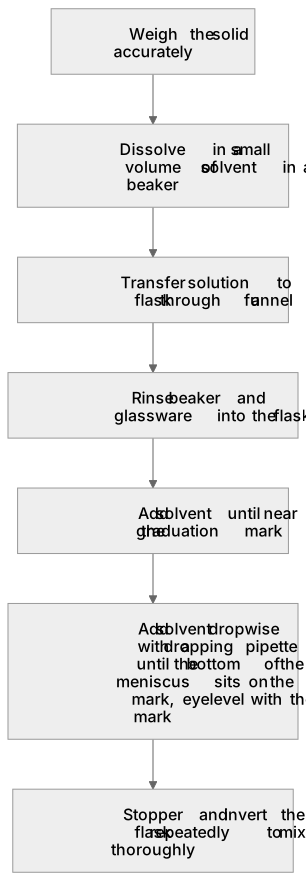
Put it in order
Put these steps in the order they happen.
- 1. Stopper and invert the flask repeatedly to mix thoroughly
- 2. Add solvent dropwise with a dropping pipette until the bottom of the meniscus sits on the mark, eye level with the mark
- 3. Transfer solution to flask through a funnel
- 4. Add solvent until near the graduation mark
- 5. Weigh the solid accurately
- 6. Dissolve in a small volume of solvent in a beaker
- 7. Rinse beaker and glassware into the flask
Key words
Say what each word means before you turn the card.
Volumetric flask calibrated to a fixed volume
Try answering aloud or in your head before turning the card.
Quantitative transfer of solute with rinsing
Try answering aloud or in your head before turning the card.
Meniscus read at eye level on the graduation mark
Try answering aloud or in your head before turning the card.
Mixing by inversion to give a homogeneous standard solution
Try answering aloud or in your head before turning the card.
See every definition
- Volumetric flask calibrated to a fixed volume
- A flask calibrated to contain its stated volume at a specified temperature, so it is used to prepare a solution of known concentration.
- Quantitative transfer of solute with rinsing
- Transferring the solution to the flask through a funnel and rinsing the beaker and glassware into the flask so no solute is lost.
- Meniscus read at eye level on the graduation mark
- Adding solvent dropwise with a dropping pipette until the bottom of the meniscus sits on the mark, with the eye level with the mark.
- Mixing by inversion to give a homogeneous standard solution
- Stoppering and inverting the flask repeatedly after making up to the mark to mix thoroughly.
Label the diagram
Some boxes have lost their names. Pick the right name for each number.
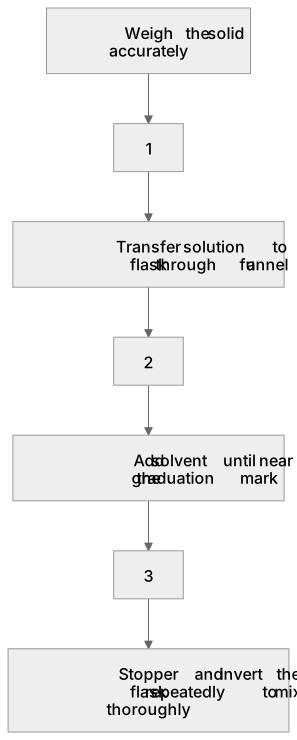
1Box 1
2Box 2
3Box 3
There is more to this lesson
The full lesson goes on to check your understanding and help you earn the marks. Create a free account to carry on, with your progress saved.
A week of Premium from your first lesson · Then the free plan continues · No card, no charge
Test your understanding of Use of apparatus and techniques: (e) use of a volumetric flask, including accurate technique for making up a standard solution
Active recall beats re-reading. Take an instant quiz now to test what you’ve learned and lock it into long-term memory.
A week of Premium from your first lesson · Then the free plan continues · No card, no charge