AQA · GCSE · Combined Science
Course version: 8464 · Version from Sept 2018
Final velocity ² −initial velocity ² = 2 × acceleration × distance
Full specification wording
Acceleration: final velocity ² −initial velocity ² = 2 × acceleration × distance
This equation links the change in velocity of an object to its acceleration and the distance travelled, but only when acceleration is uniform.
Checked against the AQA 8464 specification (opens in a new tab) on .
- Point 14 of 21
- 2 key terms
Study notes
From the checked teaching notes for this specification point.
The idea
This equation links the change in velocity of an object to its acceleration and the distance travelled, but only when acceleration is uniform. Written as v² − u² = 2 × a × s, it avoids needing time. For example, a car accelerating uniformly from 8 m/s to 20 m/s over 60 m: v² − u² = 400 − 64 = 336 m²/s², so 2 × a × 60 = 336, giving a = 2.8 m/s². Rearranging is a key skill: make the unknown the subject before substituting. Because velocity is squared, any negative sign indicating direction is lost; therefore, direction must be handled carefully through the signs of acceleration and displacement. Always square the full velocity value, including its unit, so the unit becomes m²/s².
What earns the marks
- State the equation as v² − u² = 2 × a × s and identify each symbol with its unit: v and u in m/s, a in m/s², s in m.
- Substitute numerical values only after rearranging the equation for the required quantity, keeping the squared terms intact.
- Calculate v² and u² separately, subtract, then divide by 2 × s to find acceleration, or by 2 × a to find distance.
- Interpret the signs of acceleration and displacement carefully, as squaring velocities removes their directional signs.
- Check that the final unit follows from the rearrangement, for example m²/s² divided by m gives m/s² for acceleration.
Common mistakes and how to put them right
Squaring only the number and not the unit, or writing v² as v × 2.
Put it right: Square the full quantity, so (20 m/s)² = 400 m²/s².
Forgetting to subtract u² before dividing by 2 × s.
Put it right: Complete v² − u² first, then divide by the product 2 × s.
Using the equation when acceleration is not uniform.
Put it right: This equation applies only to uniform acceleration, so check the motion description before using it.
Exam tips
- Write the rearranged equation before substituting numbers; this makes method clear and reduces arithmetic slips.
- Keep squared units throughout the working, then simplify at the end to the unit of the unknown.
- If the question gives time as well, decide whether this equation or a = (v − u) / t is more direct; do not mix equations incorrectly.
Try the lesson
The start of the Acceleration: final velocity ² −initial velocity ² = 2 × acceleration × distance lesson, made from checked teaching notes for this specification point.
Have a go first
A cyclist starts from rest and accelerates at 2 m/s² over a distance of 9 m. Using final velocity² − initial velocity² = 2 × acceleration × distance, what is the final velocity of the cyclist?
Listen
This equation links the change in velocity of an object to its acceleration and the distance travelled, but only when acceleration is uniform. Written as v² − u² = 2 × a × s, it avoids needing time. For example, a car accelerating uniformly from 8 m/s to 20 m/s over 60 m: v² − u² = 400 − 64 = 336 m²/s², so 2 × a × 60 = 336, giving a = 2.8 m/s². Rearranging is a key skill: make the unknown the subject before substituting. Because velocity is squared, any negative sign indicating direction is lost; therefore, direction must be handled carefully through the signs of acceleration and displacement. Always square the full velocity value, including its unit, so the unit becomes m²/s². A strong answer earns marks for these points. State the equation as v² − u² = 2 × a × s and identify each symbol with its unit: v and u in m/s, a in m/s², s in m. Substitute numerical values only after rearranging the equation for the required quantity, keeping the squared terms intact. Calculate v² and u² separately, subtract, then divide by 2 × s to find acceleration, or by 2 × a to find distance. Interpret the signs of acceleration and displacement carefully, as squaring velocities removes their directional signs. A common slip: Squaring only the number and not the unit, or writing v² as v × 2. Instead, square the full quantity, so (20 m/s)² = 400 m²/s². Exam tip: Write the rearranged equation before substituting numbers; this makes method clear and reduces arithmetic slips.
See it
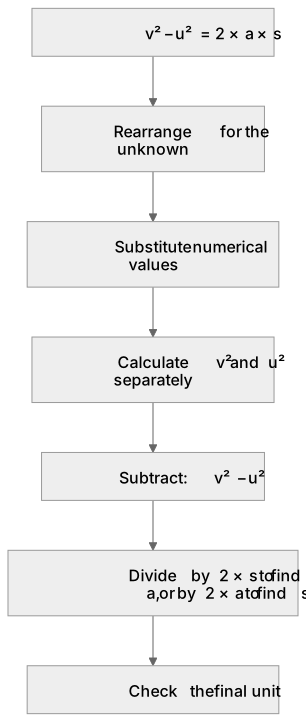
Put it in order
Put these steps in the order they happen.
- 1. Check the final unit
- 2. Divide by 2 × s to find a, or by 2 × a to find s
- 3. Substitute numerical values
- 4. Subtract: v² − u²
- 5. v² − u² = 2 × a × s
- 6. Rearrange for the unknown
- 7. Calculate v² and u² separately
Key words
Say what each word means before you turn the card.
Uniform acceleration
Try answering aloud or in your head before turning the card.
Rearranging equations
Try answering aloud or in your head before turning the card.
See every definition
- Uniform acceleration
- Acceleration that stays constant, which is the only condition under which the equation linking change in velocity to acceleration and distance applies.
- Rearranging equations
- Making the unknown the subject of the equation before substituting numerical values, which is a key skill.
Label the diagram
Some boxes have lost their names. Pick the right name for each number.
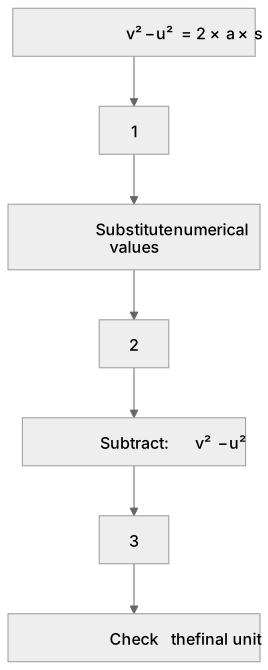
1Box 1
2Box 2
3Box 3
There is more to this lesson
The full lesson goes on to check your understanding and help you earn the marks. Create a free account to carry on, with your progress saved.
A week of Premium from your first lesson · Then the free plan continues · No card, no charge
Test your understanding of Acceleration: final velocity ² −initial velocity ² = 2 × acceleration × distance
Active recall beats re-reading. Take an instant quiz now to test what you’ve learned and lock it into long-term memory.
A week of Premium from your first lesson · Then the free plan continues · No card, no charge