AQA · GCSE · Combined Science
Course version: 8464 · Version from Sept 2018
(HT only) The distance travelled by an object (or displacement of an…
Full specification wording
Acceleration: (HT only) The distance travelled by an object (or displacement of an object) can be calculated from the area under a velocity–time graph.
This is a Higher Tier only skill.
Checked against the AQA 8464 specification (opens in a new tab) on .
- Point 10 of 21
- 4 key terms
Study notes
From the checked teaching notes for this specification point.
The idea
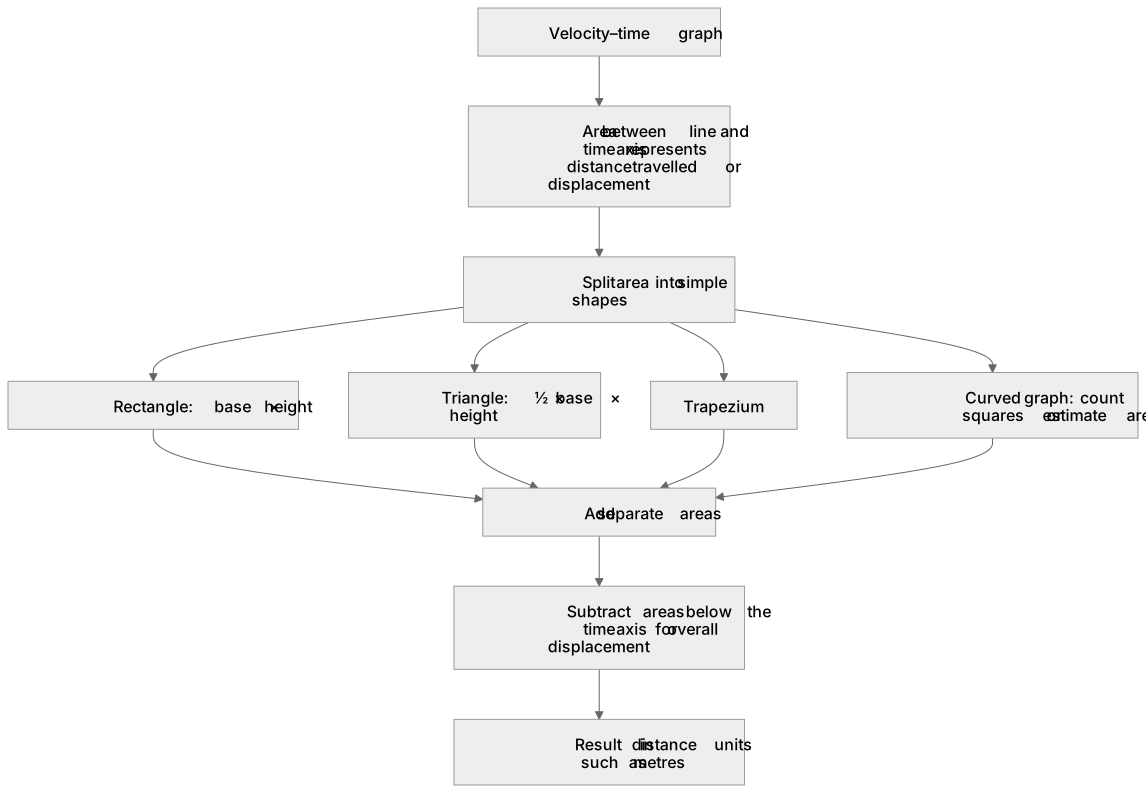
This is a Higher Tier only skill. On a velocity–time graph, the area between the line and the time axis represents the distance travelled, or displacement when direction is included. This works because distance is velocity multiplied by time, and the area of a rectangle is height × width. Split the area into simple shapes: rectangles for constant velocity, triangles for uniform acceleration, and trapezia for combined changes. For example, a car accelerating from rest to 20 m/s in 10 s covers a triangle area of ½ × 10 s × 20 m/s = 100 m. Areas below the time axis represent negative displacement, so subtract them when finding overall displacement. Count squares for curved graphs, or estimate the area between the curve and the axis.
What earns the marks
- State that the area between the velocity–time line and the time axis represents distance travelled or displacement (Higher Tier only).
- Divide a compound area into rectangles, triangles and trapezia, or count squares beneath the line, before calculating.
- Apply the correct area formulae, such as base × height for a rectangle and ½ × base × height for a triangle, using values read from the axes.
- Combine the separate areas by adding them, and subtract areas below the time axis to obtain overall displacement.
- Include correct units for the result, such as metres, and recognise that area above and below the axis has opposite sign for displacement.
Common mistakes and how to put them right
Using the gradient instead of the area to find distance.
Put it right by remembering gradient gives acceleration while area gives distance or displacement.
Forgetting the factor of ½ in a triangular area.
Put it right by identifying the shape as a triangle before substituting.
Adding areas below the time axis as if they were positive.
Put it right by treating them as negative displacement and subtracting them.
Exam tips
- Sketch dividing lines on the graph to split the area into recognisable shapes before calculating.
- Write each area calculation separately, for example triangle = ½ × 10 s × 20 m/s = 100 m, then total the values.
- Check that the unit of the answer is a distance unit such as m, since m/s multiplied by s gives m.
Try the lesson
The start of the Acceleration: (HT only) The distance travelled by an object (or displacement of an object) can be calculated from the area under a velocity–time graph. lesson, made from checked teaching notes for this specification point.
Have a go first
A cyclist travels at a constant velocity of 6 m/s for 10 s. On a velocity–time graph this motion is a horizontal line. What area lies under the line, and what does this area represent?
Listen
This is a Higher Tier only skill. On a velocity–time graph, the area between the line and the time axis represents the distance travelled, or displacement when direction is included. This works because distance is velocity multiplied by time, and the area of a rectangle is height × width. Split the area into simple shapes: rectangles for constant velocity, triangles for uniform acceleration, and trapezia for combined changes. For example, a car accelerating from rest to 20 m/s in 10 s covers a triangle area of ½ × 10 s × 20 m/s = 100 m. Areas below the time axis represent negative displacement, so subtract them when finding overall displacement. Count squares for curved graphs, or estimate the area between the curve and the axis. A strong answer earns marks for these points. State that the area between the velocity–time line and the time axis represents distance travelled or displacement (Higher Tier only). Divide a compound area into rectangles, triangles and trapezia, or count squares beneath the line, before calculating. Apply the correct area formulae, such as base × height for a rectangle and ½ × base × height for a triangle, using values read from the axes. Combine the separate areas by adding them, and subtract areas below the time axis to obtain overall displacement. A common slip: Using the gradient instead of the area to find distance. Instead, remembering gradient gives acceleration while area gives distance or displacement. Exam tip: Sketch dividing lines on the graph to split the area into recognisable shapes before calculating.
See it
Key words
Say what each word means before you turn the card.
Area under a velocity–time graph
Try answering aloud or in your head before turning the card.
Distance and displacement
Try answering aloud or in your head before turning the card.
Decomposition of complex shapes
Try answering aloud or in your head before turning the card.
Sign conventions for motion in opposite directions
Try answering aloud or in your head before turning the card.
See every definition
- Area under a velocity–time graph
- The area between the line and the time axis represents the distance travelled, or displacement when direction is included.
- Distance and displacement
- Distance travelled can be calculated from the area under a velocity–time graph, and displacement is found when direction is included.
- Decomposition of complex shapes
- The area is split into simple shapes: rectangles for constant velocity, triangles for uniform acceleration, and trapezia for combined changes.
- Sign conventions for motion in opposite directions
- Areas below the time axis represent negative displacement, so subtract them when finding overall displacement.
Label the diagram
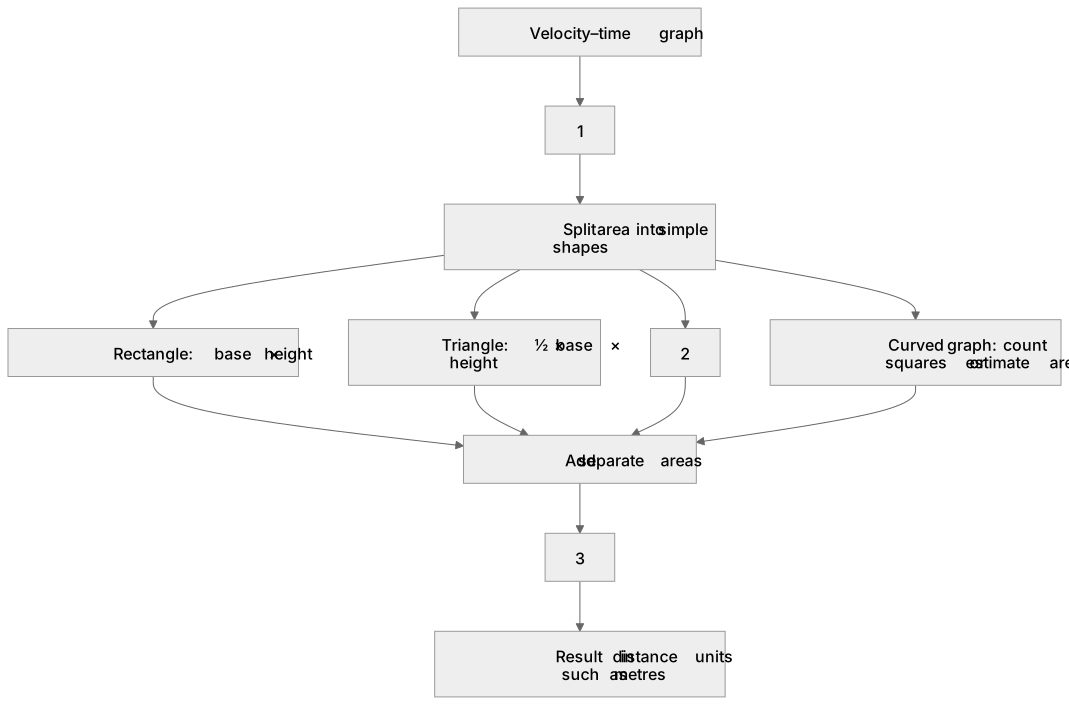
Some boxes have lost their names. Pick the right name for each number.
1Box 1
2Box 2
3Box 3
There is more to this lesson
The full lesson goes on to check your understanding and help you earn the marks. Create a free account to carry on, with your progress saved.
A week of Premium from your first lesson · Then the free plan continues · No card, no charge
Test your understanding of Acceleration: (HT only) The distance travelled by an object (or displacement of an object) can be calculated from the area under a velocity–time graph.
Active recall beats re-reading. Take an instant quiz now to test what you’ve learned and lock it into long-term memory.
A week of Premium from your first lesson · Then the free plan continues · No card, no charge