AQA · GCSE · Combined Science
Course version: 8464 · Version from Sept 2018
The acceleration of an object can be calculated from the gradient of a…
Full specification wording
Acceleration: The acceleration of an object can be calculated from the gradient of a velocity–time graph.
On a velocity–time graph, velocity is plotted on the y-axis and time on the x-axis, so the gradient measures how quickly velocity changes.
Checked against the AQA 8464 specification (opens in a new tab) on .
- Point 9 of 21
- 4 key terms
Study notes
From the checked teaching notes for this specification point.
The idea
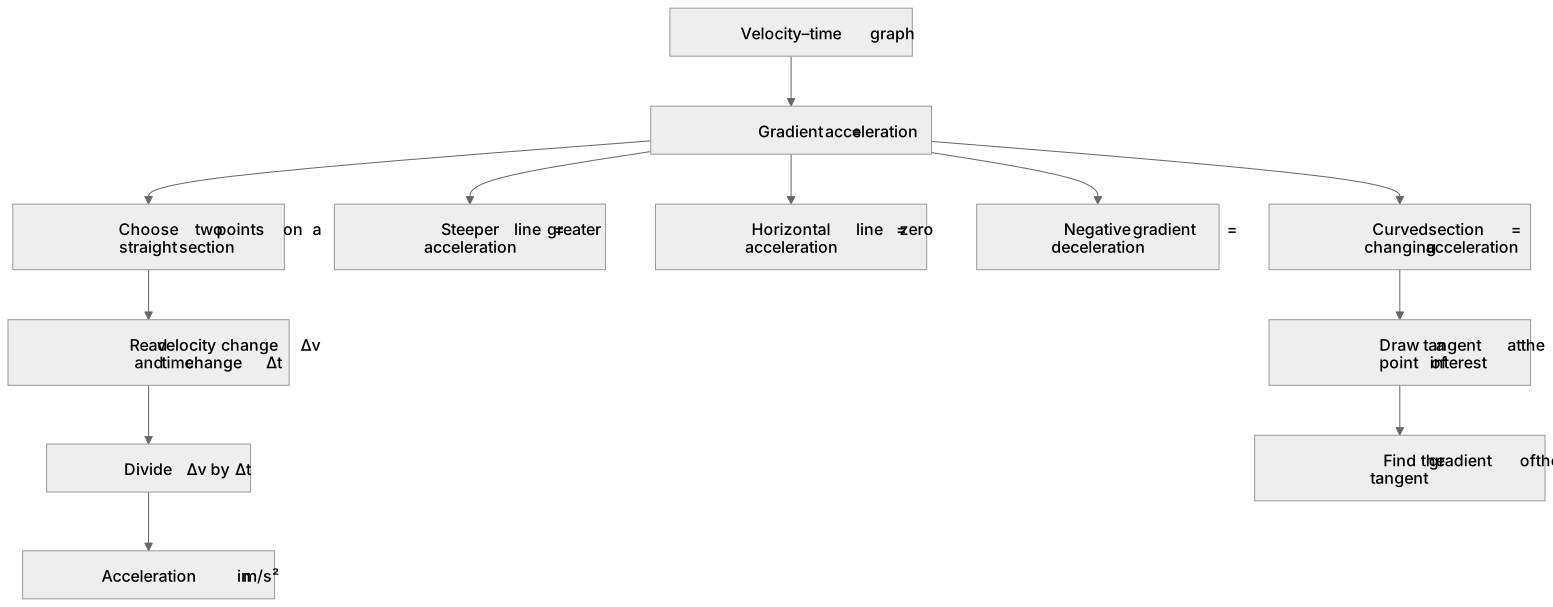
On a velocity–time graph, velocity is plotted on the y-axis and time on the x-axis, so the gradient measures how quickly velocity changes. Acceleration is the rate of change of velocity, a = Δv ÷ Δt, so the gradient equals the acceleration. To find it, choose two points on a straight section, read the velocity change Δv and time change Δt, then divide Δv by Δt. For example, if velocity rises from 4 m/s to 16 m/s between 2 s and 8 s, Δv = 12 m/s and Δt = 6 s, giving a = 2 m/s². A steeper line means greater acceleration; a horizontal line means zero acceleration; a negative gradient means deceleration. Curved sections show changing acceleration, so a tangent is drawn at the point of interest.
What earns the marks
- State that acceleration is the rate of change of velocity and that the gradient of a velocity–time graph therefore represents acceleration.
- Select two clearly separated points on the straight portion of the line and read both coordinates accurately from the axes.
- Calculate the gradient as the change in velocity divided by the change in time, Δv ÷ Δt, including correct units such as m/s².
- Interpret the sign and size of the gradient: positive for acceleration, negative for deceleration, zero for constant velocity, and steeper for larger acceleration.
- For a curved graph, draw a tangent at the required instant and find the gradient of that tangent to obtain the acceleration at that point.
Common mistakes and how to put them right
Dividing the change in time by the change in velocity instead of Δv ÷ Δt.
Put it right by remembering gradient = rise ÷ run, with velocity on the vertical axis.
Reading coordinates carelessly or using points too close together, which magnifies reading error.
Put it right by choosing widely spaced points that lie on the line.
Treating the area under the graph as the gradient.
Put it right by reserving area for distance travelled and gradient for acceleration.
Exam tips
- Annotate the graph by drawing the rise-and-run triangle directly on the line before doing any arithmetic.
- Show the substitution explicitly, for example a = (16 m/s − 4 m/s) ÷ (8 s − 2 s), so the method is visible even if the final value is wrong.
- Check the unit of the answer: velocity in m/s divided by time in s must give m/s², and a negative answer should be described as deceleration.
Try the lesson
The start of the Acceleration: The acceleration of an object can be calculated from the gradient of a velocity–time graph. lesson, made from checked teaching notes for this specification point.
Have a go first
A velocity–time graph shows a straight line rising from 0 m/s at 0 s to 8 m/s at 4 s. What is the acceleration of the object?
Listen
On a velocity–time graph, velocity is plotted on the y-axis and time on the x-axis, so the gradient measures how quickly velocity changes. Acceleration is the rate of change of velocity, a = Δv ÷ Δt, so the gradient equals the acceleration. To find it, choose two points on a straight section, read the velocity change Δv and time change Δt, then divide Δv by Δt. For example, if velocity rises from 4 m/s to 16 m/s between 2 s and 8 s, Δv = 12 m/s and Δt = 6 s, giving a = 2 m/s². A steeper line means greater acceleration; a horizontal line means zero acceleration; a negative gradient means deceleration. Curved sections show changing acceleration, so a tangent is drawn at the point of interest. A strong answer earns marks for these points. State that acceleration is the rate of change of velocity and that the gradient of a velocity–time graph therefore represents acceleration. Select two clearly separated points on the straight portion of the line and read both coordinates accurately from the axes. Calculate the gradient as the change in velocity divided by the change in time, Δv ÷ Δt, including correct units such as m/s². Interpret the sign and size of the gradient: positive for acceleration, negative for deceleration, zero for constant velocity, and steeper for larger acceleration. A common slip: Dividing the change in time by the change in velocity instead of Δv ÷ Δt. Instead, remembering gradient = rise ÷ run, with velocity on the vertical axis. Exam tip: Annotate the graph by drawing the rise-and-run triangle directly on the line before doing any arithmetic.
See it
Key words
Say what each word means before you turn the card.
Acceleration
Try answering aloud or in your head before turning the card.
Gradient
Try answering aloud or in your head before turning the card.
Deceleration
Try answering aloud or in your head before turning the card.
Tangent
Try answering aloud or in your head before turning the card.
See every definition
- Acceleration
- The rate of change of velocity, calculated as the change in velocity divided by the change in time.
- Gradient
- On a velocity–time graph, the measure of how quickly velocity changes, equal to the acceleration.
- Deceleration
- Motion shown by a negative gradient on a velocity–time graph.
- Tangent
- A line drawn at the point of interest on a curved section, whose gradient gives the acceleration at that point.
Label the diagram
Some boxes have lost their names. Pick the right name for each number.
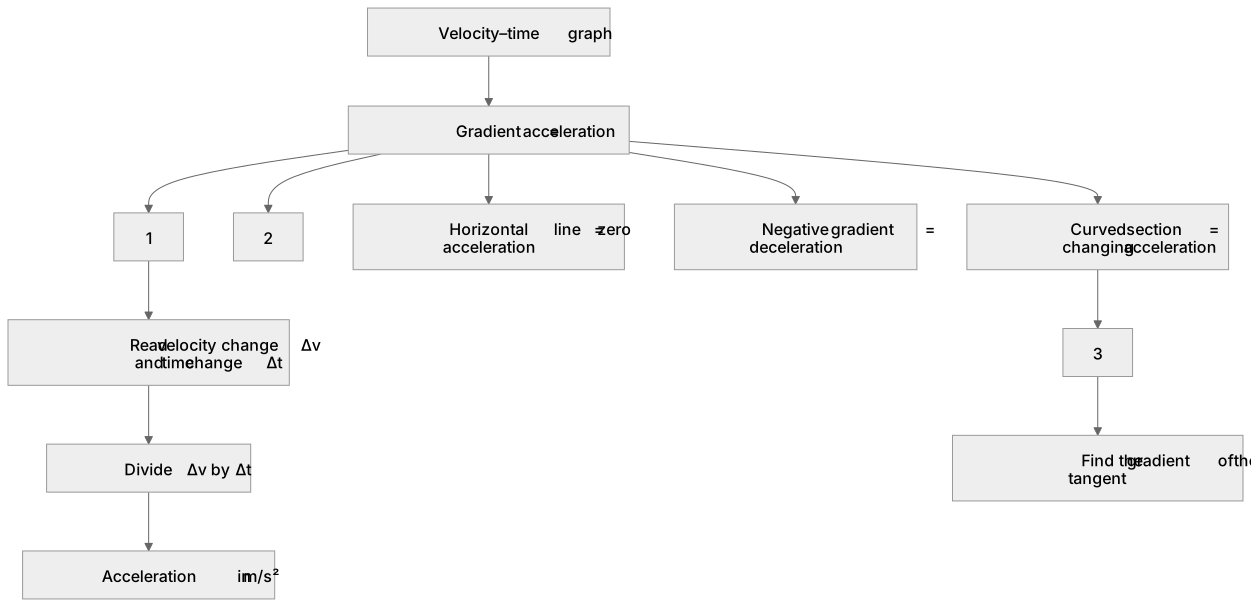
1Box 1
2Box 2
3Box 3
There is more to this lesson
The full lesson goes on to check your understanding and help you earn the marks. Create a free account to carry on, with your progress saved.
A week of Premium from your first lesson · Then the free plan continues · No card, no charge
Test your understanding of Acceleration: The acceleration of an object can be calculated from the gradient of a velocity–time graph.
Active recall beats re-reading. Take an instant quiz now to test what you’ve learned and lock it into long-term memory.
A week of Premium from your first lesson · Then the free plan continues · No card, no charge