AQA · GCSE · Combined Science
Course version: 8464 · Version from Sept 2018
Calculate the mass of solute in a given volume of solution of known…
Full specification wording
Concentration of solutions: calculate the mass of solute in a given volume of solution of known concentration in terms of mass per given volume of solution
Concentration tells you how much solute is dissolved in each unit volume of solution, commonly expressed in g/dm³.
Checked against the AQA 8464 specification (opens in a new tab) on .
- Point 2 of 3
- 3 key terms
Study notes
From the checked teaching notes for this specification point.
The idea
Concentration tells you how much solute is dissolved in each unit volume of solution, commonly expressed in g/dm³. To find the mass of solute, rearrange the relationship concentration = mass ÷ volume so that mass = concentration × volume. For example, a 250 cm³ solution of concentration 40 g/dm³ contains 40 × 0.250 = 10 g of solute. The crucial step is unit conversion: 1 dm³ = 1000 cm³, so divide a volume in cm³ by 1000 before multiplying. Check the answer by reasoning: a larger volume at the same concentration must contain proportionally more solute, and a more concentrated solution in the same volume must contain more solute. Always attach the correct unit, usually grams, and consider whether the value is sensible for the solute involved.
What earns the marks
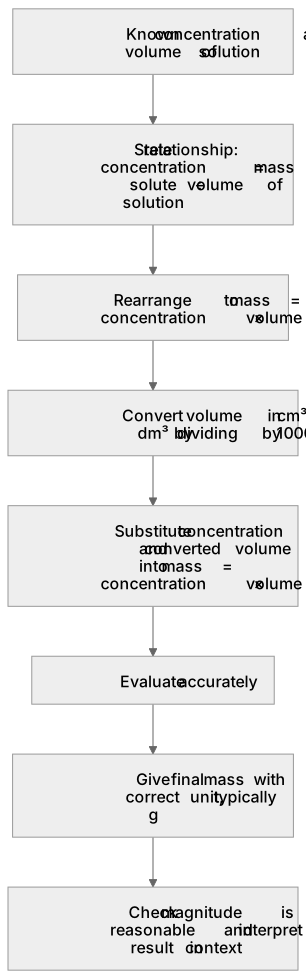
- State the relationship concentration = mass of solute ÷ volume of solution and rearrange it correctly to mass = concentration × volume.
- Convert a volume given in cm³ into dm³ by dividing by 1000 before substituting, since concentration is normally quoted in g/dm³.
- Substitute the known concentration and converted volume into mass = concentration × volume and evaluate accurately.
- Give the final mass with the correct unit, typically g, and check that the magnitude is reasonable for the volume and concentration involved.
- Interpret the result in context, for example stating the mass of solute present in the stated volume of that particular solution.
Common mistakes and how to put them right
Multiplying concentration by a volume left in cm³ instead of converting to dm³.
Put it right by dividing cm³ by 1000 first, so 500 cm³ becomes 0.500 dm³.
Using mass = volume ÷ concentration instead of mass = concentration × volume.
Put it right by rearranging concentration = mass ÷ volume carefully before substituting.
Forgetting the unit on the answer or writing an impossible unit such as g/dm³ for a mass.
Put it right by checking that the unit matches the quantity calculated, which is grams here.
Exam tips
- Write down the equation mass = concentration × volume before substituting any numbers, so the examiner can follow your method.
- Convert every volume to dm³ in a clearly shown step, since unit errors are the most common source of lost marks in this topic.
- Estimate the answer first, for example 40 g/dm³ × 0.25 dm³ is about 10 g, then compare your calculated value with the estimate to catch slips.
Try the lesson
The start of the Concentration of solutions: calculate the mass of solute in a given volume of solution of known concentration in terms of mass per given volume of solution lesson, made from checked teaching notes for this specification point.
Have a go first
A solution has a concentration of 20 g/dm³. What mass of solute is dissolved in 3 dm³ of this solution?
Listen
Concentration tells you how much solute is dissolved in each unit volume of solution, commonly expressed in g/dm³. To find the mass of solute, rearrange the relationship concentration = mass ÷ volume so that mass = concentration × volume. For example, a 250 cm³ solution of concentration 40 g/dm³ contains 40 × 0.250 = 10 g of solute. The crucial step is unit conversion: 1 dm³ = 1000 cm³, so divide a volume in cm³ by 1000 before multiplying. Check the answer by reasoning: a larger volume at the same concentration must contain proportionally more solute, and a more concentrated solution in the same volume must contain more solute. Always attach the correct unit, usually grams, and consider whether the value is sensible for the solute involved. A strong answer earns marks for these points. State the relationship concentration = mass of solute ÷ volume of solution and rearrange it correctly to mass = concentration × volume. Convert a volume given in cm³ into dm³ by dividing by 1000 before substituting, since concentration is normally quoted in g/dm³. Substitute the known concentration and converted volume into mass = concentration × volume and evaluate accurately. Give the final mass with the correct unit, typically g, and check that the magnitude is reasonable for the volume and concentration involved. A common slip: Multiplying concentration by a volume left in cm³ instead of converting to dm³. Instead, dividing cm³ by 1000 first, so 500 cm³ becomes 0.500 dm³. Exam tip: Write down the equation mass = concentration × volume before substituting any numbers, so the examiner can follow your method.
See it
Put it in order
Put these steps in the order they happen.
- 1. Substitute concentration and converted volume into mass = concentration × volume
- 2. Check magnitude is reasonable and interpret result in context
- 3. Evaluate accurately
- 4. Known concentration and volume of solution
- 5. State relationship: concentration = mass of solute ÷ volume of solution
- 6. Give final mass with correct unit, typically g
- 7. Rearrange to mass = concentration × volume
- 8. Convert volume in cm³ to dm³ by dividing by 1000
Key words
Say what each word means before you turn the card.
Concentration of solutions
Try answering aloud or in your head before turning the card.
Rearranging and using equations
Try answering aloud or in your head before turning the card.
Unit conversion between cm³ and dm³
Try answering aloud or in your head before turning the card.
See every definition
- Concentration of solutions
- Tells you how much solute is dissolved in each unit volume of solution, commonly expressed in g/dm³.
- Rearranging and using equations
- The relationship concentration = mass ÷ volume is rearranged so that mass = concentration × volume before substituting.
- Unit conversion between cm³ and dm³
- Since 1 dm³ = 1000 cm³, divide a volume in cm³ by 1000 before multiplying.
Label the diagram
Some boxes have lost their names. Pick the right name for each number.
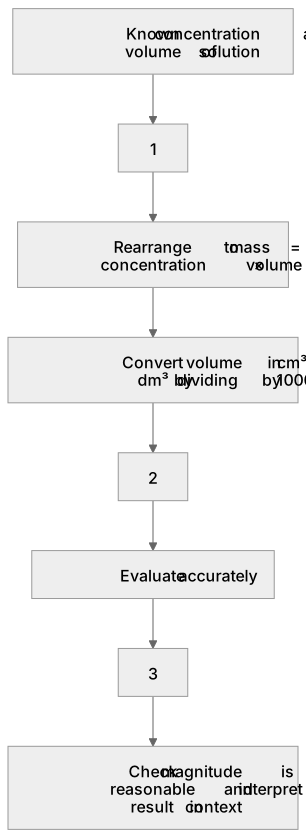
1Box 1
2Box 2
3Box 3
There is more to this lesson
The full lesson goes on to check your understanding and help you earn the marks. Create a free account to carry on, with your progress saved.
A week of Premium from your first lesson · Then the free plan continues · No card, no charge
Test your understanding of Concentration of solutions: calculate the mass of solute in a given volume of solution of known concentration in terms of mass per given volume of solution
Active recall beats re-reading. Take an instant quiz now to test what you’ve learned and lock it into long-term memory.
A week of Premium from your first lesson · Then the free plan continues · No card, no charge