AQA · GCSE · Combined Science
Course version: 8464 · Version from Sept 2018
(HT only) explain how the mass of a solute and the volume of a solution is…
Full specification wording
Concentration of solutions: (HT only) explain how the mass of a solute and the volume of a solution is related to the concentration of the solution.
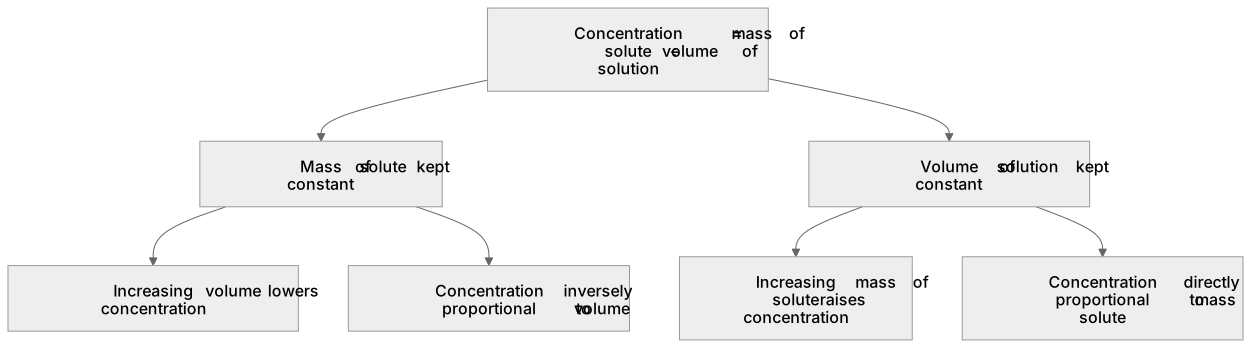
Concentration measures how much solute is dissolved in a given volume of solution, linking mass and volume through concentration = mass ÷ volume.
Checked against the AQA 8464 specification (opens in a new tab) on .
- Point 3 of 3
- 2 key terms
Study notes
From the checked teaching notes for this specification point.
The idea
Concentration measures how much solute is dissolved in a given volume of solution, linking mass and volume through concentration = mass ÷ volume. For a fixed volume, increasing the mass of solute raises the concentration proportionally: doubling the mass doubles the concentration. For a fixed mass of solute, increasing the volume lowers the concentration: dissolving the same mass in twice the volume halves the concentration. This explains why a small volume of a concentrated solution can contain the same solute mass as a larger volume of a dilute solution. Expressing the relationship as an equation allows predictions about how concentration changes when variables are altered.
What earns the marks
- State that concentration is directly proportional to the mass of solute when the volume of solution is kept constant.
- State that concentration is inversely proportional to the volume of solution when the mass of solute is kept constant.
- Express the relationship as concentration = mass of solute ÷ volume of solution and use it to justify the proportionalities.
- Apply the relationship to a numerical or practical example, such as showing that dissolving 20 g in 2 dm³ gives 10 g/dm³ whereas the same 20 g in 1 dm³ gives 20 g/dm³.
Common mistakes and how to put them right
Claiming that adding more solvent increases concentration.
Put it right by explaining that adding solvent increases volume and therefore decreases concentration for the same mass of solute.
Treating mass and volume as interchangeable or ignoring one of them.
Put it right by relating concentration to both the mass of solute and the volume of solution together.
Saying concentration is proportional to volume rather than inversely proportional.
Put it right by noting that doubling the volume halves the concentration when the mass is unchanged.
Exam tips
- Use the words directly proportional and inversely proportional explicitly, since Higher Tier explanation questions reward precise relationship language.
- Support your explanation with a simple numerical example, as this demonstrates understanding rather than repeating the definition.
Try the lesson
The start of the Concentration of solutions: (HT only) explain how the mass of a solute and the volume of a solution is related to the concentration of the solution. lesson, made from checked teaching notes for this specification point.
Have a go first
How does the concentration of a solution change if the volume of the solution is doubled while the mass of the dissolved solute remains the same?
Listen
Concentration measures how much solute is dissolved in a given volume of solution, linking mass and volume through concentration = mass ÷ volume. For a fixed volume, increasing the mass of solute raises the concentration proportionally: doubling the mass doubles the concentration. For a fixed mass of solute, increasing the volume lowers the concentration: dissolving the same mass in twice the volume halves the concentration. This explains why a small volume of a concentrated solution can contain the same solute mass as a larger volume of a dilute solution. Expressing the relationship as an equation allows predictions about how concentration changes when variables are altered. A strong answer earns marks for these points. State that concentration is directly proportional to the mass of solute when the volume of solution is kept constant. State that concentration is inversely proportional to the volume of solution when the mass of solute is kept constant. Express the relationship as concentration = mass of solute ÷ volume of solution and use it to justify the proportionalities. Apply the relationship to a numerical or practical example, such as showing that dissolving 20 g in 2 dm³ gives 10 g/dm³ whereas the same 20 g in 1 dm³ gives 20 g/dm³. A common slip: Claiming that adding more solvent increases concentration. Instead, explaining that adding solvent increases volume and therefore decreases concentration for the same mass of solute. Exam tip: Use the words directly proportional and inversely proportional explicitly, since Higher Tier explanation questions reward precise relationship language.
See it
Key words
Say what each word means before you turn the card.
Concentration of solutions
Try answering aloud or in your head before turning the card.
Mass, volume and concentration relationships
Try answering aloud or in your head before turning the card.
See every definition
- Concentration of solutions
- Measures how much solute is dissolved in a given volume of solution, linking mass and volume through concentration = mass ÷ volume.
- Mass, volume and concentration relationships
- Expressed as concentration = mass of solute ÷ volume of solution, and used to justify the proportionalities and predict how concentration changes when variables are altered.
Label the diagram
Some boxes have lost their names. Pick the right name for each number.
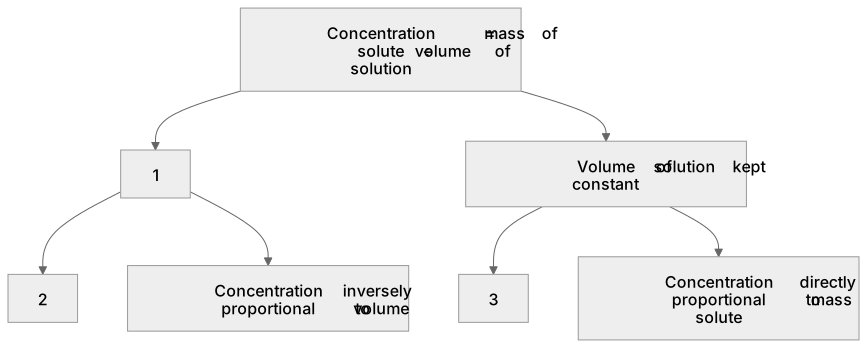
1Box 1
2Box 2
3Box 3
There is more to this lesson
The full lesson goes on to check your understanding and help you earn the marks. Create a free account to carry on, with your progress saved.
A week of Premium from your first lesson · Then the free plan continues · No card, no charge
Test your understanding of Concentration of solutions: (HT only) explain how the mass of a solute and the volume of a solution is related to the concentration of the solution.
Active recall beats re-reading. Take an instant quiz now to test what you’ve learned and lock it into long-term memory.
A week of Premium from your first lesson · Then the free plan continues · No card, no charge