AQA · GCSE · Combined Science
Course version: 8464 · Version from Sept 2018
Clinical trials use healthy volunteers and patients.
Full specification wording
Discovery and development of drugs: Clinical trials use healthy volunteers and patients.
Clinical trials happen after preclinical testing and involve people.
Checked against the AQA 8464 specification (opens in a new tab) on .
- Point 10 of 13
Study notes
From the checked teaching notes for this specification point.
The idea
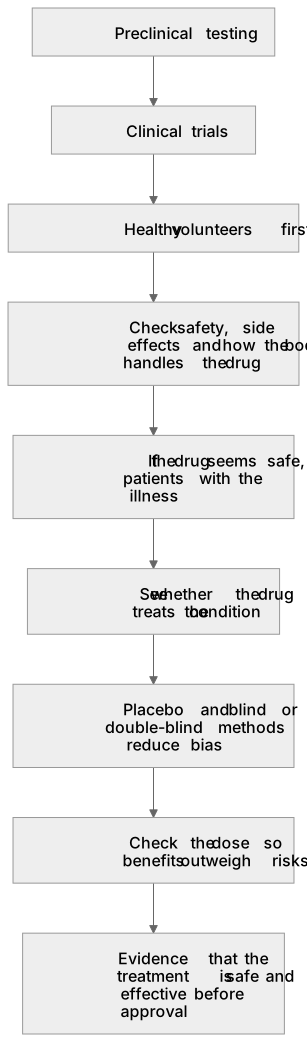
Clinical trials happen after preclinical testing and involve people. Healthy volunteers are used first, usually in small numbers, to check that the drug is safe and to find out how the body handles it, including any side effects. If the drug seems safe, patients who have the illness are then given it to see whether it actually treats the condition. Some patients may receive a placebo so results can be compared, and trials are often blind or double-blind to reduce bias. The dose is also checked so that the benefits outweigh the risks. This stage is essential because effects in animals do not always match effects in humans, so clinical trials provide evidence that a treatment is safe and effective before it is approved for general use.
What earns the marks
- Clinical trials take place after preclinical testing and involve human participants.
- Healthy volunteers are used first to test safety, side effects and how the body processes the drug.
- Patients with the illness are then used to test whether the drug actually works as a treatment.
- Control groups, placebos and blind or double-blind methods may be used to make results valid and reduce bias.
- Trials help establish a suitable dose and show whether benefits outweigh risks.
- Clinical trials are needed because animal results do not always predict human responses.
Common mistakes and how to put them right
Saying patients are always tested before healthy volunteers.
Put it right by stating healthy volunteers come first to check safety.
Thinking a placebo is a real medicine.
Put it right by explaining a placebo contains no active drug and is used for comparison.
Assuming clinical trials prove a drug works for everyone.
Put it right by noting trials provide evidence of safety and effectiveness for a defined group, with possible side effects.
Exam tips
- Distinguish clearly between healthy volunteers, used for safety, and patients, used to test effectiveness.
- Mention placebos or blind trials when asked how bias is reduced, but do not invent exact numbers of participants.
- Use the order preclinical testing, then clinical trials, then approval when describing drug development.
Try the lesson
The start of the Discovery and development of drugs: Clinical trials use healthy volunteers and patients. lesson, made from checked teaching notes for this specification point.
Have a go first
Who takes part in clinical trials of a new drug?
Listen
Clinical trials happen after preclinical testing and involve people. Healthy volunteers are used first, usually in small numbers, to check that the drug is safe and to find out how the body handles it, including any side effects. If the drug seems safe, patients who have the illness are then given it to see whether it actually treats the condition. Some patients may receive a placebo so results can be compared, and trials are often blind or double-blind to reduce bias. The dose is also checked so that the benefits outweigh the risks. This stage is essential because effects in animals do not always match effects in humans, so clinical trials provide evidence that a treatment is safe and effective before it is approved for general use. A strong answer earns marks for these points. Clinical trials take place after preclinical testing and involve human participants. Healthy volunteers are used first to test safety, side effects and how the body processes the drug. Patients with the illness are then used to test whether the drug actually works as a treatment. Control groups, placebos and blind or double-blind methods may be used to make results valid and reduce bias. A common slip: Saying patients are always tested before healthy volunteers. Instead, stating healthy volunteers come first to check safety. Exam tip: Distinguish clearly between healthy volunteers, used for safety, and patients, used to test effectiveness.
See it
Label the diagram
Some boxes have lost their names. Pick the right name for each number.
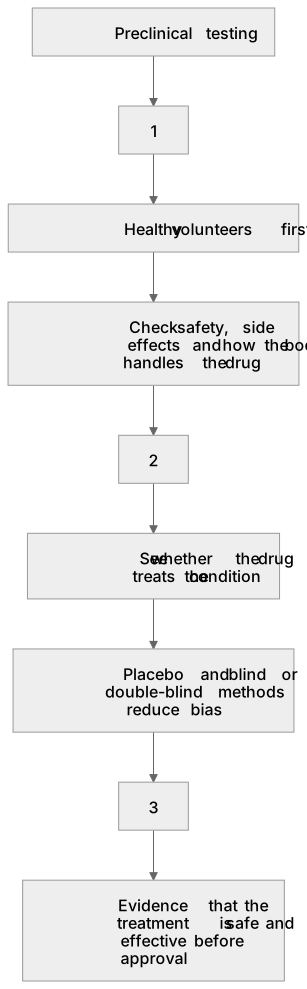
1Box 1
2Box 2
3Box 3
There is more to this lesson
The full lesson goes on to check your understanding and help you earn the marks. Create a free account to carry on, with your progress saved.
A week of Premium from your first lesson · Then the free plan continues · No card, no charge
Test your understanding of Discovery and development of drugs: Clinical trials use healthy volunteers and patients.
Active recall beats re-reading. Take an instant quiz now to test what you’ve learned and lock it into long-term memory.
A week of Premium from your first lesson · Then the free plan continues · No card, no charge