AQA · GCSE · Combined Science
Course version: 8464 · Version from Sept 2018
Bacterial cells have been genetically engineered to produce useful…
Full specification wording
Genetic engineering: Bacterial cells have been genetically engineered to produce useful substances such as human insulin to treat diabetes.
Genetic engineering transfers a desired gene into a bacterial cell so the bacterium makes a human protein.
Checked against the AQA 8464 specification (opens in a new tab) on .
- Point 3 of 12
- 4 key terms
Study notes
From the checked teaching notes for this specification point.
The idea
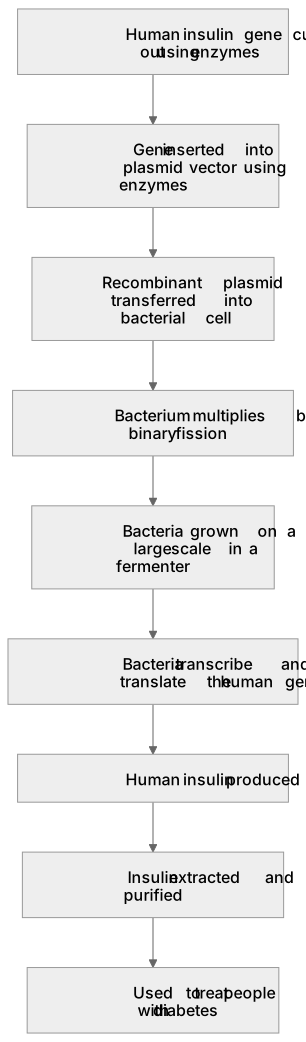
Genetic engineering transfers a desired gene into a bacterial cell so the bacterium makes a human protein. For insulin, the human insulin gene is cut out using enzymes and inserted into a plasmid vector, which is put into a bacterium. The bacterium is grown in a fermenter, where it multiplies and expresses the gene, producing human insulin that is extracted and purified. This works because bacteria reproduce rapidly and can be grown on a large scale. The insulin is identical to human insulin, so it is less likely to cause an immune reaction than animal insulin, and it can be made in unlimited quantities. This links gene transfer, protein synthesis, bacterial growth and medical use.
What earns the marks
- The human insulin gene is removed from a human chromosome using enzymes that cut DNA at specific base sequences.
- The gene is inserted into a vector, usually a bacterial plasmid, using enzymes that join DNA fragments together.
- The recombinant plasmid is transferred into a bacterial cell, which then multiplies by binary fission.
- The genetically engineered bacteria are grown on a large scale in a fermenter under controlled conditions.
- The bacteria transcribe and translate the human gene, producing human insulin protein.
- The insulin is extracted and purified before being used to treat people with diabetes.
Common mistakes and how to put them right
Thinking the bacterium makes insulin because it naturally contains the human gene.
Put it right: The human gene must first be cut out and inserted into the bacterium.
Confusing the roles of the cutting and joining enzymes.
Put it right: One type of enzyme cuts the gene and plasmid, and another joins the gene into the plasmid.
Believing bacteria can produce any human protein without a vector.
Put it right: The gene must be carried into the bacterium, usually by a plasmid.
Exam tips
- Name the vector and explain why a plasmid is suitable, for example it is small and can be taken up by bacteria.
- Sequence the stages clearly: cut out gene, insert into vector, transfer into bacterium, grow, express, extract and purify.
- Link the medical benefit to the product being human insulin, which reduces the risk of rejection compared with animal insulin.
Try the lesson
The start of the Genetic engineering: Bacterial cells have been genetically engineered to produce useful substances such as human insulin to treat diabetes. lesson, made from checked teaching notes for this specification point.
Have a go first
Which useful substance is produced by genetically engineered bacteria to treat diabetes?
Listen
Genetic engineering transfers a desired gene into a bacterial cell so the bacterium makes a human protein. For insulin, the human insulin gene is cut out using enzymes and inserted into a plasmid vector, which is put into a bacterium. The bacterium is grown in a fermenter, where it multiplies and expresses the gene, producing human insulin that is extracted and purified. This works because bacteria reproduce rapidly and can be grown on a large scale. The insulin is identical to human insulin, so it is less likely to cause an immune reaction than animal insulin, and it can be made in unlimited quantities. This links gene transfer, protein synthesis, bacterial growth and medical use. A strong answer earns marks for these points. The human insulin gene is removed from a human chromosome using enzymes that cut DNA at specific base sequences. The gene is inserted into a vector, usually a bacterial plasmid, using enzymes that join DNA fragments together. The recombinant plasmid is transferred into a bacterial cell, which then multiplies by binary fission. The genetically engineered bacteria are grown on a large scale in a fermenter under controlled conditions. A common slip: Thinking the bacterium makes insulin because it naturally contains the human gene. Instead, the human gene must first be cut out and inserted into the bacterium. Exam tip: Name the vector and explain why a plasmid is suitable, for example it is small and can be taken up by bacteria.
See it
Key words
Say what each word means before you turn the card.
Gene transfer between species
Try answering aloud or in your head before turning the card.
Use of vectors in genetic engineering
Try answering aloud or in your head before turning the card.
Large-scale production using microorganisms
Try answering aloud or in your head before turning the card.
Medical application of biotechnology
Try answering aloud or in your head before turning the card.
See every definition
- Gene transfer between species
- The human insulin gene is cut out and inserted into a bacterial cell so the bacterium makes a human protein.
- Use of vectors in genetic engineering
- The gene is inserted into a vector, usually a bacterial plasmid, which carries it into the bacterium.
- Large-scale production using microorganisms
- The genetically engineered bacteria are grown on a large scale in a fermenter under controlled conditions, multiplying by binary fission.
- Medical application of biotechnology
- The human insulin produced is extracted and purified before being used to treat people with diabetes.
Label the diagram
Some boxes have lost their names. Pick the right name for each number.
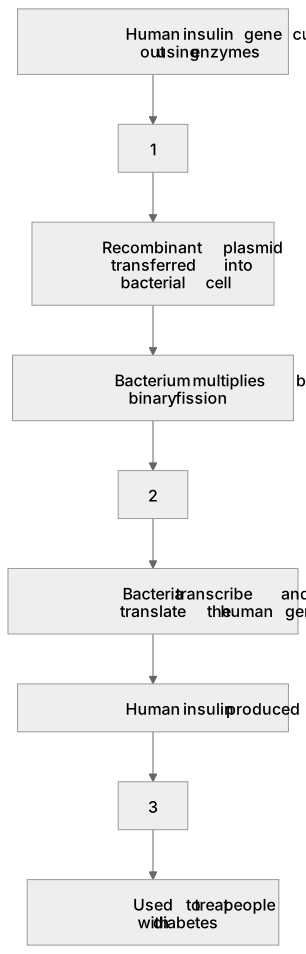
1Box 1
2Box 2
3Box 3
There is more to this lesson
The full lesson goes on to check your understanding and help you earn the marks. Create a free account to carry on, with your progress saved.
A week of Premium from your first lesson · Then the free plan continues · No card, no charge
Test your understanding of Genetic engineering: Bacterial cells have been genetically engineered to produce useful substances such as human insulin to treat diabetes.
Active recall beats re-reading. Take an instant quiz now to test what you’ve learned and lock it into long-term memory.
A week of Premium from your first lesson · Then the free plan continues · No card, no charge