AQA · GCSE · Combined Science
Course version: 8464 · Version from Sept 2018
In genetic engineering, genes from the chromosomes of humans and other…
Full specification wording
Genetic engineering: In genetic engineering, genes from the chromosomes of humans and other organisms can be ‘cut out’ and transferred to cells of other organisms.
Genetic engineering involves modifying an organism's genome by introducing a gene from another organism to give a desired characteristic.
Checked against the AQA 8464 specification (opens in a new tab) on .
- Point 5 of 12
- 3 key terms
Study notes
From the checked teaching notes for this specification point.
The idea
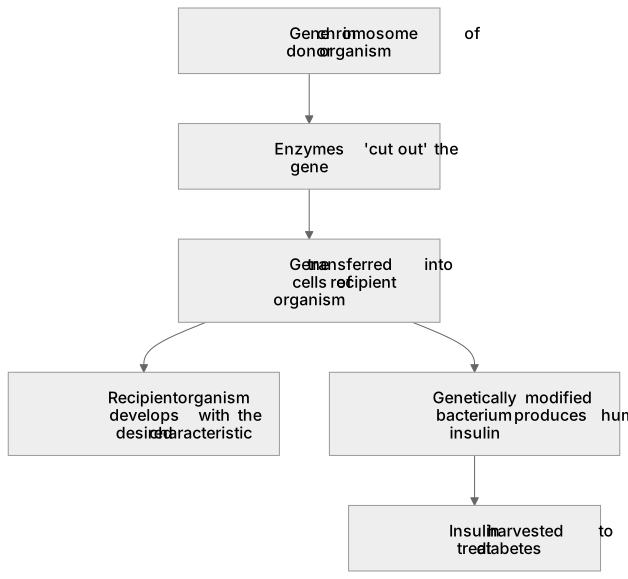
Genetic engineering involves modifying an organism's genome by introducing a gene from another organism to give a desired characteristic. For example, the gene that codes for human insulin can be 'cut out' of a human chromosome using enzymes. This gene is then transferred into the DNA of a bacterium. The genetically modified bacterium will then produce human insulin, which can be harvested to treat diabetes. Other examples include transferring genes into plants to make them resistant to diseases, insects, or herbicides. The transfer happens at an early stage of development so the organism develops with the desired characteristics.
What earns the marks
- Genetic engineering involves changing an organism's DNA by inserting a gene from another organism.
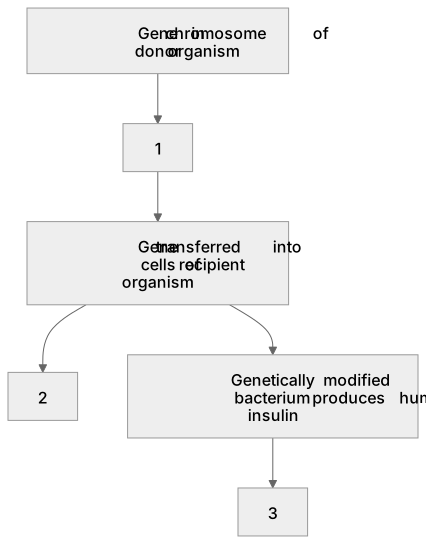
- Enzymes are used to 'cut out' the required gene from the chromosome of the donor organism.
- The isolated gene is then transferred into the cells of the recipient organism.
- For example, the human insulin gene is transferred into bacteria to produce insulin for treating diabetes.
Common mistakes and how to put them right
Saying the whole chromosome is transferred rather than a gene.
Put it right by stating that only the specific gene coding for the desired characteristic is cut out.
Thinking the recipient organism becomes human.
Put it right by explaining that only one gene is added, so a bacterium remains a bacterium but can make a human protein.
Forgetting what is used to cut the gene.
Put it right by remembering that enzymes are used to 'cut out' the gene.
Exam tips
- State clearly that enzymes are used to cut out the required gene.
- Use the human insulin example to illustrate how a gene from one species can be transferred to another to produce a useful product.
Try the lesson
The start of the Genetic engineering: In genetic engineering, genes from the chromosomes of humans and other organisms can be ‘cut out’ and transferred to cells of other organisms. lesson, made from checked teaching notes for this specification point.
Have a go first
In genetic engineering, from which part of a human cell is a gene cut out before it is transferred into a bacterial cell?
Listen
Genetic engineering involves modifying an organism's genome by introducing a gene from another organism to give a desired characteristic. For example, the gene that codes for human insulin can be 'cut out' of a human chromosome using enzymes. This gene is then transferred into the DNA of a bacterium. The genetically modified bacterium will then produce human insulin, which can be harvested to treat diabetes. Other examples include transferring genes into plants to make them resistant to diseases, insects, or herbicides. The transfer happens at an early stage of development so the organism develops with the desired characteristics. A strong answer earns marks for these points. Genetic engineering involves changing an organism's DNA by inserting a gene from another organism. Enzymes are used to 'cut out' the required gene from the chromosome of the donor organism. The isolated gene is then transferred into the cells of the recipient organism. For example, the human insulin gene is transferred into bacteria to produce insulin for treating diabetes. A common slip: Saying the whole chromosome is transferred rather than a gene. Instead, stating that only the specific gene coding for the desired characteristic is cut out. Exam tip: State clearly that enzymes are used to cut out the required gene.
See it
Key words
Say what each word means before you turn the card.
Genetic engineering
Try answering aloud or in your head before turning the card.
Enzymes in genetics
Try answering aloud or in your head before turning the card.
Useful products from GM
Try answering aloud or in your head before turning the card.
See every definition
- Genetic engineering
- Modifying an organism's genome by introducing a gene from another organism to give a desired characteristic.
- Enzymes in genetics
- Used to 'cut out' the required gene from the chromosome of the donor organism.
- Useful products from GM
- The genetically modified bacterium will produce human insulin, which can be harvested to treat diabetes.
Label the diagram
Some boxes have lost their names. Pick the right name for each number.
1Box 1
2Box 2
3Box 3
There is more to this lesson
The full lesson goes on to check your understanding and help you earn the marks. Create a free account to carry on, with your progress saved.
A week of Premium from your first lesson · Then the free plan continues · No card, no charge
Test your understanding of Genetic engineering: In genetic engineering, genes from the chromosomes of humans and other organisms can be ‘cut out’ and transferred to cells of other organisms.
Active recall beats re-reading. Take an instant quiz now to test what you’ve learned and lock it into long-term memory.
A week of Premium from your first lesson · Then the free plan continues · No card, no charge