AQA · GCSE · Combined Science
Course version: 8464 · Version from Sept 2018
Maintaining biodiversity: These include:
This lead-in line introduces a list of named strategies that humans use to protect biodiversity, so you must be able to recall and explain each one.
Checked against the AQA 8464 specification (opens in a new tab) on .
- Point 3 of 8
- 3 key terms
Study notes
From the checked teaching notes for this specification point.
The idea
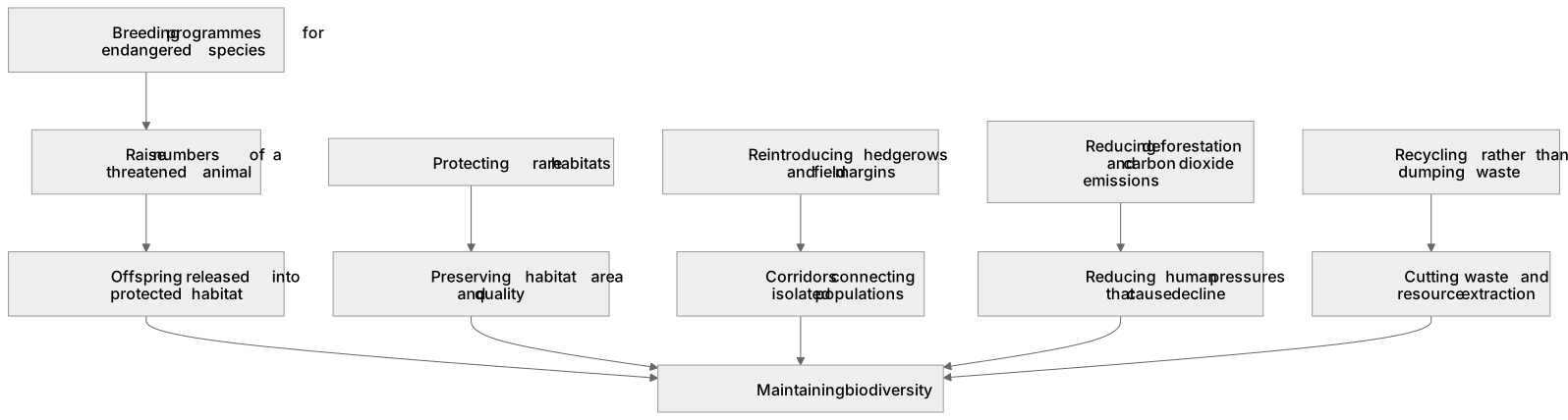
This lead-in line introduces a list of named strategies that humans use to protect biodiversity, so you must be able to recall and explain each one. Biodiversity means the variety of different species and the range of genetic variation within them, and it matters because stable ecosystems depend on many interlinked organisms. Human activity such as deforestation, pollution and overfishing reduces this variety, so conservation methods aim to keep populations viable and habitats intact. The listed methods are breeding programmes for endangered species, protection of rare habitats, reintroduction of hedgerows and field margins, reduction of deforestation and carbon dioxide emissions, and recycling rather than dumping waste. For each, link the action to its effect: for example, a zoo breeding programme raises numbers of a threatened animal, then offspring are released into protected habitat.
What earns the marks
- Biodiversity is the variety of species and the genetic variation within populations, and maintaining it supports ecosystem stability.
- Each strategy works by increasing population size, preserving habitat area or quality, or reducing the human pressures that cause decline.
- Answers should link a specific method to a specific biodiversity benefit, such as captive breeding increasing numbers before release into the wild.
- Positive and negative human impacts on biodiversity can be compared, for example conservation versus deforestation or overfishing.
Common mistakes and how to put them right
Treating biodiversity as simply the number of individual organisms.
Put it right: It is the variety of species and genetic variation, not total abundance.
Listing a method without explaining how it maintains biodiversity.
Put it right: Add the mechanism, such as habitat protection preserving breeding sites.
Confusing recycling with reducing carbon dioxide emissions.
Put it right: Recycling cuts waste and resource extraction, while lowering emissions mainly limits climate-related habitat change.
Exam tips
- Use the command word to judge depth: describe needs the method, explain needs the method plus its effect on biodiversity.
- Name at least three different strategies and give a distinct benefit for each rather than repeating one idea.
- Link answers to a real context, such as hedgerows providing corridors that connect isolated populations.
Try the lesson
The start of the Maintaining biodiversity: These include: lesson, made from checked teaching notes for this specification point.
Have a go first
Which programme is often put in place by farmers to help maintain biodiversity in agricultural areas?
Listen
This lead-in line introduces a list of named strategies that humans use to protect biodiversity, so you must be able to recall and explain each one. Biodiversity means the variety of different species and the range of genetic variation within them, and it matters because stable ecosystems depend on many interlinked organisms. Human activity such as deforestation, pollution and overfishing reduces this variety, so conservation methods aim to keep populations viable and habitats intact. The listed methods are breeding programmes for endangered species, protection of rare habitats, reintroduction of hedgerows and field margins, reduction of deforestation and carbon dioxide emissions, and recycling rather than dumping waste. For each, link the action to its effect: for example, a zoo breeding programme raises numbers of a threatened animal, then offspring are released into protected habitat. A strong answer earns marks for these points. Biodiversity is the variety of species and the genetic variation within populations, and maintaining it supports ecosystem stability. Named strategies include breeding programmes for endangered species, protecting rare habitats, reintroducing hedgerows and field margins, reducing deforestation and carbon dioxide emissions, and recycling resources rather than dumping waste. Each strategy works by increasing population size, preserving habitat area or quality, or reducing the human pressures that cause decline. Answers should link a specific method to a specific biodiversity benefit, such as captive breeding increasing numbers before release into the wild. A common slip: Treating biodiversity as simply the number of individual organisms. Instead, it is the variety of species and genetic variation, not total abundance. Exam tip: Use the command word to judge depth: describe needs the method, explain needs the method plus its effect on biodiversity.
See it
Key words
Say what each word means before you turn the card.
Biodiversity
Try answering aloud or in your head before turning the card.
Conservation strategies
Try answering aloud or in your head before turning the card.
Human impact on the environment
Try answering aloud or in your head before turning the card.
See every definition
- Biodiversity
- The variety of different species and the range of genetic variation within them, which matters because stable ecosystems depend on many interlinked organisms.
- Conservation strategies
- Named methods such as breeding programmes for endangered species, protection of rare habitats, reintroduction of hedgerows and field margins, reduction of deforestation and carbon dioxide emissions, and recycling rather than dumping waste.
- Human impact on the environment
- Activity such as deforestation, pollution and overfishing that reduces the variety of species and genetic variation, so conservation methods aim to keep populations viable and habitats intact.
Label the diagram
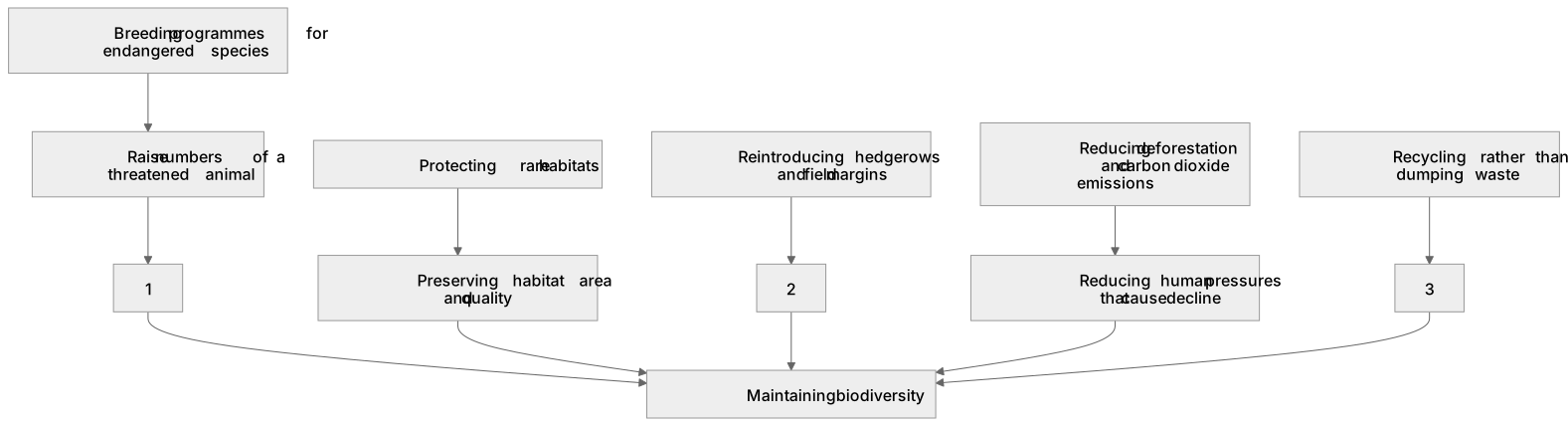
Some boxes have lost their names. Pick the right name for each number.
1Box 1
2Box 2
3Box 3
There is more to this lesson
The full lesson goes on to check your understanding and help you earn the marks. Create a free account to carry on, with your progress saved.
A week of Premium from your first lesson · Then the free plan continues · No card, no charge
Test your understanding of Maintaining biodiversity: These include:
Active recall beats re-reading. Take an instant quiz now to test what you’ve learned and lock it into long-term memory.
A week of Premium from your first lesson · Then the free plan continues · No card, no charge