AQA · GCSE · Combined Science
Course version: 8464 · Version from Sept 2018
The majority of elements are metals. Metals are found to the left and…
Full specification wording
Metals and non-metals: The majority of elements are metals. Metals are found to the left and towards the bottom of the periodic table. Non-metals are found towards the right and top of the periodic table.
The periodic table separates elements into metals and non-metals, and most known elements are metals.
Checked against the AQA 8464 specification (opens in a new tab) on .
- Point 3 of 6
- 4 key terms
Study notes
From the checked teaching notes for this specification point.
The idea
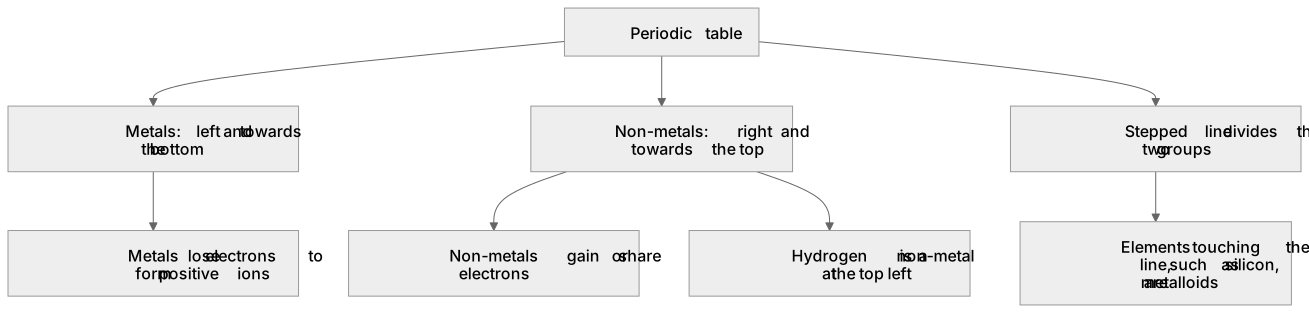
The periodic table separates elements into metals and non-metals, and most known elements are metals. Metals occupy the left side and lower regions, while non-metals cluster towards the right and top. A stepped line running below boron and down through silicon, arsenic and tellurium roughly divides the two groups. Elements touching this line, such as silicon, are metalloids with intermediate properties. Position links to structure: metals lose electrons to form positive ions, whereas non-metals gain or share electrons. For example, sodium on the far left forms Na⁺, while chlorine on the right forms Cl⁻. Hydrogen is a non-metal placed at the top left because of its single electron shell. Use the table's position to predict whether an element is a metal or non-metal.
What earns the marks
- States that most elements in the periodic table are metals, with non-metals forming a minority.
- Identifies metals as occupying the left-hand side and lower portions of the periodic table.
- Identifies non-metals as occupying the right-hand side and upper portions of the periodic table.
- Uses the stepped dividing line to classify an unfamiliar element as metal, non-metal or metalloid.
- Links position to typical behaviour, such as metals forming positive ions and non-metals forming negative ions or sharing electrons.
- Recognises hydrogen as a non-metal positioned at the top left of the periodic table.
Common mistakes and how to put them right
Assuming every element on the left is a metal and every element on the right is a non-metal without checking the stepped line.
Put it right by noting metalloids such as silicon sit on the boundary.
Placing hydrogen with the metals because it is at the top left.
Put it right by recalling hydrogen is a non-metal with one electron.
Thinking the periodic table is mostly non-metals.
Put it right by stating that the majority of elements are metals.
Exam tips
- Sketch a simple periodic table outline and shade the metal and non-metal regions to anchor the pattern visually.
- When asked to classify an element, quote its position relative to the stepped line before naming it as metal or non-metal.
- Use the terms left, right, top and bottom precisely, since vague answers such as 'one side' lose clarity.
Try the lesson
The start of the Metals and non-metals: The majority of elements are metals. Metals are found to the left and towards the bottom of the periodic table. Non-metals are found towards the right and top of the periodic table. lesson, made from checked teaching notes for this specification point.
Have a go first
Which statement about the elements in the periodic table is correct?
Listen
The periodic table separates elements into metals and non-metals, and most known elements are metals. Metals occupy the left side and lower regions, while non-metals cluster towards the right and top. A stepped line running below boron and down through silicon, arsenic and tellurium roughly divides the two groups. Elements touching this line, such as silicon, are metalloids with intermediate properties. Position links to structure: metals lose electrons to form positive ions, whereas non-metals gain or share electrons. For example, sodium on the far left forms Na⁺, while chlorine on the right forms Cl⁻. Hydrogen is a non-metal placed at the top left because of its single electron shell. Use the table's position to predict whether an element is a metal or non-metal. A strong answer earns marks for these points. States that most elements in the periodic table are metals, with non-metals forming a minority. Identifies metals as occupying the left-hand side and lower portions of the periodic table. Identifies non-metals as occupying the right-hand side and upper portions of the periodic table. Uses the stepped dividing line to classify an unfamiliar element as metal, non-metal or metalloid. A common slip: Assuming every element on the left is a metal and every element on the right is a non-metal without checking the stepped line. Instead, noting metalloids such as silicon sit on the boundary. Exam tip: Sketch a simple periodic table outline and shade the metal and non-metal regions to anchor the pattern visually.
See it
Key words
Say what each word means before you turn the card.
Metals
Try answering aloud or in your head before turning the card.
Non-metals
Try answering aloud or in your head before turning the card.
Metalloids
Try answering aloud or in your head before turning the card.
Stepped line
Try answering aloud or in your head before turning the card.
See every definition
- Metals
- Most elements are metals, found to the left and towards the bottom of the periodic table.
- Non-metals
- These are found towards the right and top of the periodic table, forming a minority of the elements.
- Metalloids
- Elements touching the stepped dividing line, such as silicon, with intermediate properties.
- Stepped line
- A stepped dividing line running below boron and down through silicon, arsenic and tellurium that roughly divides metals from non-metals.
Label the diagram
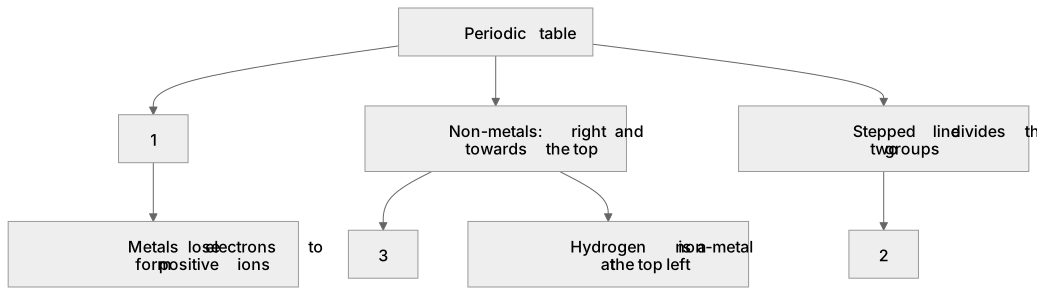
Some boxes have lost their names. Pick the right name for each number.
1Box 1
2Box 2
3Box 3
There is more to this lesson
The full lesson goes on to check your understanding and help you earn the marks. Create a free account to carry on, with your progress saved.
A week of Premium from your first lesson · Then the free plan continues · No card, no charge
Test your understanding of Metals and non-metals: The majority of elements are metals. Metals are found to the left and towards the bottom of the periodic table. Non-metals are found towards the right and top of the periodic table.
Active recall beats re-reading. Take an instant quiz now to test what you’ve learned and lock it into long-term memory.
A week of Premium from your first lesson · Then the free plan continues · No card, no charge