AQA · GCSE · Combined Science
Course version: 8464 · Version from Sept 2018
Newton's Second Law: As an equation:
This statement introduces the mathematical form of Newton's Second Law, showing that the relationship between resultant force, mass and acceleration can be written as a word equation and then as a…
Checked against the AQA 8464 specification (opens in a new tab) on .
- Point 3 of 13
Study notes
From the checked teaching notes for this specification point.
The idea
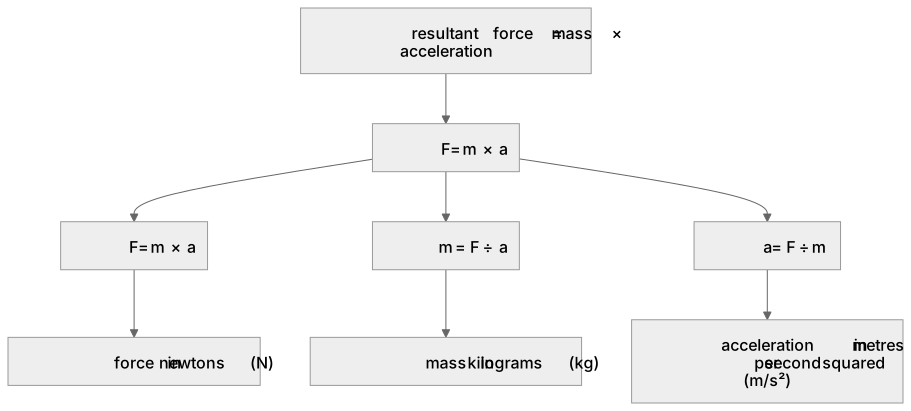
This statement introduces the mathematical form of Newton's Second Law, showing that the relationship between resultant force, mass and acceleration can be written as a word equation and then as a symbol equation. In AQA GCSE Combined Science: Trilogy, you must recognise that the equation links three quantities: resultant force (F), mass (m) and acceleration (a). The word equation is: resultant force = mass × acceleration. The symbol equation is: F = m × a. For example, a 2 kg trolley accelerating at 3 m/s² has a resultant force of 2 × 3 = 6 N. The equation applies only when the force is the resultant force acting on the object, and the acceleration is in the same direction as that resultant force. You should be able to rearrange the equation to find mass or acceleration, and substitute values with correct units.
What earns the marks
- States the word equation: resultant force = mass × acceleration.
- States the symbol equation: F = m × a, with F, m and a defined.
- Uses the equation to calculate resultant force when mass and acceleration are given.
- Rearranges the equation to calculate mass as m = F ÷ a or acceleration as a = F ÷ m.
- Applies correct units: force in newtons (N), mass in kilograms (kg), acceleration in metres per second squared (m/s²).
- Recognises that the force in the equation is the resultant force, not any single applied force.
Common mistakes and how to put them right
Writing the equation as force = mass ÷ acceleration.
Put it right: Force = mass × acceleration, so F = m × a.
Using grams instead of kilograms for mass without converting.
Put it right: Convert grams to kilograms by dividing by 1000 before substituting.
Treating any single force as the resultant force.
Put it right: Add forces in the same direction and subtract forces in opposite directions to find the resultant force first.
Exam tips
- Write the equation you are using before substituting numbers, so the examiner can see your method.
- Check that mass is in kilograms and acceleration is in metres per second squared before calculating.
- When rearranging, use inverse operations carefully: divide both sides by mass to find acceleration, or by acceleration to find mass.
Try the lesson
The start of the Newton's Second Law: As an equation: lesson, made from checked teaching notes for this specification point.
Have a go first
A resultant force of 30 N acts on a trolley and gives it an acceleration of 5 m/s². Using F = m × a, what is the mass of the trolley?
Listen
This statement introduces the mathematical form of Newton's Second Law, showing that the relationship between resultant force, mass and acceleration can be written as a word equation and then as a symbol equation. In AQA GCSE Combined Science: Trilogy, you must recognise that the equation links three quantities: resultant force (F), mass (m) and acceleration (a). The word equation is: resultant force = mass × acceleration. The symbol equation is: F = m × a. For example, a 2 kg trolley accelerating at 3 m/s² has a resultant force of 2 × 3 = 6 N. The equation applies only when the force is the resultant force acting on the object, and the acceleration is in the same direction as that resultant force. You should be able to rearrange the equation to find mass or acceleration, and substitute values with correct units. A strong answer earns marks for these points. States the word equation: resultant force = mass × acceleration. States the symbol equation: F = m × a, with F, m and a defined. Uses the equation to calculate resultant force when mass and acceleration are given. Rearranges the equation to calculate mass as m = F ÷ a or acceleration as a = F ÷ m. A common slip: Writing the equation as force = mass ÷ acceleration. Instead, force = mass × acceleration, so F = m × a. Exam tip: Write the equation you are using before substituting numbers, so the examiner can see your method.
See it
There is more to this lesson
The full lesson goes on to check your understanding and help you earn the marks. Create a free account to carry on, with your progress saved.
A week of Premium from your first lesson · Then the free plan continues · No card, no charge
Test your understanding of Newton's Second Law: As an equation:
Active recall beats re-reading. Take an instant quiz now to test what you’ve learned and lock it into long-term memory.
A week of Premium from your first lesson · Then the free plan continues · No card, no charge